

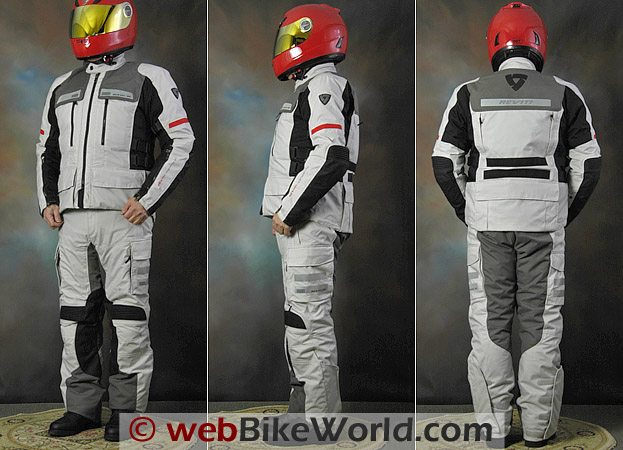
The new REV’IT! Sand jacket is the 2010 replacement for the popular REV’IT! Off-Track jacket. It has rugged good looks, excellent fit and “professional” styling details that make it an excellent choice for all-weather, all-season use. I described the new REV’IT! Sand jacket (review) in a 2010 REV’IT! clothing update.
That article was published after a visit to REV’IT! U.S. headquarters in New York, back in November of 2009. The Sand jacket that was available for the photographs during that visit was a prototype that was nearly ready for production, but the Sand jacket is now available at REV’IT! retailers. The Sand jacket is a replacement for the REV’IT! Off-Track jacket (review), which was a popular choice with Adventure Touring types and others and was sort of a street-based version of the Cayenne Pro.
The “Pro” in the name apparently signifies the position the jacket holds; the Cayenne Pro is the REV’IT! technology leader. But although it may not look all that much different from the Sand jacket, hard-core Adventure-Tourer and off-road riders are willing to pay for the best. For the other 98% of us, the Sand jacket should do just fine, thank you.
Which doesn’t mean that a Cayenne Pro isn’t something to lust after; just that the Sand jacket should very nicely fulfill just about any requirement that can be dished up by the vast majority of motorcyclists.
See Also: REV’IT! Sand Pants ReviewREV’IT! Sand Jacket Features
At the risk of redundant redundancy, I’ll repeat some of the differences and improvements noted in the First Look before describing the Sand jacket in detail.
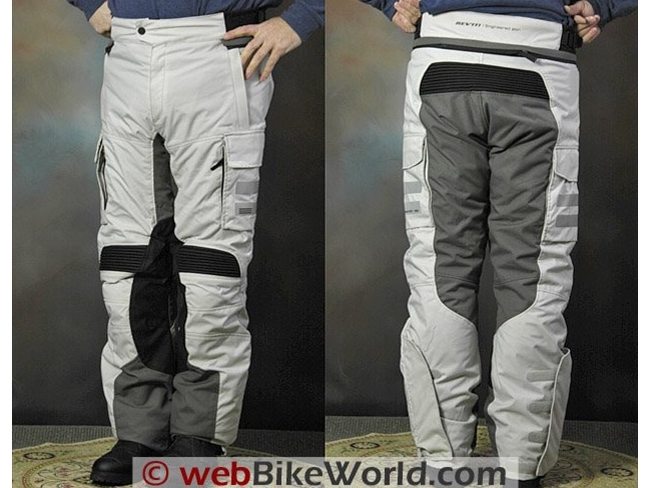
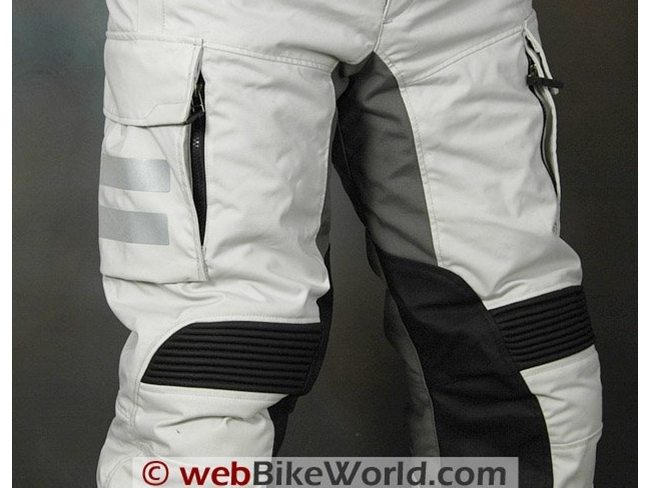
Part 2 of this review will describe the new Sand pants that are a perfect match for the jacket.
Zippers
I don’t remember having difficulties with the zippers on the Off-Track jacket, but apparently some owners didn’t care for the coiled-loop zipper style.
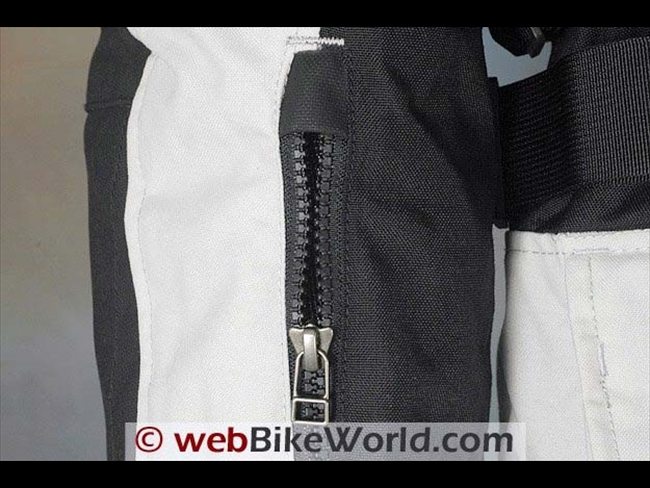
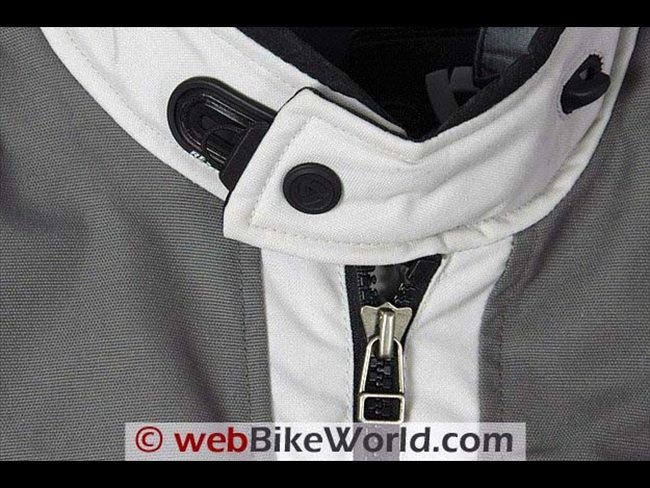
REV’IT! now uses the YKK Vislon zipper, which features specially molded large zipper teeth that look like they mean business.
The YKK Vislon zippers are designed to be self-cleaning to prevent jamming when the teeth get dirty during those off-road rides on your F 800 GS.
An additional benefit is that these “low-torque, low-effort” zippers are very easy to use and they operate smoothly. They can be found in the front of the jacket, on the placket, in the vents and on the sleeves,
The Vison zippers make it very easy for the owner to open and close the new-style front vents with one hand.
While that may sound like something that should be a requirement on a motorcycle jacket, it’s definitely not the case on many other jackets we’ve reviewed and this has always puzzled me.
A front vent zipper that requires two hands to operate is not a good idea for motorcycle use. But, with too many zippers, one hand has to hold the jacket material while the other struggles with the zipper pull.
Now it may sound borderline silly to wax poetic about something as mundane as a zipper, but this is a good example of the REV’IT! attention to detail we’ve mentioned in reviews of many REV’IT! products.
Someone actually took owner feedback and thought about how the jacket will be used in the “real world” and figured out a better solution.
The ease with which the zippers work is also emblematic of other design features on the Sand jacket. For example, the very first time I put the jacket on, I noticed how much easier it was to use the lower front pockets.
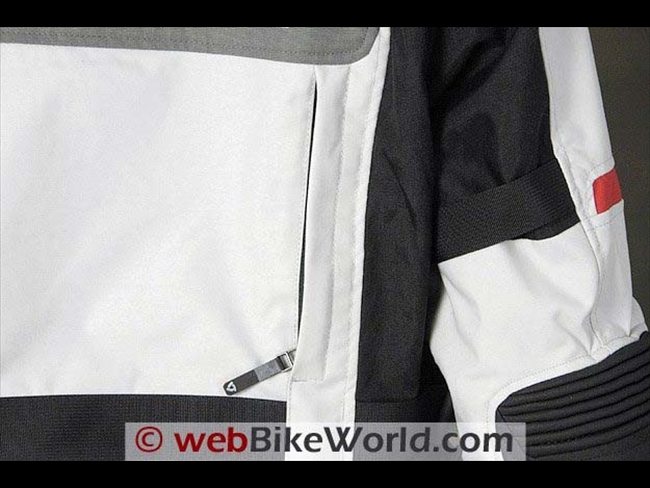
Those two pockets do not have a waterproof zipper underneath the pocket flap. The flap simply folds over and is secured by hook-and-loop.
So I can reach down, open a pocket with one hand and make a deposit or withdrawal with less drama than is usually the case.
Another very subtle feature that, had we not worn dozens of other jackets during webBikeWorld reviews, probably would have been missed. But it again points to the way the Sand jacket was designed for real-world motorcycle use.
That said, there is one issue that is a side effect of the new low-torque zippers, but you’ll have to wait until I get to the section describing the venting system on the Sand jacket to learn more!
Pockets
As I mentioned in the First Look, owners asked for larger front pockets.
Not only are the front pockets of the Sand jacket easier to use, they’re larger — a full 23 cm wide and 15 cm deep, not counting the folded-over internal flap to keep out moisture.
The front pockets are “patch” style, with large pleats on either side which allow overstuffing if desired and they appear to have a water-resistant lining.
The large chest vents can also be used as pockets in a pinch, but they provide excellent ventilation, so it’s probably not a good idea to load them up with Snickers…uh, I mean Power Bars.
Inside the thermal liner is another deep pocket at the left side, this one is 17 cm deep and secured by a zipper. The jacket shell has a similar pocket in the same location.
The jacket has a huge rear pocket along the bottom hem; this one measures about 36 cm wide, it’s 20 cm deep and has two separate pleats.
You could probably stuff an entire bedroll in there! Actually, it will hold either the separate water-resistant liner or the thermal liner or both.
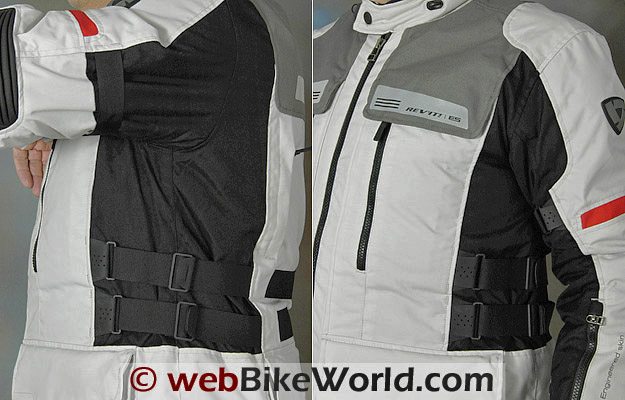
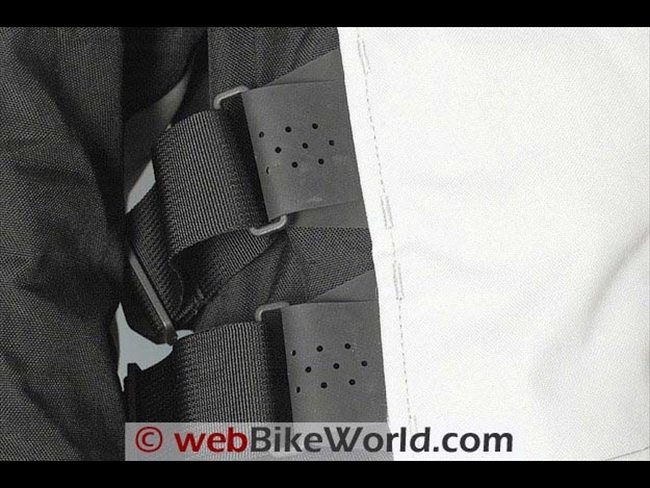
Above and Below: The waist and arm adjustment system used on the REV’IT! Sand jacket.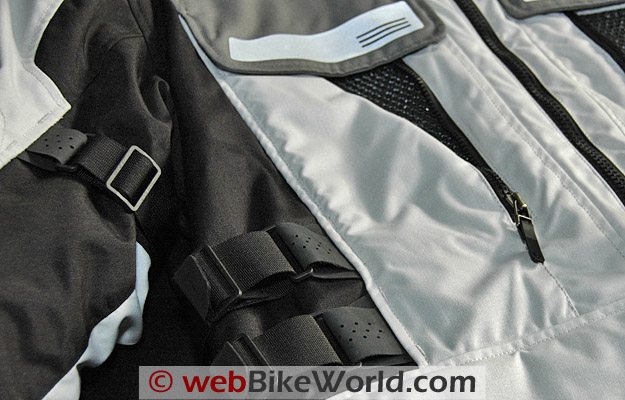
Adjusters
The Sand jacket has plenty of adjustment, and the adjusters will get a good workout because the jacket will go up and down about a size, depending on how the separate liners are configured.
There are dual side adjusters with really big, really beefy and wide nylon straps that are attached to equally large pieces of rubber elastic in the front of the jacket.
These adjuster straps continue all the way around the back of the jacket to the other side, so when you cinch them up, you’re strapped in for the ride, no two ways about it.
To do that, there’s a rubber pull attached to the nylon holder.
It takes some effort at first to tighten up the wide straps because they offer a lot of resistance due to their width, but they seem to be loosening up a bit with use.
The wide adjuster system is also used on the inside of the upper arm, although the typically snug REV’IT! fit doesn’t require much adjustment here.
What is interesting about the fit of the arms though is that they feel snug, which is correct, of course, to keep the armor in place, but they don’t bind when I bend my arms.
This was a problem in both the Scorpion XDR Commander jacket (review) and the Firstgear Rainier TPG jacket (review) and others, where the arm right at the inside of the elbow does not have enough “give” to feel comfortable when my arms are bent. Indeed, it can actually be painful.
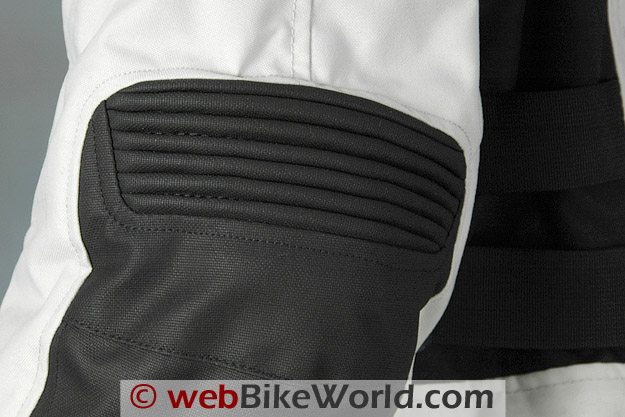
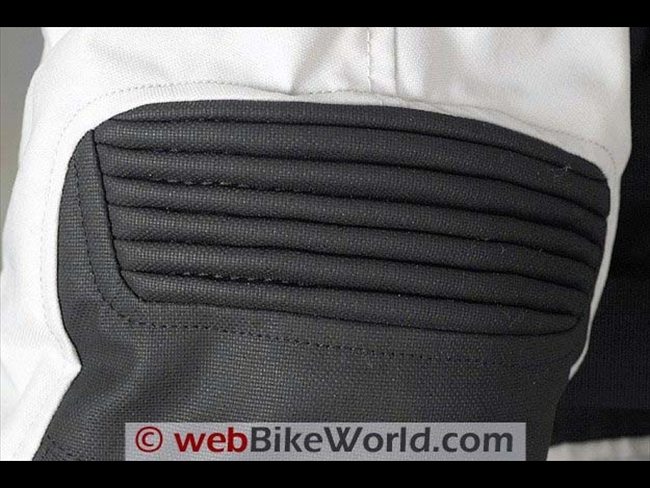
Anyway, no such problem with the Sand jacket, and this is probably due to two things: first, the accordion pleats in the elbow provide some extra give in that area.
And it’s also due to another REV’IT! specialty — they know how to cut the fabric to fit a human body. I’d have to say that typically the REV’IT! clothing just fits better than most anything else.
The Sand jacket and pants — once I found the right combination of sizes — fits “like a glove”, which makes for a very comfortable ride in a wide range of conditions. The adjusters make it that much better.
Reinforced Stitching
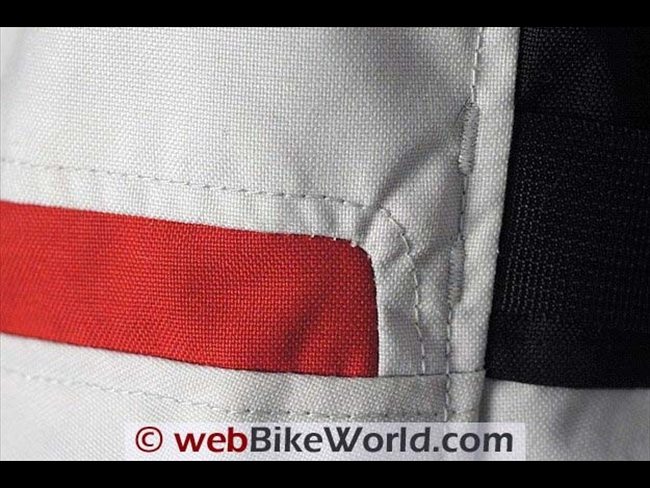
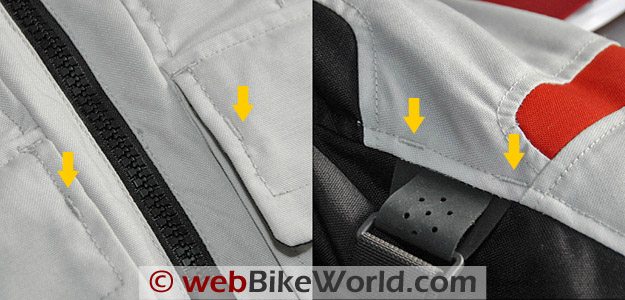
The First Look also described the new bar tack stitching reinforcements used near the high stress areas of the Sand jacket.
Yet another subtle detail that would probably be missed by most owners unless they were pointed out, these reinforcements can be found in several locations.
They’re on the pocket flap on either side of the webbing for the waist and arm adjusters, at the flaps that cover the front vents, at the rear vents, rear pocket and probably elsewhere.
You have most likely seen bar tack stitching before; this reinforcement method is used on heavy-duty work jeans and similar clothing that will experience a lot of wear and abuse.
It is not commonly found on motorcycle clothing because each bar tack means an added manufacturing step and it uses a different style and process of stitching with careful placement to ensure that the correct area will get reinforced.
Armor
The Sand jacket uses removable Prolife CE-approved armor in the elbows and shoulders and a removable back pad in the rear. The armor is comfortable and not bulky.
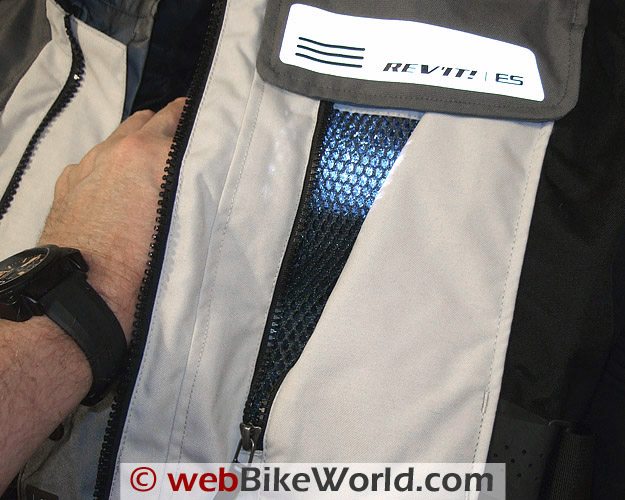
Front vent system is easy to deploy and forms an air scoop when open. Flashlight shown behind 3D mesh.
Ventilation
The Sand jacket has an entirely new and successful front venting system. My evaluation is based on recent brief usage when the temperature soared to 68 F after weeks of snowy cold.
68 degrees Fahrenheit is not really a temperature that requires the ultimate in ventilation, but it was at least warm enough for a trial.
The all-season motorcycle jacket concept has pretty much baffled many clothing designers; the problem is having a jacket that can go from windproof and warm for winter to open and flowing lots of air for summer.
We’ve seen a variety of different front venting solutions to address the issue, but very few are successful.
Most of the “scoop” type front vents don’t really work as designed; either they don’t open wide enough to scoop the air, or they’re blocked underneath by the jacket lining or other material.
Probably the most successful near-all-season jacket available is the REV’IT! Sirocco (review), because it converts from nearly windproof to very nice mesh for warm-weather riding.
The new Sand jacket is now also a top choice for all-season use. It’s biased slightly more towards cold-weather riding only because it doesn’t have the huge mesh surface area of the Sirocco.
As it turns out, the new front vent design on the Sand jacket with its “3D” mesh is an excellent design for the real world.
In the Sirocco, the foam inserts that block the wind and keep in some warmth for winter riding must be removed and stored in the jacket pockets, which is a bit of a hassle.
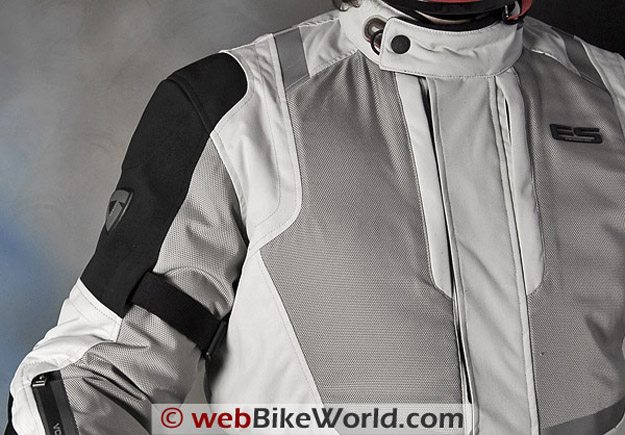
The Sand jacket features two vertical zippers in front, using the low-torque zipper teeth described earlier. Open the flap at the top, roll down the zipper, fold the fabric over into a “V” shape and close the flap and you’re done.
The vent now looks roughly like two right triangles; the triangle towards the center is open mesh and the triangle towards the outside acts as the air scoop.
The “3D” mesh is about 10 mm thick and it feels somewhat like a block of foam that was perforated to create the mesh.
The thickness of the 3D mesh keeps the fabric away from the rider’s clothing and seems to help increase air flow.
If the mesh was as thin as a piece of fabric, it would probably lay closer to the rider and allow air to flow only on that one section as the wind pushed it back.
If the separate water-resistant and wind-resistant liners are removed from the jacket, the rear vents can be opened and the combination of the open front and rear vents creates a very nice flow of air into and out of the jacket.
Arm vent has two-way zipper but the zipper pull at the wrist doesn’t remain secured.Arm Vents
The sleeves of the Sand jacket also have a new type of vent system that is different than the system used on the Off-Track.
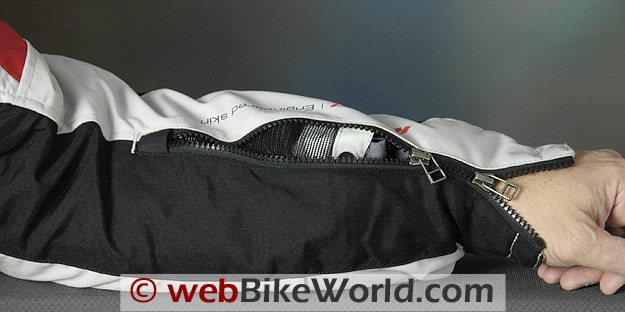
The sleeve vents on the Sand jacket have been moved down on the forearm and the two-way zipper can be opened from the bottom (at the wrist) or the top to expose a section of fabric mesh underneath.
This brings up the only issue I have with the Sand jacket; the zipper doesn’t stay closed at the wrist end of the arm vent. I think this is due to the low-torque YKK Vislon zipper, which requires less effort than a coil type to open or close.
You can see in the photo above that the zipper is open at the wrist end; the zipper pull starts creeping open every time I wear the jacket.
It’s not a big problem in the scope of things because I wear gloves with the gauntlet over the sleeve.
But I would have preferred a separate fabric section with hook-and-loop or a snap or some way to ensure that the sleeve stays closed and the zipper stays shut.
The specially treated Cordura fabric used to create the accordion pleat on the arm.Sand Jacket Water- and Wind-Resistant Liners
The Sand jacket is actually a “4-in-1” combination. The shell can be worn alone without the liners and it has a full-length mesh lining permanently bonded to the inside.
The jacket also has a separate full-length wind-resistant liner, then a separate full-length thermal liner is attached to the inside of that.
But either liner can be used separately, so both liners can be installed, or the thermal liner removed, leaving the shell and the water/wind resistant liner, or the thermal liner only, which can be connected to the shell with a separate set of internal zippers.
This is a nice feature that offers a lot of versatility.
The four-ways in which the jacket can be configured are: shell only; shell with both liners; shell with water/wind resistant liner only; shell with thermal liner only.
With both liners installed, the jacket is very warm and the thermal liner seems a bit thicker than some of the thermal liners used in other REV’IT! jackets.
In our recent variable weather, I wore the Sand jacket and pants in temperatures ranging from about 40 degrees F to 68 F and the outfit was just as comfortable in both extremes.
The water-resistant liner is the REV’IT! Hydratex membrane, labeled as tested to 7,000 grams of moisture transfer per square meter over 24 hours and able to resist a 5,000 (5 meter) column of water.
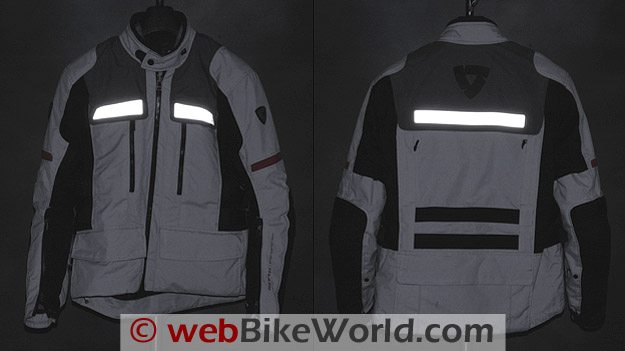
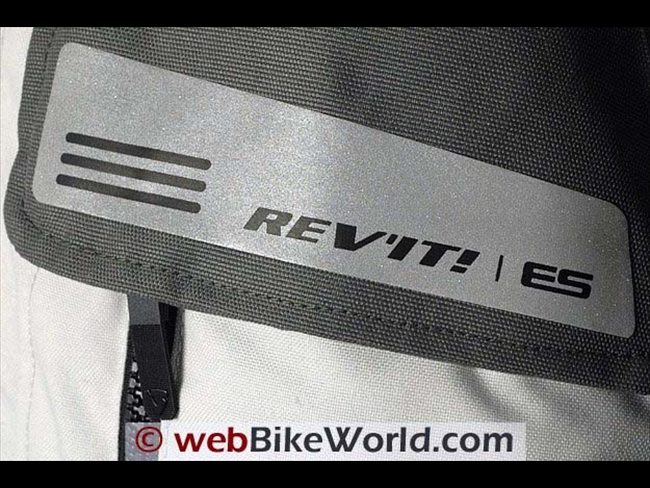
Large strips of reflective material are used on the front and rear of the Sand jacket.
Sizing
The Sand jacket shown here is a size XL. It fits perfectly with both liners installed and is about one size larger with both liners removed.
For the most part, the extra room when the liners are removed can be taken in by tightening the adjusters.
The REV’IT! size chart for the Sand jacket is somewhat different than expected, based on the sizing chart in the 2010 catalog on the REV’IT! website.
So the recommendation is to study the size charts at REV’IT! and your retailer and take your measurements to make sure you order the correct size.
The size chart indicates that a size XL will fit a U.S. men’s 41″ to 44″ chest, which seems like a slightly wider range than usual for a size XL and also the size range one would expect for a size L, not XL.
I do think that the size XL Sand jacket will be too large for someone with a 41″ chest, and a more rational size range would be 42″ to 44″ for the size XL.

The XXL jacket is listed as fitting a 44″ to 46″ chest, according to the size chart. I tried an XXL and it felt like…an XXL, which is too big for me. I would normally choose a size large motorcycle jacket, which is usually sized to fit a 43″ to 44″ chest.
REV’IT! uses letter sizes for Unisex clothing and numeric sizes for men- and women-specific clothing. More discussion on this topic in the REV’IT! Sand Pants Review.
Other Features
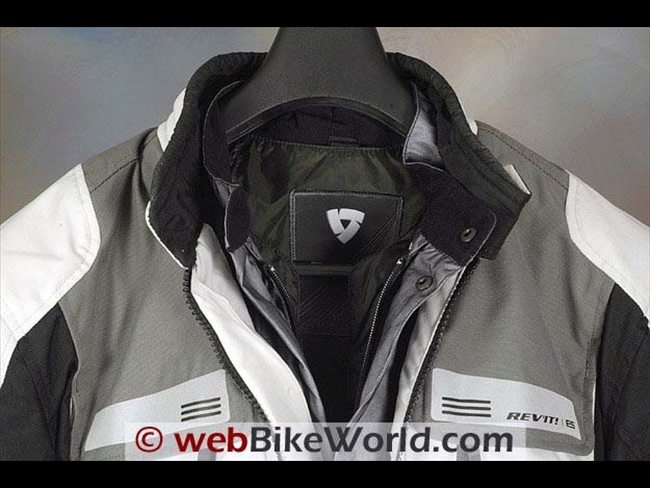
The Sand jacket has the REV’IT! adjustable collar system which is slightly difficult to close but at least is adjustable.
The last couple of jackets we reviewed had non-adjustable collars, which is obviously not a good thing.
The jacket uses high-quality (and expensive) all metal Prym snaps made in Italy, rather than the plastic snaps used in the Off-Track jacket. The snaps can be found in the water/wind resistant liner and towards the inside of the flap that covers the front vents.
Besides the main zippers mentioned above, REV’IT! said that YKK zippers are used throughout but REV’IT! uses zipper pulls of their own design. The main YKK Vislon zippers are labeled on the back side of the pull.
The special REV’IT! catch for the collar has also been reinforced; this allows the collar to be left open by securing it to the catch on the left-hand side.
The REV’IT! heat sealed and bonded reflectors are used in the front and back of the Sand jacket.
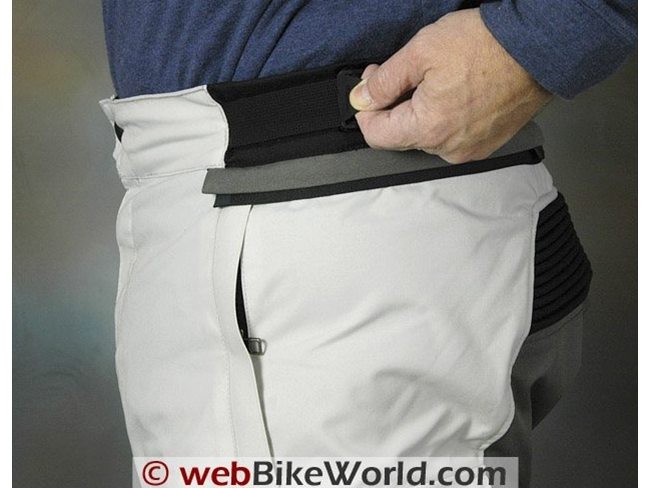
Also, the jacket has an attachment zipper for the Sand pants.
The zipper can be attached with either liner (or both) installed. The jacket weighs 2.5 kg (5.5 lbs.) and the pants weigh 1.8 kg (4.0 lbs.) with all liners installed, which makes for a nice lightweight combination.
REV’IT! Sand Jacket Specifications
- Shell: Combination of 500, 750 and 1200 Denier fabric, 100% polyamide.
- Insulation: Removable thermal liner
- Waterproofing: Removable Hydratex liner, tested at 3L (5,000mm H2O)
- Breathability: Removable Hydratex liner tested at 3L (7000g/m2/24hrs)
- Thermal Liner: 100% polyamide (insulation 100%polyester)
- Armor: Prolife CE-approved protection at shoulders and elbows.
Conclusion
The new REV’IT! Sand jacket is an excellent choice for all-season use.
It has thoughtful design and many useful features that are “real-world” tested and not just thrown on the jacket for the sake of a thicker marketing brochure.
But the jacket is also very comfortable to wear — the cut and styling fits snugly as it should but without binding and the way the pockets and zippers work make the jacket an immediate favorite.
UPDATE: REV’IT! Sand 3 Jacket Review
Part 2: REV’IT! Sand Pants Review
More wBW: All REV’IT! Clothing Reviews | REV’IT! Sand Jacket First Look
| wBW Review: REV’IT! Sand Jacket | |
|---|---|
| Manufacturer: REV’IT! | List Price (2010): $429.95 |
| Colors: Silver/Black, Silver/Red or Safari/Black | Made In: Unknown |
| Sizes: S-4XL | Review Date: March 2010 |
Owner Comments and Feedback
See details on submitting comments.
From “M.R.” (June 2012): “First of all I would like to thank you for your excellent reviews which helped me a lot during my searches for motorgear.
I just purchased the Revit Sand outfit (Jacket and Pants), in which your review was my main reason (and the suit looks amazing).
You mentioned the arm vents and the lack of something that keeps the sleeve closed. I’m happy to say they added this, there is now a small strap that snaps close. And I have to say I love the outfit. Keep up the good work.”
From “D.W.” (12/10): “I wanted to point out that on your review of the Sand Jacket, you mentioned that the zippers at the sleeve tend to open on their own.
I bought a Sand Jacket recently, and it appears from comparing the pics of the jacket you reviewed, and my jacket, the zippers that open and close the sleeve are different.”
The zippers on my jacket appear to have a spring closure that when you push the zipper pull down and back over the zipper, it stiffens the resistance needed for the zipper to slide.
I haven’t worn the jacket while riding yet, but in wearing around with gloves on and off, there doesn’t seem to be a problem anymore with the zipper opening that easily on its own.
Editor’s Reply: Thanks for the info. What happened — and I should have noted this — is that REV’IT! changed the design after our review to incorporate the new locking zippers, which they now use on all their clothing.
We had one of the first from the production run, but this problem should now be solved and I have noticed that the locking zippers are used on all of the subsequent REV’IT! clothing we have.
From “P.T.” (4/10): “I bought a pair of the Sand size large pants online and had to return them also to get a size extra large, the pants are sized very small.
I think they made the linings too thick, when you take the lining out, then they fit like they should, but if you get the right size then the pants are too tight with the linings in.
Also I wish the waist had more adjustments. I’m wearing them with a Off-Track jacket also.”
From “E.B.” (4/10): “I have extensively tested the REV’IT! Off-Track and Dakar Pant (review)combination on a 4 month trip through Africa.
That was including the hot, desert interior of Mauritania, the hot, sticky heat of the jungle in Cameroon and commuted to work with snow on the ground and a waterproof overjacket over the top. This jacket has a lot to live up to!
The Off-Track has its main vertical zip covered by a flap that is secured down to the front of the jacket with Velcro. If you remove that flap I think you will get cold air/water/dust seeping in through the main front zip which is a shame.
Dust kills zips but they probably removed the vent for ease of manufacture, simpler zip access and better cooling.”
The increased pocket sizes on the Sand jacket are welcomed as is the same high level of fittings and clever cut of the garment (fitted but adjustable where it counts).
The pants are also in keeping with the Dakar pant but with larger pockets but I the only problem I could see is that the light coloured versions (aren’t good for) the dirt.
Because let’s face it, legs get dirtier and stay dirtier for longer on trips. The dirt gets ingrained and means that the pants don’t ultimately last as long as the jacket.
They also need more protection against rubbing on the inside of the lower leg – this is where mine failed by rubbing against the bike.
Overall – excellent and I’ll be putting down some money for the Sand outfit very soon!”