

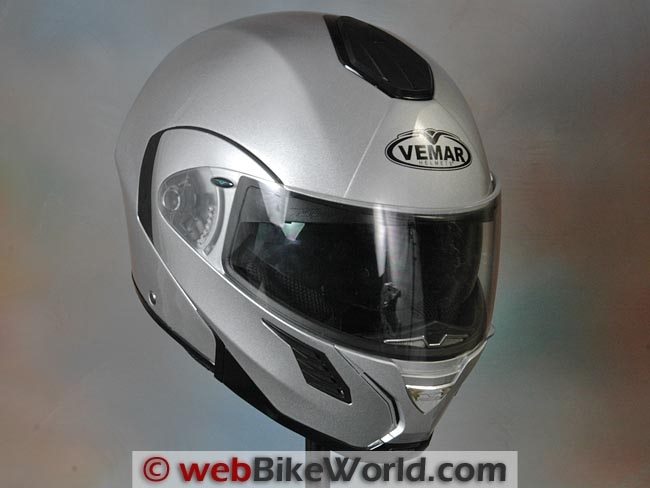
The Vemar VTXE fits just under the VSREV in the Vemar lineup.
In many ways, this is the Vemar helmet of choice.
It offers excellent noise control under most conditions and very good build quality.
It also has a high degree of comfort for round and neutral head shapes.
Good outward visibility and a new visor design that is very easy to use seal the deal.
The Vemar VTXE is currently the only other full-face helmet in the Vemar U.S.A. lineup.
It’s quite different from the Vemar VSREV we reviewed just 3 weeks ago and, of course, from the new-for-2008 Vemar Jiano flip-up we reviewed only a couple of weeks prior to that.
It’s very difficult — and probably unfair — to call the VTXE Vemar’s “low end” helmet, because it has all of the top-drawer features expected from a modern high-quality motorcycle helmet.
The real differences are in the way the VTXE fits.
Where the VSREV has a new type of “round oval” internal shape that may or may not fit many motorcyclists, the VTXE has a “classic” round internal shape that’s just a touch towards neutral.
This makes it feel very similar to the internal shape of the Shoei RF-1000 (review).
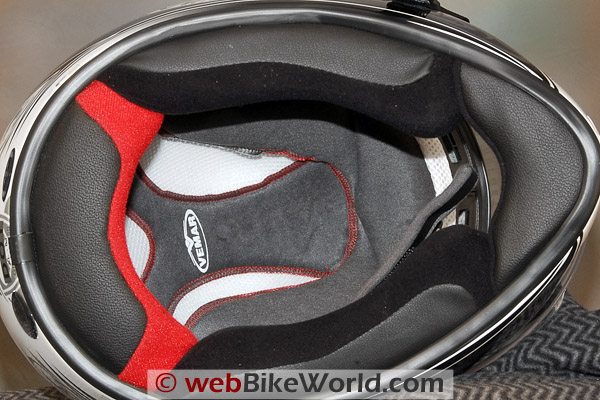
However, the VTXE feels much more comfortable than the RF-1000 — when I first slipped the VTXE out of its box and on to my head, I was in heaven! Vemar uses a special type of memory foam in the VTXE, and it feels soft and cushy and comfy.
But I’m getting ahead of myself here in my enthusiasm, and there are one or two minor quibbles I have with the VTXE, so let’s get started…
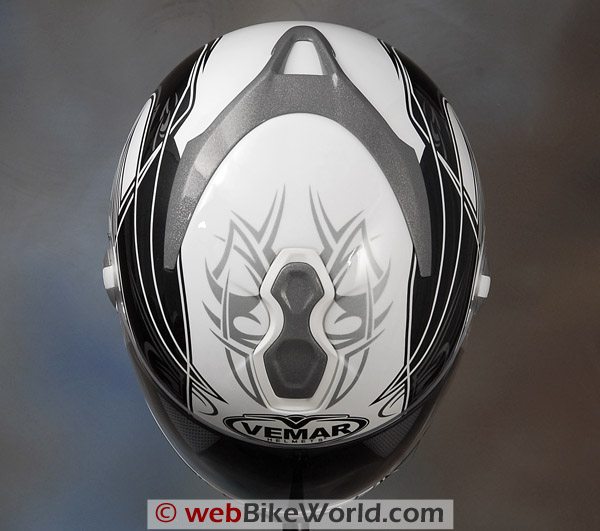
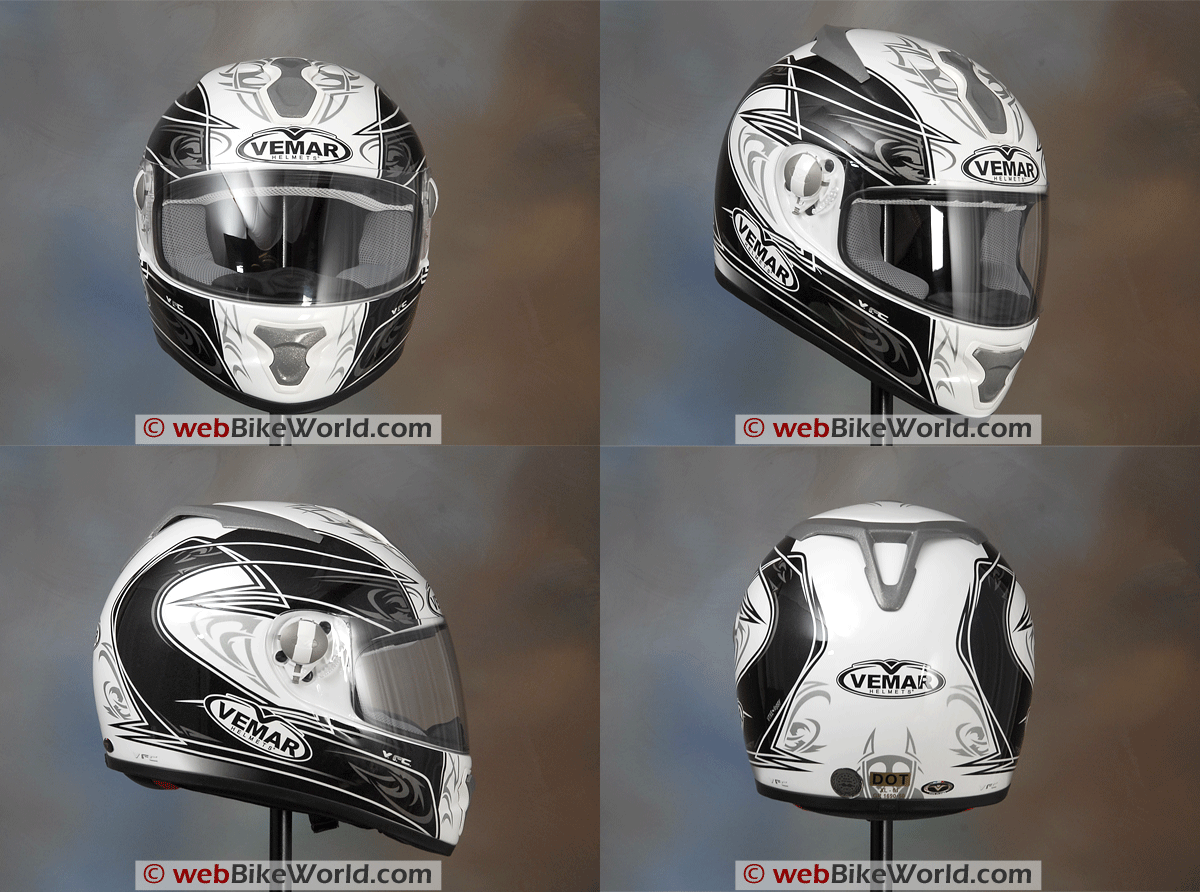
The VTXE is available in several different color choices, but it’s surprising to me that the Italians don’t show a bit more flair in their choice of graphics on these helmets.
Nevertheless, the white/gray/black graphics shown here are look good and are perfectly applied.
It may be hard to tell from the photos, but the “black” sections are actually colored a very dark metalflake charcoal, which gives the helmet a nice depth in certain lighting.
Vemar has applied a thick UV-protective clearcoat over the surface, and the finish feels rugged and it should help protect against the occasional chip and scratch.
The white and dark graphics have a safety component, because the scheme improves the helmet’s visibility, based on my observations from riding with others who were also evaluating the helmet.
The VTXE is also available in gloss silver and black, along with matte black (who buys matte black helmets?) and a few other graphics patterns with various color combinations.
The quality of the rest of the helmet is excellent; the liner especially is very comfortable and seems much “deeper” than the liner in the VSREV.
I’ll get into this in more detail in a minute, along with a description of the new and interesting type of venting system and the very easy to use (and remove) visor.
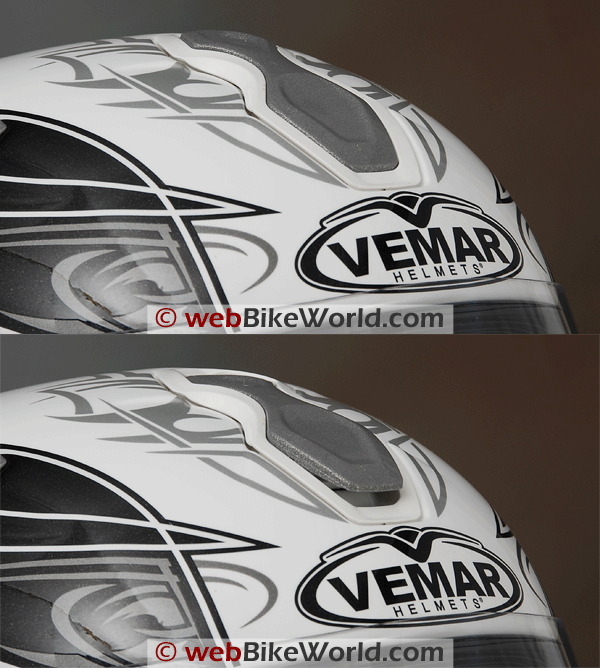
The only parts that are slightly below par might be the metalflake gray plastic spoiler and maybe the vent surrounds.
They don’t quite fit with Lexus-like quality, with a slight gap here and there between the assembly and the helmet shell, but this is a very minor quibble.
Score: I’ll give the Vemar VTXE an “Outstanding” rating for the overall finish, paint and graphics, along with the quality of the lining and a definite plus for the visor removal system. The fittings get an “Excellent”.
See the ratings scale in the summary table at the bottom of this page for more information.
Helmet Shape, Fit and Sizing
The VTXE has what I’d call a “classic” round fit, shaded just a touch towards neutral.
It is a shape that is very similar to the Shoei RF-1000 (review), in my opinion, which means that the VTXE should fit comfortably for a large percentage of riders.
I find the VTXE to be a very comfortable helmet.
The plush liner feels even more comfortable to me than the Arai Quantum II (review), a benchmark for comfort. Vemar uses a new type of memory foam in the liner, and the padding, which Vemar claims is a proprietary design, feels thicker and more plush than the VSREV.
Vemar also offers replacement helmet liners and cheek pads in different sizes for a custom-tailored fit if necessary, along with an array of tinted and clear visors, and they even have visor system parts available if needed.
As always, be sure to read our Motorcycle Helmet FAQ for more information on choosing and fitting a motorcycle helmet, which is crucial for both comfort and safety.
The VTXE is made in three shell sizes, which is unusual — and expensive.
This allows Vemar to offer the VTXE in an expanded size range, all the way from XXS to XXXL, also unusual, unexpected and very beneficial.
They’re apparently hoping that the VTXE will be a popular selling helmet, and I think they’re on to something here.
The size XL shown here fits as expected, so we assume that the rest of the size range will also fit correctly. This one should fit correctly on a 60.5 – 62.0 cm round to neutral shaped head.
Oh, and by the way — the VTXE has decent sized ear pockets with a hard backing that’s covered by liner material, so thin helmet speakers should fit with no problems.
Also, I can fit sunglasses with thin wire rim frames into the helmet and over my ears when I’m wearing the helmet.
Score: I’ll give the Vemar VTXE an “Outstanding” rating for the internal shape and fit and the plush and comfortable liner.
Ventilation
The VTXE has an interesting venting system that, while perhaps not providing class-leading ventilation, does work well and is easy to use.
Both vents work on a type of rocker switch system and they’re hinged in the middle. They have a nearly a flush fit to the helmet’s surface, which helps reduce wind noise.
Push on the back side of the top vent and the front flips open; push on the front part of the vent and it closes.
There are indents that provide feel through gloves, and once you know where to push, the system works well.
The top vent doesn’t have a huge opening, but it does open towards the front and it seems to flow air on to the rider’s head.
The air isn’t really felt directly, but it flows in through relatively large passages molded into the EPS foam core and through some of the mesh lining material on either side.
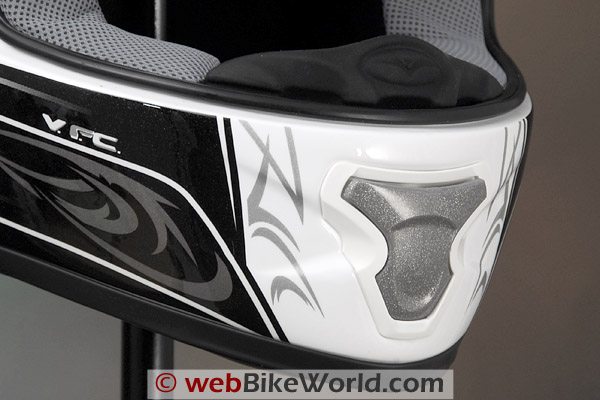
Push the chin vent in on the lower section and it pops open; push on the upper section to close. The chin vent opens perpendicular to the air flow, which means that it doesn’t offer a direct passageway for air.
Most of the air that comes in through the chin vent flows up in back of the one-piece molded chin bar padding and flows up on to the visor, where it can be felt on the rider’s face and brow.
There are two features that look like vent passages molded in to the one-piece chin bar padding, and although they seem like they’re supposed to be direct channels for air flowing in through the chin vent, they’re not open holes.
So either Vemar didn’t do a very good job of cutting the holes after the piece was molded, or they’re not really supposed to be vents, I’m not sure which.
We had a similar problem with the VSREV, but we were able to clear the chin bar padding vent holes with an X-Acto knife on that helmet.
I’m hesitant about pulling the chin bar padding out of the VTXE, because I’m not sure if it’s permanently installed or if I could get it back in place after I’m done.
In any case, the helmet does provide a good amount of air flowing up on to the rider’s face.
But there’s one other factor — the VTXE comes with a large chin curtain underneath the chin bar, which helps keep the uncontrolled air from blowing upwards into the helmet, and also keeps noise levels low.
While chin curtains like this are welcome because they do limit the amount of air that comes in from under the helmet and they help control noise, many riders don’t realize that air flowing in from under the helmet is usually the #1 source of helmet ventilation.
Most helmet venting systems are pretty weak.
But large volumes of air can blow in from underneath, and since it isn’t easy to tell where the air is coming from, many riders assume the helmet’s venting system is doing its job, when in reality, the air isn’t coming in through the vents at all.
A chin curtain can control this, but the chin curtain on the VTXE is large enough and does such a good job that the rider’s chin and mouth can get a little hot in slow speed riding in hot weather.
The thick and cushy liner also conspires with the relatively large chin curtain to create a still pocket around the rider’s mouth.
To the rescue comes the VTXE’s visor, which works well and can be opened just a notch to provide ventilation at slow speeds, just what the Doctor ordered.
Score: I’ll give the VTXE an “Excellent” rating for venting and air flow, which I think overall is better than average for this class of helmet.
A Note on Buying Replacement Cheek Pads
As I mentioned above, and similar to the VSREV, Vemar is offering a variety of cheek pad and liner sizes to custom-tailor the fit of the VTXE.
I’ll repeat what we said about fitting cheek pads in the VSREV review: Remember that purchasing replacement cheek pad sizes is counterintuitive.
That is, the cheek pads are usually labeled “S, M, L, XL”.
If you want a tighter fit, you’d think that larger would be thicker, but it isn’t always so. You have to look at this from a perspective of what size you want to change the helmet to.
The first thing to do is to confirm the size of the cheek pads that are installed in the helmet (the labels are usually on the back of the cheek pad, so you’ll have to remove them first).
If your helmet has a size L cheek pad and you want to make the helmet fit tighter, you’d go to a size M cheek pad, not a size XL, which in effect brings the helmet fit around the cheek pads down a size to what you’d expect in a medium.
Conversely, if a size large helmet has L cheek pads that feel too tight, then moving up to size XL cheek pads should loosen things up a bit, because, in effect, you’re now making the helmet fit like a size XL with the thinner cheek pads.
Note that Arai cheek pads are usually sold by their thickness in millimeters.
VTXE Helmet Liner
I’ve already extolled the virtues of the liner in the VTXE with words like plush, comfy, thick and the like. Very few helmets fit me correctly, but the slipping on the VTXE was a revelation — a near-perfect fit!
The liner material feels soft; I’m not sure if it’s the same used in the VSREV, but it has a texture like a soft micro-fleece.
Vemar says the material is washable and “manufactured from a technical fiber that provides life-long treatment against odor, fungus and bacteria” and that it has “extraordinary wicking capabilities that result in enhanced rider comfort” and I’d agree.
I’ve been wearing the VTXE in 90+ degree weather, and although no full-face helmet feels cool in these conditions, the liner does seem to keep my head relatively dry.
The rear of the liner is similar to that used on the Jiano and VSREV, but it seems more connected to the rest of the liner than it does in those helmets, and we haven’t experienced the problem of air flowing in between the liner separation.
Perhaps the liner in the VTXE is thicker, which prevents that from happening.
Score: I’ll give the VTXE an “Outstanding” for comfort, padding and its moisture wicking ability.
Noise Levels
Here’s where it gets interesting — in some situations, I’ve found that the VTXE is one of, if not the quietest helmet I’ve ever tried. But in other situations, it can be transmit quite a lot of noise!
On an unfaired motorcycle, the helmet is very quiet. When the vents are open, they allow air to flow in with almost no extra noise — I have to really concentrate when I flip the vents open and closed to discern a difference in noise levels.
There is a slight wind rush noise around the helmet, and, like most helmets, if the bottom of the liner was just a bit thicker, or if my neck fit into it just a bit tighter, this noise would be diminished even more.
I can tell this by placing my hand up around the bottom of the liner.
But overall, on a motorcycle without a windscreen or fairing, I’d say the VTXE is a very quiet — relatively speaking — helmet that has excellent noise control.
Riding behind a short windscreen, the VTXE can be affected by turbulence hitting the middle to lower sections of the helmet.
Under certain conditions, the turbulence can induce a low-frequency vibration on the visor and around the opening underneath the helmet, and this can seem louder than normal. I was able to repeat this on three different motorcycles.
However, this is an extreme condition — on the same bikes, if I moved my head upright just slightly, and if my shoulders are hunched up, the helmet is almost eerily quiet.
I’d say that in that situation, the VTXE rivals or is better than the quietest helmet we’ve ever tried, the SCHUBERTH R1 (review).
So it’s interesting that the VTXE has such a wide range of ability to control noise, but overall, in most conditions, this is a very quiet helmet in my opinion.
It has probably the best combination of air flow and noise control, which are normally mutually exclusive, than any other helmet I’ve tried.
Be sure to visit to the wBW Motorcycle Helmet Noise page for more information.
Also, note that we always wear high-quality, correctly fitted ear plugs when riding. Please see the wBW Earplugs and Hearing Protection page for more information on choosing and wearing earplugs.
If you don’t wear ear plugs, all bets are off — every motorcycle helmet is dangerously noisy, in our opinion, and your hearing is as precious as your eyesight, so don’t mess with it.
Wear ear plugs! And make sure they’re correctly fitted.
Also, note that small changes in clothing, jacket collars, motorcycle types and, of course, windscreens and fairings can make huge differences in the amount of perceived noise.
Score: The Vemar VTXE gets an “Outstanding” rating for excellent noise control combined with good air flow.
Face Shield
Here’s another interesting Vemar innovation — the visor on the VTXE has a very light touch; that is, it takes very little effort to open or close, yet the detents on the side are strong enough to keep it open at the desired position.
The visor does not have a locking feature, and I haven’t noticed any tendency for the visor to open unexpectedly when turning my head at speed, so I’ll have to assume that this won’t be a problem with the light touch system.
The visor has 6 full detents, and it can be opened about 15 mm to allow venting at slow speeds.
The light touch system has a side benefit — it means that the visor doesn’t twist when it’s opened or closed, as many visors can when they have a stiff ratcheting system.
So the visor on the VTXE is a pleasure to use and it’s easy and simple to operate. It feels slightly strange at first because it’s so easy to open, but I quickly adapted and other visors now seem like crude brutes in comparison.
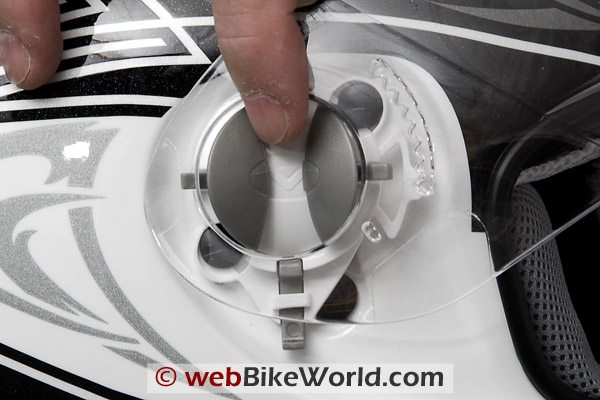
The other very interesting feature is the new and innovative visor release mechanism Vemar has designed for the VTXE. It’s so easy to use that it really makes me scratch my head wondering how so many other helmet manufacturers can get this so wrong.
The visor fits over semi-flush “buttons” on either side.
There’s a rod that serves as a lock underneath; pull down the rod, press the center of the button and two side “wings” snap open and the visor pops right off.
To replace the visor, slip it back on, press the two side wings closed and push the rod up to lock it in place. Simple, easy, smooth and — would you believe it — fun!
Be sure to watch our video (below), which fully illustrates this very nice system.
So kudos to Vemar for developing an interesting new mechanism for an age-old problem. I wonder if they patented the device and will license it to others? They should!
The semi-flush mounting also helps reduce wind noise in this area, and the visor fits without gaps to the gasket around the eye port.
In fact, the visor fits very close to the helmet — closer I think and with a smaller gap than most any other helmet in my experience.
Vemar says the visor is 2.2 mm thick; we measured this one at 2.3 mm.
Visibility out of the VTXE’s eye port is good, with good side-to-side and vertical sight lines. It’s been too hot to evaluate the visor’s anti-fog properties, so that will have to wait.
Score: I’ll give the VTXE an “Outstanding” for the light touch visor ratcheting system and the unique and easy-to-use visor removal system. It gets an “Excellent” for the field of view offered by the eye port.
Helmet Weight
OK, so here’s the chink in the VTXE’s armor. For some reason, all of the Vemar helmets we’ve reviewed recently seem to weigh more than their contemporaries, and the VTXE is no different.
This VTXE in size XL weighs a hefty 1790 grams, putting it at number 86 out of the 95 helmets we’ve reviewed to date, when sorted by weight.

Vemar claims that the VTXE shell is made from a “lightweight yet incredibly strong carbon fiber “aramidic” [sic] fiberglass blend”, but if there’s any carbon fiber in this shell, it seems to be adding, rather than subtracting, weight.
I knew the VTXE would tip the scales on the heavy side as soon as I took it out of the box, because it felt heavy.
But when all is said and done, the helmet fits me so well and the weight is very evenly placed, so I don’t really notice it when riding, except maybe if I turn my head side to side, when the mass can be felt.
For comparison, the VTXE at 1790 grams is similar to the Scorpion EXO-400 (review) at 1785 grams (3 lbs. 15 oz.) and the Shoei Multitec (review), a flip-front helmet, at 1786 grams (3 lbs. 15 oz.).
Also compare this to the SCHUBERTH S1 (review) at 1789 grams (3 lbs. 15-1/8 oz.) and the Scorpion EXO-1000 (review) at 1821 grams (4 lbs. 0-1/4 oz.).
See the wBW Motorcycle Helmet Weights page for charts listing the helmet weights of the hundreds of helmets we’ve reviewed to date.
Score: The VTXE gets a “Poor” for its weight but a “Very Good” for balance.
Miscellaneous
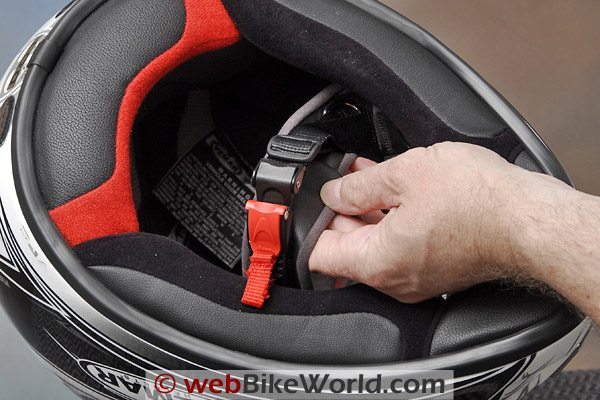
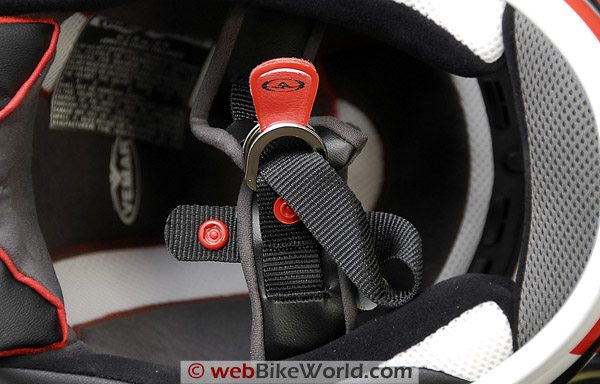
The VTXE uses the ratcheting type of “quick release” system used on the Vemar Jiano.
It may need to undergo an initial adjustment for the owner, and although the system works well, it’s more complicated, has many more moving parts and is probably heavier than the classic and simple double D-ring adjustment system.
The chin strap has a long extra piece that can be tucked up under a separate metal D-ring.
The padding under the chin strap uses the same cushy lining material as the rest of the liner, which makes it feel comfortable. Eyeglasses should fit when wearing the VTXE.
The VTXE meets DOT safety standards in the U.S. and it is also labeled with an ECE 22.05 sticker on the back.
Our understanding is that the ECE doesn’t like this sticker to be used outside of member countries, but it’s there nonetheless. The helmet has a 5-year warranty, which is commendable.
| webBikeWorld Opinionator: Vemar VRX7 | |
|---|---|
| Picks… | …and Pans |
|
|
Conclusion
The VTXE has a lot going for it — it’s very well made, with a very comfortable liner. It’s relatively quiet and, under certain conditions, we think it has some of the best noise control of any helmet we’ve reviewed.
The venting system works well and doesn’t add to the overall noise levels, and the visor operates smoothly and easily. The visor removal system works very well.
The only real issue we have with the VTXE is its weight, but the shell does feel very stiff and non-flexible, if that helps.
| wBW Review: Vemar VTXE Helmet | |
|---|---|
| Manufacturer: Vemar Helmets (Italy) | List Price: $350.00 |
| Colors: Solids and graphics. | Made In: Italy |
| Sizes: 2XS-3XL Shell Sizes: Unknown | Review Date: June 2008 |
|
Rating Scale is subjective: Unacceptable, Poor, Neutral, Very Good, Excellent, Outstanding.
|
|
Note: Item provided by a retailer, distributor or manufacturer with these Terms and Conditions.
Owner Comments and Feedback
See details on submitting comments.
From “L.S.” (10/09): “After reading the wBW review, I ordered a size small in the black/white that was on sale at MSS. Was too small, but they didn’t have any mediums, so I found (a) Hi-Viz (color version)…
The color on this helmet is eye-popping. Anyone who loves Hi-Viz gear would die for this helmet. It’s beautiful and no one would miss me.
In terms of size: Going from the size small to the size medium, it seems to me that the increase in the size is much greater side-to-side and top to bottom than it is front to back.
So this helmet fits me well front to back, but fits me too large side-to-side and top to bottom.
Bottom line is that the small was too small for me, and the medium was too big.
I believe that I have an oval head shape, and it seems to me that this helmet would fit a round or round-oval head shape better, which is why neither size fit me well.
Strap closure mechanism: Normally I’m a fan of the D-ring, but I love the closure on this helmet.
Soooo easy to use, easy to close, easy to open, and feels good.
The liner is feels good and is extremely comfortable.
Eye Port: The Eye Port on the VTXE was subjectively smaller than that of my HJC CL helmets.
Measuring confirmed my subjective impression: The eye port on the HJC CL helmets is ½ inch wider and ¼ inch taller than that of the VTXE helmet.
Brief ride test: I took about an 8 mile test ride, reaching speeds of 80 mph. You were right, this helmet is the quietest helmet I’ve ever tried!
Prior to this, the HJC CL helmet was the quietest helmet I’d ever ridden in. The VTXE beats it.
In fact, the VTXE helmet is the ONLY helmet I’ve ever tried that, worn by itself, virtually eliminates the booming low pitched wind noise that comes up from under the helmet. I always wear my HJC CL helmets with a Windjammer II applied to the bottom.
The VTXE alone is almost as quiet as the HJC CL with Windjammer II combo.
The VTXE with Windjammer II applied is (as you said), almost eerily quiet on the one hand, quieter than the HJC CL with Windjammer II in terms of the most problematic low pitched wind noise that comes up from underneath the helmet.
But unfortunately, for whatever reason, the medium pitched noise of the wind rushing past the helmet is louder. I don’t know if the aerodynamics of the helmet are not as good or what.
Because of that though, I prefer the HJC CL helmets with Windjammer II over the VTXE with Windjammer II. So I’ll just sell the Hi-Viz on one of the forums.”
From “A.P.” (4/09): “I bought this helmet based on your review (as I do much of my gear) and I agree with pretty much your entire review.
But, I have to seriously disagree with your “Outstanding” conclusion regarding the VTXE’s visor system.
My friend & I both ordered 2 of these helmets (both XL in size). However, both helmets had issues with the visor not staying up during riding at speeds of 40mph (he rides a naked bike & I ride a faired bike).
At anything approaching highway speeds the wind would simply close the visor, & neither one of us could see any way of tightening the shield (nothing in instructions either).
My friend was so frustrated he returned it & bought a RF-1000. I loved the fit of my VTXE but needed a smaller size for a correct fit, so I exchanged it for a large size hoping maybe I’d have better luck with the visor — but this didn’t happen.
When I ride in misty conditions I must hold the visor open with my left hand otherwise it fogs instantly & I’m blind as a bat. For this reason alone I would consider the helmet dangerous.
After using three different VTXE’s on 2 different types of bikes, I think it’s safe to say this helmet has a serious design problem.”
From “C.C.”: “I want to thank you for writing a great review and more importantly finding this great product. I have a HUGE noggin with a truly earth shaped face. Most helmets clamp down on my jaw like a vice. When I saw you compare the fit to the Quantum and the sizes ran to XXXL, I ordered that day.
About three days later this little gem appeared on my doorstep. I usually wear an Arai Quantum XXL as it fits me the best.
The Shoei 3XL RF-1000 is a distant second and I have tried numerous other helmets that fit (HJC, Zeus, etc.) usually finding some oddity that makes them uncomfortable. Then along came a Vemar… wow is all I can say.
I made a small adjustment to the cheek pads by trimming them down a bit, but I have to do that with all my helmets.
The Vemar fits better than a Quantum, the visor exchange as you noted is the best I have ever seen, the visor ratcheting is also the best I have found.
The memory foam was a brilliant addition as it works better for these type applications in my opinion, the venting system works and is glove proof (I live in Hotlanta so venting is a big deal and noticeable).
I even like the new strap system. D-Rings are proven, but this thing is a much faster on and off.
The weight of the helmet isn’t noticeable at all to me so great balance and the noise at least on my Versys is a considerable improvement over my Quantum.
In the end this helmet is as good or better than the premium helmets I have used in the past and at the asking price I would say the biggest bargain for earth shaped big headed folks like me.
I will probably order a couple more and stash them in a cool, dry, dark place just to have spares for years to come.”