Lazer Helmets SuperSkin Helmet Technology
New Technology Proven to Reduce Motorcycle Helmet Rotational Acceleration by More Than 50% During a Motorcycle Accident
UPDATE: Read our review of the Lazer Rider helmet with Superskin!
Here’s a question for you old-timers: Can you name the the very first motorcycle helmet reviewed on webBikeWorld.com?
Here’s a hint: webBikeWorld went online in 2000, and the review was published in the Spring of 2001.
Here’s another hint: the helmet was made by the world’s longest-established motorcycle helmet manufacturers.
Give up? It was the Lazer Century (review), my very first “flip-up” motorcycle helmet.
If you remembered that, you get a webBikeWorld Gold Star award!
Lazer Helmets (Belgium) was new to the U.S. motorcycle helmet market in 1999 and one of the very first (lots of ‘firsts’ here) motorcycle helmet manufacturers with an online presence that also featured online purchasing!
Don’t forget, that was 10 years ago, and the Internet was a much different place…
A few years after that, Lazer Helmets were marketed and sold by AGV in the U.S., but the brand never became as popular in North America as it was in Europe.
Lazer is now independent again, and they’re going through a sort of re-emergence in their 90th year anniversary with a very interesting new technology called SuperSkin.
The helmets will be available for sale some time in March 2009 in both “Jet” and full-face styles.
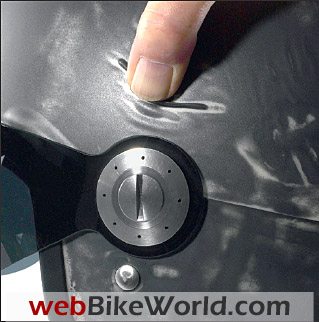 Lazer SuperSkin before paint and graphic overlay.
We’re always anxious to learn about new technologies with the potential to make motorcycling safer.
So I will be meeting the CEO of Lazer Helmets at the upcoming 2009 Powersports Dealer Expo in Indianapolis next week to learn more and to take possession of a brand-new Lazer SuperSkin helmet.
It will then be put it through the standard webBikeWorld motorcycle helmet evaluation and review.
In the meantime, Lazer sent us some information on this exciting new technology, which I’ve edited, along with some interesting graphics.
If you have any questions about Lazer SuperSkin, be sure to send them to me at my email address in the Comments section below before February 14 and I’ll get them answered.
What is Lazer SuperSkin?
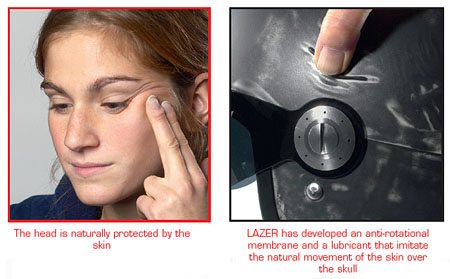
The concept of SuperSkin is simple Think about one of the ways in which your skin protects you — it moves and slides over your body to provide some “give” when you bump into things.
Sometimes the friction is greater than the protection offered by the skin, resulting in a bruise or abrasion. But think about what might happen if your skin didn’t provide any “give” — just like the surface of a traditional motorcycle helmet.
The SuperSkin helmet uses this same natural strategy by covering a motorcycle helmet with a “skin” that provides a sort of lubricity, which then allows the helmet to slide, rather than catch.
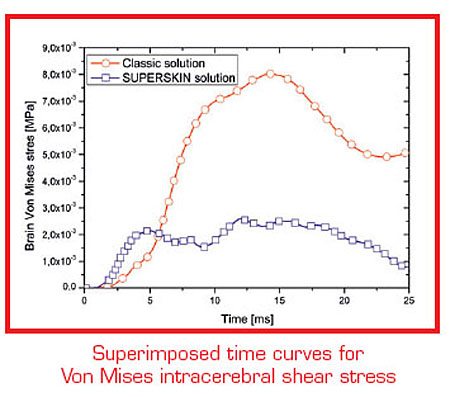
According to tests, SuperSkin can reduce the rotational acceleration of the motorcycle helmet by 60% (Edit: Changed from 50%), resulting in a reduction in the risk of intra-cerebral shearing by 67.5%.
What does this mean for motorcyclists? As you can see in the Lazer SuperSkin video included at the end of this article, a motorcycle helmet equipped with SuperSkin rotates less when it glances off a surface.
The SuperSkin basically gives up its life for the motorcycle rider by “lubricating” the surface of the helmet and lowering what we call “stiction” — the resistance to movement forces, like in the seals on a motorcycle front fork.
Lazer says that SuperSkin protects the head and brain significantly better than traditional helmets in these types of impacts by reducing the forces ultimately transmitted to the head and brain.
Alexander de Vos van Steenwijk, the CEO of Lazer, told us that this is “based on the broadly accepted medical diagnosis that diffuse axonal injury is caused by rotational impact”.
He said “Rotational impact causes ‘torque’ inside the brain. Diffuse axonal injury is one of the most devastating lesions our brain can suffer, in all medical literature it is explained as such”.
Lazer Helmets has completed many tests to prove this theory.
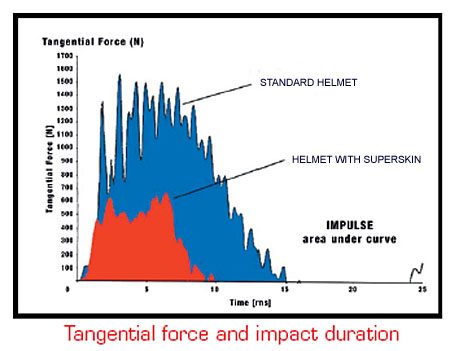
he decrease of the rotational impact was tested and certified by Transport Research Laboratory (TRL) in the UK, and is demonstrated in the video of the falling helmets, where the tangential force is reduced by 60%.
Also, research conducted by Prof. Willinger at L’Institut de Mécanique des Fluides et des Solides(IMFS) in Strasbourg, France, demonstrated the effect of this decrease in rotational impact on the probability of suffering diffuse axonal injury.
Professor Willinger’s mathematical modeling, on which he and his team are leading experts, estimates that this probability is decreased by 67.5%.
Other tests at the Louis Pasteur University of Strasbourg in association with the CNRS, the French National Scientific Research Centre, were conducted in what is said to be a detailed scientific study of the ability of the SuperSkin to prevent brain injury in accidents.
Lazer said that the tests prove that on head impact, a Lazer SuperSkin helmet reduces the risk of intra-cerebral shearing by 67.5%.
Following is an edited version of the Lazer Helmets SuperSkin press release:
The Lazer SuperSkin Helmet
The skull, which is the best-designed casing for providing the brain with protection, is itself naturally protected by the scalp.
SuperSkin is a layer on the outside of the helmet, which acts exactly like the scalp does in the human head; by sliding on the shell it limits rotation.
Rotation of the head causes severe and untreatable damage to the brain from the very first milliseconds following a blow and the scalp reduces the effect of the impact by sliding over the skull.
It is precisely this infinitesimal time lapse of 15 milliseconds that is so critical, it is what scientists call “rotational injury”. The Lazer SuperSkin helmet was invented and designed precisely to counteract this in the most effective manner.
Rotational Injury: The Absolute Enemy
It is important to note that in 67% of all cases the head is affected in a motorcycle accident and, according to the European COST 327 helmet study concerning motorcyclist safety, “rotational acceleration was identified as a principal cause of head injury”.
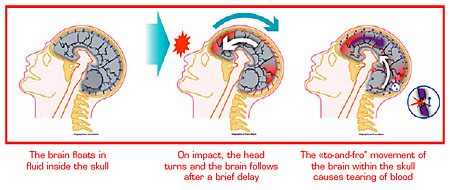
In order to understand how this phenomenon occurs, you should be aware that the brain is not fixed to the inside of the skull and the brain linings but that it floats, immersed in cerebrospinal fluid.
In fact, the skull and the brain can be compared to a hollow globe that encloses a gelatinous sphere, the brain matter, which floats within the bony walls in a whole network of membranes and elastic cables (blood vessels, tissues etc).
Any impact causes instantaneous pivoting of the head, to a greater or lesser degree. Of course, the brain mass follows the rotational movement of the skull, but with a slight time delay.
Kinetic energy results in the brain undergoing a rotational to-and-fro movement inside the skull.
And as described previously, this happens within the first 15 milliseconds following the impact. Clearly the violence of this rotational movement within the skull can instantaneously cause the tearing of blood vessels and nerve fibers inside the brain.
This phenomenon, called “intracranial shearing” by doctors, is the cause of serious and inoperable injuries leading to serious disabilities (coma, paralysis and various other disorders) and all too often, death.
This is why, in conjunction with the work carried out on this subject by Dr. Ken Philips of Philips Helmets Limited, the makers of LAZER helmets have decided to invest their effort and capital in the development of a new technology.
It is called PHPS: Philips Head Protection System, that makes it possible to considerably limit the pathological and neurological consequences of rotational injury on the brain considerably.
Actually, as we can see later, a helmet fitted with the SuperSkin membrane reduces intra-cerebral shearing by 67.5%, by reducing the mechanical effects of rotational acceleration by more than 50%.
This exceptional outcome is the result of long research and meticulous design and development.

Do All Motorcycle Helmets Slide in an Accident?
Even if your helmet is as shiny and lacquered as a piece of Chinese furniture, and even if you can imagine that in the event of a fall it will slide like a bowling ball, in fact matters are much more complex.
This is what has been proved by work carried out by the biomechanics team at the Louis Pasteur University of Strasbourg in association with the CNRS (the French National Centre for Scientific Research).
Also, tests for official approval have been carried out by the independent Transport Research Laboratory in the United Kingdom.
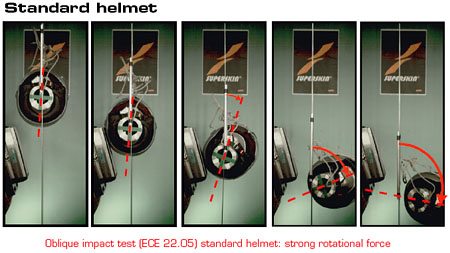
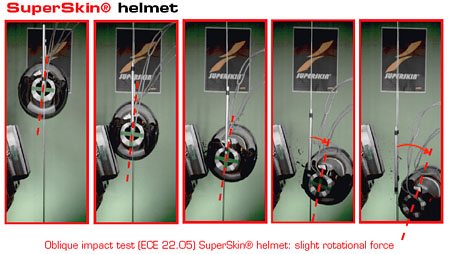
Impact tests on the standard anvil were conducted (the inclined impact test, part of the ECE 22.05 standard) with a LAZER Rider standard model.
And comparing the results of these with results of the same tests carried out on a LAZER Rider SuperSkin, video recordings clearly show that the rotational effect is greatly reduced with the model equipped with the SuperSkin membrane.
The elasticity of the covering combined with the lubrication of the LAZER SuperSkin helmet provides a quantitative reduction of up to 60% of the tangential force.
Diagrams demonstrate that the maximum rotational speed experienced is four times greater with the standard helmet than with the SuperSkin.
These experiments have clearly indicated that the synthetic membrane reduces the rotational acceleration by two-thirds, clearly demonstrating the potential effect of this unique solution on the risks of brain damage.
This major technological advance, LAZER SuperSkin, becomes the pioneer of a new generation of advanced helmets whose qualities in terms of passive safety will soon be indispensable to all users of two-wheeled vehicles, drivers and passengers alike.
New Advanced Research Methods for Motorcycle Helmet Safety
It would have been impossible for LAZER to devise a truly innovative helmet without basing this work on the results of the various studies carried out by specialists using more highly specialized research tools than those traditionally used.
Today, more advanced instruments are available to biomechanics researchers.
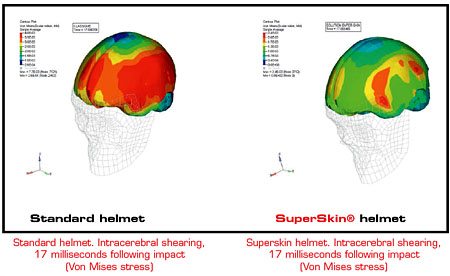
These are computerized mathematical or digital models, making it possible to evaluate with greater precision what is happening to the head in terms of pressure and intra-cerebral shearing in the event of an impact.
Due to this type of highly specialized equipment and at the request of LAZER, researchers at the Institute of Mechanics of Fluids and Solids at the Louis Pasteur University of Strasbourg conducted tests.
This was done under the direction of Professor Rémy Willinger and the researchers have been able to define the performance of the LAZER SuperSkin by comparing it with a standard helmet without a protective membrane.
Until now, only the linear acceleration was taken into consideration in helmet design, whereas it is now indisputable that rotational acceleration is particularly dangerous to the head and must be a feature of all future design.
Currently, a standard helmet is composed of a layer of shock-absorbing material of a thickness of about 30 mm.
The effectiveness of the protection relies in this case on the deformation and dispersal of the energy of the helmet.
This traditional concept of a helmet, essentially based on protection from linear acceleration, now has to be enhanced by the results of the biomechanics studies that highlight the tangential impact component.
Dr. Ken Phillips: Intuition and Perseverance Led to SuperSkin
Dr. Ken Philips is a British doctor who has spent several years working on improving helmet safety, which was initiated after a discussion with his son, a journalist specializing in the motorcycle press.
Dr. Phillips considered that the best helmet had already been invented by nature — the scalp.
He postulated that the skin on the skull played an all-important role in the event of an impact and was able to demonstrate that the same effect was achieved by putting a lubricated membrane on a helmet.
This pioneer has dedicated a total of fifteen years of his life to saving ours. Over the years, he has developed his head protection concept, called the Philips Head Protection System, or PHPS.
By joining forces with this project, the LAZER immediately became aware of the tremendous added benefits that the SuperSkin solution could provide for its customers in terms of safety.
So LAZER now has the exclusive use of this concept adapted to motorcycle helmets.
For his part, Dr Philips envisages extending the application of his discovery to helmets for cyclists and to riding helmets and other forms of protective headwear.
Lazer SuperSkin and Traditional Motorcycle Helmet Styling
From the outside, it is impossible to tell the difference between a standard LAZER helmet and its SuperSkin version.
The principle is to coat the helmet of the LAZER range (Full-face and Urban Jet) with a synthetic membrane and its lubricant, which can be colored without any problem and without any loss of its intrinsic qualities.
This means that the SuperSkin helmet keeps its LAZER look, with the advantage of its flattering design that contributes to the success of the brand.
But although nothing is evident to the eye, it is easy to tell the difference by the feel.
When the surface of the helmet is stretched with the fingers, the membrane lengthens slightly, evidence of the suppleness of this innovative and life-saving covering.
European Helmet Safety Studies Led to the Development of SuperSkin
At the root of the work carried out by the Louis Pasteur University and the French National Scientific Research Centre is the in-depth statistical study on motorcycle accidents and their injuries.
This was motivated by the European study COST 327 (European Cooperation in the field of Scientific and Technical Research).
A total of 253 accidents involving motorcyclists, the vast majority of whom were wearing helmets, were analyzed within the framework of the COST 327 project, “Motorcyclist’s Helmets”.
The results show that rapid rotational motion was responsible for over 60% of all head injuries. This statement of fact has brought to light the urgent necessity for improvement to the protective capacities of helmets.
The first conclusion of the COST 327 report is as follows: “in order to reduce the number and gravity of these injuries, it is necessary in the first instance to reduce the rotational impact”.
What Happens During an Impact to the Head?
In order to give a detailed analysis of what takes place when the head receives an impact, a real motorcycle accident with head injury was digitally simulated.
The first time it included the rotational acceleration experienced and the second, without the rotational forces.
By doing this, researchers were able to calculate the shear stress inside the brain.
The comparison of the results of the two tests made it possible to assess the damaging effect of the rotational element of the head in intra-cerebral shearing.
Digital models also made it possible to show that a very brief, hard impact (such as a hammer blow) causes fractures to the skull, whereas a longer –lasting impulse tends instead to cause neurological lesions.
The three most common lesions are:
- Skull fracture associated with deformation of the bone: a hammer blow.
- Subdural hematoma associated with the rotational movement of the brain/skull (this causes the rupture of veins joining the brain mass and the skull wall).
- Neurological lesions or intra-cerebral shearing caused by the rotational component of the impact.
Digital simulations have shown a 67.5% reduction in the risk of intra-cerebral shearing. This significant result represents a key advance in terms of safety.
LAZER Helmets – Since 1919
At the beginning of the twentieth century, the very first helmets worn by automobile, aviation and motorcycle pioneers were made only from leather.
So it is not surprising to learn that the family business that was to become the LAZER Company was, at the outset, a modest leather workshop, founded by Roger Lacroix.
This craftsman could never have imagined that in 2009 his business would be celebrating its ninetieth year.
After the Second World War, Lacroix changed its name, became the CROSS company and started marketing rigid leather helmets. In 1980 CROSS created LAZER, which from then on became the brand name under which all the company’s products were marketed.
In spite of its great age, the company‘s high-tech name demonstrates its determination to remain one of the front runners in innovation and progress – a policy that remains unchanged.
The company now has the a large Research and Development department, with all the mechanical and informational means available for developing, modifying and testing all the components of a helmet.
As a direct consequence for the consumer, the quality and safety criteria for LAZER helmets are often higher than the European standards in force as well as other official standards across the world.
LAZER is present in 49 companies via a network of 6000 dealers. Thanks to these retailers, in 2008 the company sold over half a million helmets.
By commercializing the new SuperSkin technology, the forerunner of the next generation of helmets, the world’s longest-established helmet manufacturer has brilliantly demonstrated that after almost one hundred years, the venerable LAZER Company is younger and more dynamic than ever.
The Rider SuperSkin is in production now and in March a full-face version will follow shortly thereafter.
UPDATE
Read our review of the Lazer Rider helmet with Superskin!
For More Information, contact Lazer Helmets
Owner Comments and Feedback
See details on submitting comments.
Editor’s Note: UPDATE: I met with Andrew de Vos van Steenwijk at the 2009 Powersports Dealer Expo during the weekend of February 13-16 to discuss the new Lazer Superskin helmet and answer your questions. More detailed responses are available in the Lazer SuperSkin FAQ page on their website.
From “J.E.”: “I beg to question the testing procedure used by Lazer SuperSkin Helmets in the video. It appears that the helmet is hanging “loose” in the test, as in no resistance to rotation.
In the real world, there is a lot of resistance to rotation provided by both the skeleton and musculature. My uneducated guess that if this resistance were applied to the testing procedure, the rotational difference would be miniscule.
You simply cannot compare a freely rotating helmet to a helmet attached to a skull that is attached to a neck that is attached to a spine and on and on.”
Editor’s Reply: The helmet is not “hanging loose”. It is on a standard headform used for motorcycle helmet testing. Also, notice that the same headform is used for the “normal”, non-SuperSkin helmet and it clearly shows the difference in rotation.
From “J.Y.”: “So how much and where can you buy them??”
Editor’s Reply: March 2009 availability. Pricing TBD.
From “M.S.”: “Does the SuperSkin make a helmet any more or less fragile to drops and bumps? If my buddy accidentally knocks mine off my ride while goofing off, should I expect that it has been damaged and needs replacement?”
Editor’s Reply: Not based on anything I can see. The Superskin helmet should be handled the same as a standard helmet. The Superskin is very tough. Damage concerns should be identical to any other helmet.
From “K.D.”: “Interesting concept. Could you make sure the face shield is “anti fog” as well.”
Editor’s Reply: Won’t know the answer to that one until the helmet is released for sale.
From “S.F.”: “Looks intriguing and makes logical sense as demonstrated. I’m curious about the additional weight of the lubricated membrane as well as the construction of the core helmet. Have they cost reduced the other components to pay for this new technology?
Editor’s Reply: The helmet does feel slightly heavier, but the Superskin layer appears to be only about 1 mm thick, so I don’t think it adds much. I’ll have to wait until we can put it on the scale, and then we won’t have a non-Superskin equivalent to compare it to. But any weight it adds seems negligible.
The rest of the helmet appears to be high quality, and no other components were changed from a “normal” helmet. The size large open face “Jet” style helmet I tried on in size large felt like it had a neutral to round shape and was very comfortable.
From “D.H.”: “Living in Arizona I’m all too aware that extreme temperatures can effect my riding experience. How will extreme hot/cold temperatures effect the performance of Lazer SuperSkin?
We easily reach ambient temps of 120 degrees on the road here in Phoenix area during the summer and ride into 30 degree temps in the cool mornings in winter.”
Editor’s Reply: No difference from standard helmets.
From “J”: “Interesting concept. Does this mean we’ll have to use Nivea to clean the helmet instead of Plexus?”
Editor’s Reply: No, but I heard you have to shave it once a week… 😉
From “G.K.”: “I’m curious to know if this technology can be applied to existing helmets, or can it be applied only during the helmet’s original production.”
Editor’s Reply: It could be applied to other helmets but needs a special manufacturing technique. For now, it will be featured on Lazer Superskin helmets only.
From “M.K.”: “How would the skin hold up against debris flung up at high speeds while riding on the highway, such as a rock. Will it cut the Superskin?”
Editor’s Reply: See response above. No difference from any normal helmet shell.
From “P.F.”: “In your review and on their website, the reduction in rotation is listed as 67.5% from university lab testing. However, if you listen to the good doctor himself speak on the video, he says 60%.
It appears that he mouthed 67.5% or something else, but the audio cuts out briefly after he says the word “sixty.”
So, is the reduction in rotation 67.5% or 60%?”
Editor’s Reply: Claimed 67.5%.