

Solid helmet with excellent quality and many features at a reasonable price.
Includes internal sun visor, large chin curtain and good ventilation.
The HJC IS-series is new for 2009, with three family members.
First is the HJC IS-Max (review), which was recently reviewed on webBikeWorld.com.
Next is the HJC IS-33 (review) “Jet” styled open-face helmet.
Then comes the IS-16 full-face helmet that is the subject of this review.
(Note: The HJC IS-33 (review) was also recently added to the lineup).
Where the “IS” name came from, what it means and why the numbers “16” and “33” are used is a mystery.
HJC uses the two letter designations to represent families of helmets, with the FS-series now apparently taking the place of the HJC AC-series at the top of the heap (here’s our FS-15 Carbon review).
Then comes the IS-series, followed by the long-lived CL-series.
There’s still a CS-series helmet in the mix; the CS-R1 (review), which seemed to be an aberration and one HJC helmet we really didn’t care for. The CS-series had a short production run; possibly it is being phased out.
A few other helmets populate the HJC lineup, including the popular Sy-Max II (review); the CL-Max flip-up, which we’ve never quite gotten around to reviewing; and even a CS-Y line of children’s helmets.
It’s no wonder HJC lays claim to being the “#1 in the World”, with an ever-changing and always-improving lineup of helmets to fit just about every budget — but mostly targeted towards what might be called the value-oriented customer.
The HJC IS-16
And that formula of continuous improvement with value pricing is represented perfectly by the new IS-16 full-face helmet. First introduced in the U.S. at the 2009 Powersports Dealer Expo in Indianapolis (report), the IS-16 seemed to be the right helmet at the right time.
The worldwide economic recession that started in 2008 was in full swing, with motorcyclists and consumers everywhere finally realizing by February of 2009 just how serious of an issue this would be.
The IS-series of helmets offered (and still offers) a very well-made product, packed with features, with modern updated styling (compared to previous HJC helmets) and all at a very reasonable list price of less than $200.00.
This is one of the keys to HJC’s success.
The ability to quickly design, produce and distribute some very nice products using a layered pricing strategy that pretty much covers the market, from the $79.99 CS-R1 to the FS-15 Carbon, with each model separated by about $30-$40 or so.
This pricing strategy, by the way, is very successfully employed by the digital camera industry, where a manufacturer will produce dozens of models, each with very slightly different features and each priced with about a 10% or so spread, all the way up the line from the most basic to the most advanced.
The idea is to both cover the market and any consumer price sensitivities, plus outwit the competition by being able to offer every combination of product and feature imaginable — albeit at the risk of confusing the customer.
Just go to the Panasonic or Sony or Canon digital camera website to see what I mean…
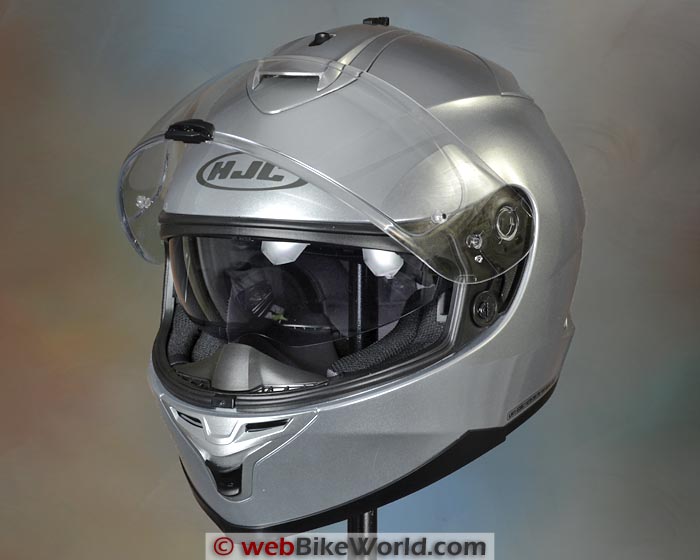
Anyway, the IS-16 checks all the boxes: updated styling; excellent surface finish; a variety of colors and graphics; super-quick-and-easy visor change; internally rotating sun visor; removable “SilverCool” liner and even a nice, big chin curtain.
Throw in very good ventilation that even features vent passages through the chin bar and you’ve got a winner.
OK, so the review’s over, right? Well, not so fast!
Paint, Graphics and Overall Quality
Every once and a while, HJC comes up with a ringer, like the CS-R1 (review), which just didn’t seem to be up to HJC standards and which was a real disappointment around here.
But they’ve definitely been back on track with the last couple of helmets, and the IS-16 can sort of be viewed as a “poor man’s” FS-15.
The FS-15 Carbon we reviewed was and is pretty phenomenal in all respects, and again demonstrates why HJC sells so many helmets.
I’ll use the FS-15 as a benchmark for comparison here with the IS-16 because the helmets seem very similar to me.
The styling of the IS-16 reminds me a lot of the FS-15 — obviously a good thing. The IS-16 has what seems to be an updated shell design and overall styling for HJC.
Some (most) of their previous helmets were…well, the styling was a bit mundane. But the IS-series is a leap (or at least a step) forward in terms of looks.
Now a helmet is a helmet is a helmet; there’s not much that can be done with a round shell that has to meet DOT, Snell, ECE, JIS, et al safety standards.
The standards either have forced the typical motorcycle helmet shape, or no one has been able to figure out a way forward yet.
But as any automotive stylist will tell you, it’s all in the details.
Throw in a feature line here and there and you can dramatically change the appearance and impression of a smooth design — for better or worse.
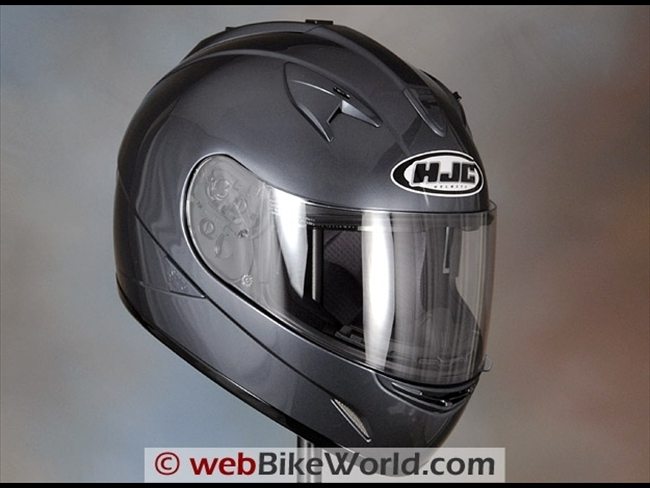
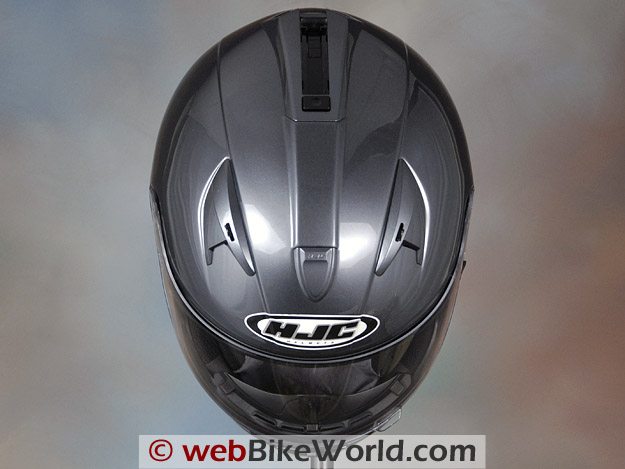
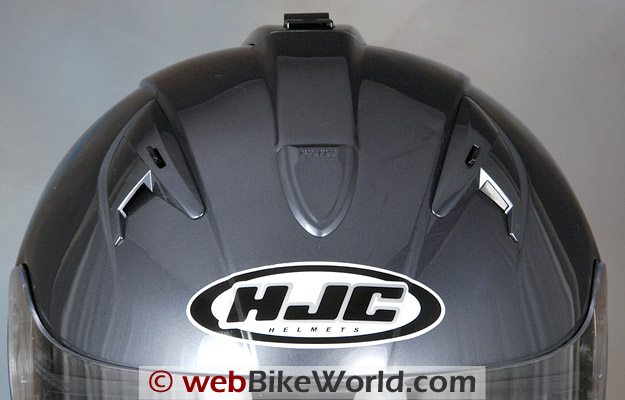
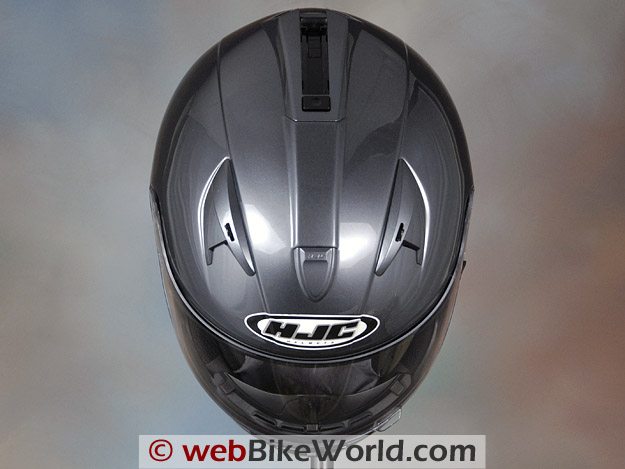
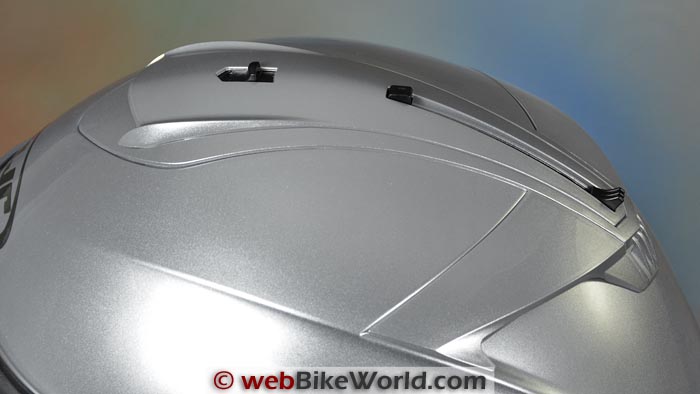
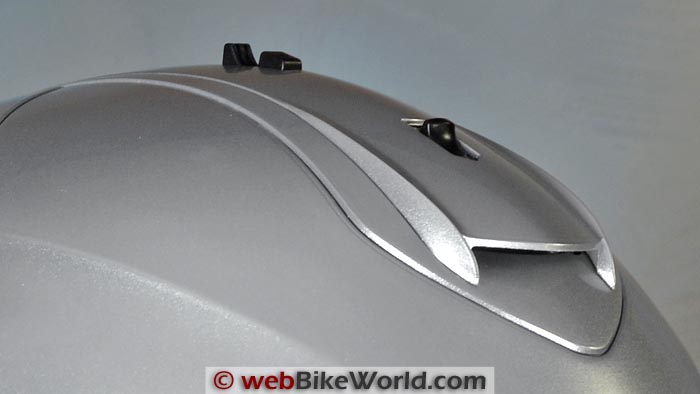
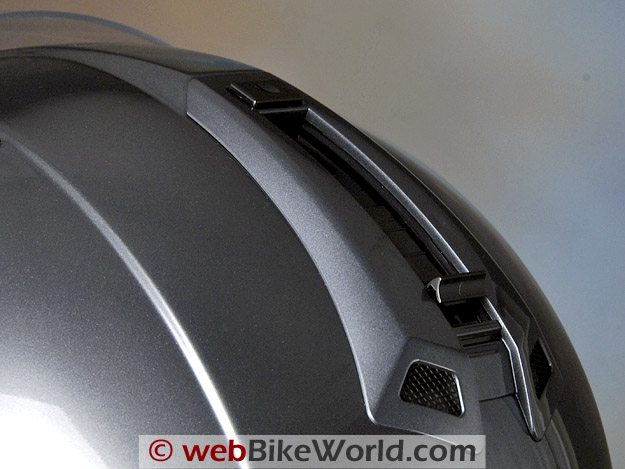
The most dramatic difference on the IS-16 (and IS-Max) are the contoured sculpted cutouts added to the side of the helmet and the “power bulge” on top of the helmet, which add a bit of a sharp swept-back look.
This instantly gives the helmets a modern “jet fighter” style and avoids the round “ball” shape of the lesser HJC helmets like the CL- and CS-series.
The IS-16 shown here is a simple Anthracite metallic, but the paint and clear coat are very well executed, with no bumps or runs or bits of dust underneath to mar the surface.
The clear coat is relatively thick, at least at this price point, and the surface feels smooth and it should provide good service.
In fact, the photos shown here were taken after the helmet was evaluated, not before as is usually the case. We usually take the photos first because the products can (and do) pick up dents, scratches and bugs.
Bugs can be wiped off, but you can see from these photos that the clear coat and the surface finish still looks remarkable.
The rest of the IS-16 also has excellent quality, with all the fitments, tolerances and everything else in good shape.
If you look closely (not in the photos, because this doesn’t show up), you may find a couple of very slight gaps where the top air vents are attached to the shell, and along the back where the complex HJC internal sun visor rotating mechanism is attached.
But these are very minor and forgivable in a sub-$200.00 helmet.
One single feature that does stick out as a quality faux pas that doesn’t seem to be up to the rest of the helmet is the HJC sticker on the front. It’s a simple stick-on vinyl decal and it is not placed under the clear coat.
It instantly looks out of place because the edges of the decal are visible — and, there are a couple of dust or dirt bumps underneath this one that look like pimples sticking out of the surface.
Some owners will peel the decal off anyway, and, in fact, we get occasional emails complaining about logos that can’t be removed.
My feeling is that HJC really should have either added a nice raised “3D” logo on front, or at least placed a thin decal under the clear coat, because the cheap stick-on decal just doesn’t cut it and, I think, affects the overall impression of this helmet.
Score: I’ll give the HJC IS-16 an “Excellent” rating for overall quality, surface finish and clear coat and excellent overall fit and finish. See the ratings descriptions in the summary table at the end of this page.
Helmet Fit, Comfort and Internal Shape
The IS-16 has a neutral internal shape that should fit a wide variety of heads. The shape is probably biased slightly towards round, but everyone who has tried the helmet so far has found it comfortable.
It’s not as narrow on the sides or as slightly pinched on top as the fit typical of a Scorpion helmet like the EXO-700 (review); the IS-16 feels more like a compromise between the Scorpion shape and the Shoei RF-1000 (review).
The IS-16 fits very much like the FS-15 Carbon we reviewed, so apparently this is the “standard” HJC helmet fit, and as far as a neutral fit goes, it’s probably the best compromise we’ve found in any helmet.
This IS-16 in size XL also is sized to what seems identical to the FS-15 we reviewed; both are about 1/2 size smaller than expected for an XL.
The IS-16 in XL then should fit about a 60.0-60.5 cm to 61.0-61.5 cm circumference head, compared to the HJC fitment chart that shows an XL at 61-62 cm.
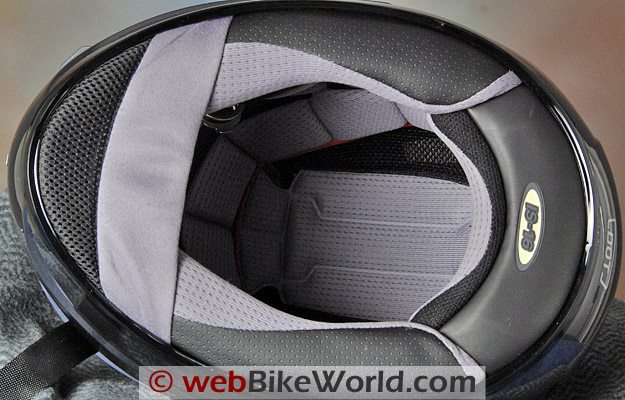
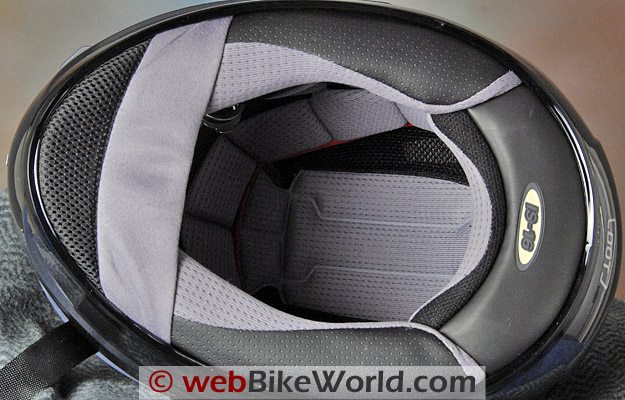
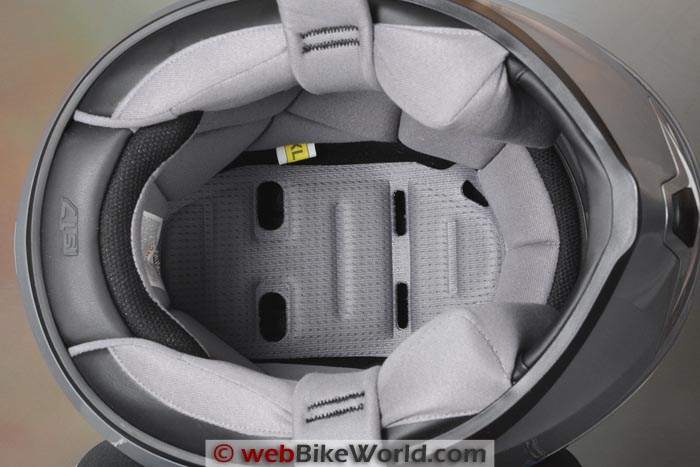
The helmet is very comfortable, and HJC’s “SilverCool” lining material probably helps in this regard. It feels smooth and the liner is put together very nicely, with all the stitches and tucks and seams in place.
As always, make sure you try the helmet on before buying, and try a variety of sizes. The smallest size that fits comfortably is usually the safest. For more information on choosing and fitting a motorcycle helmet, please see the wBW Motorcycle Helmet FAQ page, which also includes a discussion on head shapes.
Liner and Fabric Comfort
Just about everything that can be said for the more expensive FS-15 goes also for the IS-16, so I’ll crib some of it here.
The cheek pads of the IS-16 are ample and, like the FS-15, they fit low, along the bottom of the rider’s jaw line.
The IS-16 feels very slightly narrow or tapered inwards along the lower part of the liner, which may also add a slight pressure to the cheek pads.
But this is better than being too loose and I really don’t feel anything obvious in the way of pressure points when I wear the helmet for a couple of hours at a stretch.
The rest of the internal padding is on the thick side and also feels slightly firm. The liner in the IS-16 also has some tufts with padding at the top, which adds to the comfort.
The HJC “SilverCool” lining is removable and claimed to be a “moisture-wicking and odor-free interior with advanced silver anti-bacterial fabric”.
As was mentioned in the FS-15 review, the use of silver (if the fabric really does include silver) is interesting. Silver is, in fact, used in a type of anti-bacterial cream called Silvadene, which is used on burns.
Like the FS-15, the IS-16 has a similar vertical shape and the helmet also includes a large wind block under the chin, made from the same comfortable fabric as the liner.
The ear pockets are slightly larger than normal and they’re fully padded towards the shell, so the IS-16 should also be a good candidate for speakers and a microphone.
The ear pockets feel slightly larger on the IS-16 and they fit my normal sized ears.
At the risk of getting ahead of myself for the ventilation section, the liner in the IS-16 has 6 vent holes that are perfectly placed over the intake holes for the vents.
This includes the two top vents, the two exhaust vents at the back of the internal sun visor mechanism and the two exhaust vents at the lower rear section of the helmet.
That these internal liner holes are perfectly lined up is an important point; even very expensive helmets costing three times as much as the IS-16 usually get this wrong.
It must be very difficult to align a helmet liner with the intake holes, which themselves must be lined up through the EPS foam to the outer shell.
That HJC has this nailed on the IS-16 is a very commendable effort that is an excellent indicator of the overall quality, and to me this again shows that HJC is relentless in perfecting these kinds of details that most/many/all others seem to flub.
Score: I’ll give the HJC IS-16 an “Outstanding” for an internal shape that should fit the majority of head types, along with a very comfortable lining with generous padding and with outstanding quality of workmanship.
Venting and Air Flow
Those vents and the perfectly aligned vent passages in the liner give the IS-16 very good air flow and ventilation. While the helmet doesn’t have the “built in fan” effect of, say, the GMax GM68S (review), it does provide very good air flow through the top and the chin.
Less noticeable, but just as important, is the air venting out the back, through the four vent passages that are lined up with the exhaust ports on the back of the helmet.
Many helmets have exhaust vents in the rear, but the passages are buried under the liner. Not the IS-16. They definitely work.
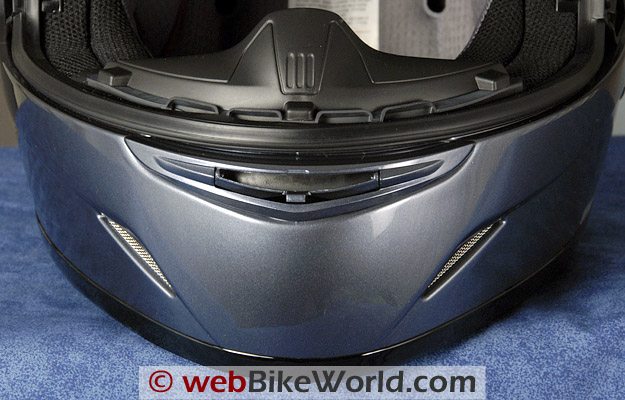
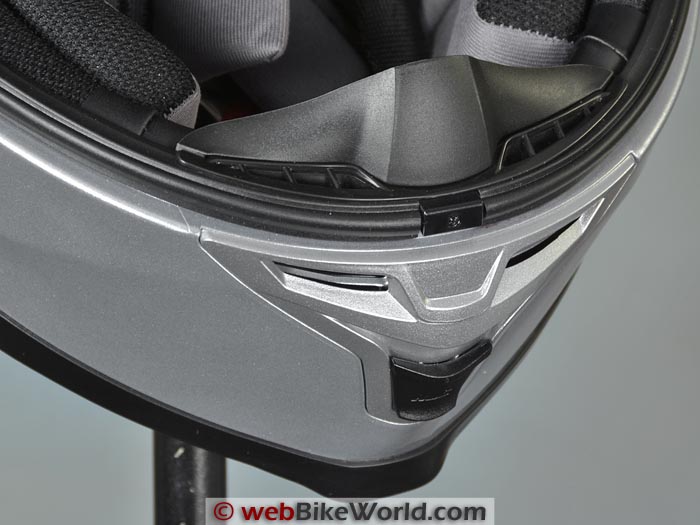
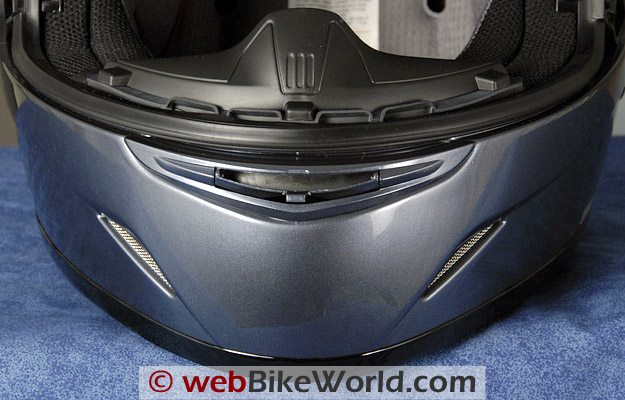
The chin vent uses a door that rotates downwards in two steps.
The middle step is difficult to find though, because the detent isn’t firm. This vent door does seem a bit flimsy though, and the small plastic tab on top is too flexible and feels like it will probably snap off over time after it sees some use.
Most of the air through the chin vent is directed through larger-than-average vent passages at the top of the chin bar, directing air on to the back of the visor.
The chin bar also has two always-open intakes on either side, covered by mesh, just at the front of the long indented “scoop” styled into the side of the helmet.
Again, unlike many/most other helmets, these actually work, directing air through matching vent passages built through the chin bar on either side of the rider’s chin.
There is a direct air passage from the outside through the chin bar, and the vent holes on the inside of the chin bar are even covered with a round vinyl gasket to give them a nicely finished and quality appearance.
In fact, the back of the chin bar is lined with a type of dimpled material that again gives an impression of high quality in this area that is mostly ignored by other manufacturers.
Curiously, there is a long strip of the “loop” side of a hook-and-loop section sewn on to the inside of the chin bar. I have no idea what this might be used for — possibly a microphone?
HJC and Chatterbox are part of the same family in the U.S., so perhaps they have something cooking… (Update: Possible attachment for Respro Foggy? See comments below).
The top vents operate independently and have a solid switch that opens or closes the vent cover. These also work fairly well, providing adequate air flow.
However, the combination of these vents and the large internal sun visor operating mechanism in the rear conspire to add a whistling noise that gives the IS-16 a higher than average noise rating.
I can place my hand over the top of the air vents and the noise almost disappears, and otherwise the IS-16 is a fairly quiet helmet, so it’s too bad that these vents spoil the party.
But overall, the IS-16 has very good air flow and ventilation, and special kudos to HJC for really focusing on the tiny details that matter by getting the liner, vent passages, vent holes and overall ventilation to work in concert.
Score: I’ll give the IS-16 an “Excellent” for nicely constructed switchgear, positive opening and for good air flow and ventilation.
Helmet Weight
This HJC IS-16 in size XL weighs 1653 grams (3 lbs., 10-1/4 oz.), which is just about mid-pack or average for this type of helmet. The good news is that the internal sun visor doesn’t seem to have added too much weight to the helmet.
The IS-16’s weight compares favorably with a few other helmets in its range.
Those include the Icon Airframe in size XL at 1657 grams (3 lbs. 10-3/8 oz.); the Arai Profile in XL at 1658 grams (3 lbs. 10-3/8 oz.); and the IS-16 is lighter than the GMAX GM68S in XL, which comes in at 1677 grams (3 lbs. 11-1/8 oz.).
The IS-16 feels balanced when riding, and the overall shell shape helps, because the helmet does not feel like it has any unusual tendencies towards lifting or buffeting.
See the wBW Motorcycle Helmet Weights page for charts comparing the weights of all of the open-face, full-face and flip-up helmets we’ve reviewed.
Score: The HJC IS-16 gets a “Very Good” rating from me for its balance and not-too-heavy feel.
Face Shield
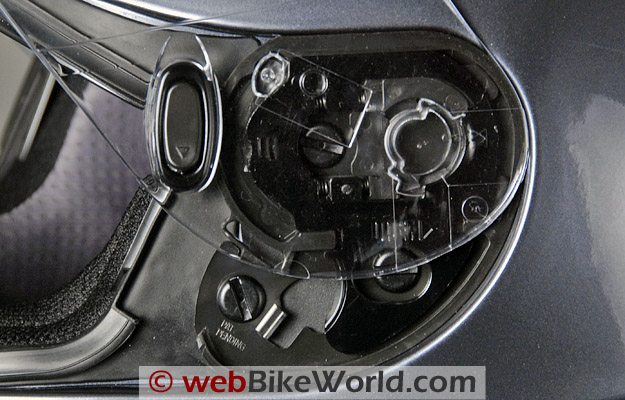
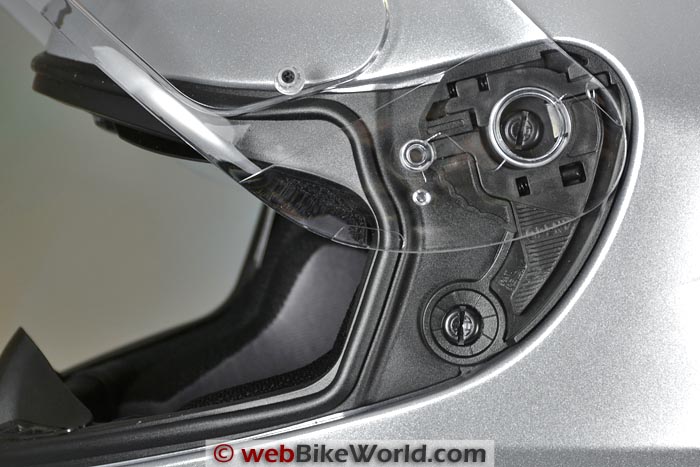
Like the FS-15 and other HJC helmets, the IS-16 uses the HJC “RapidFire” face shield removal system. As you can see towards the end of our video, this is one of — if not the — easiest and quickest face shield removal systems that can be found.
Lift the face shield all the way up until the two arrows line up; push the trigger and it pops right off. Putting it back in is about as easy. The IS-16 also features HJC’s locking system to hold the face shield shut.
Push in the rocker switch on the left-hand side and the face shield will lock shut, for racing or riding at extra-legal speeds.
Face shield optical clarity is very good and the range of visibility seems about average — not exceptional — in both side-to-side and top-to-bottom dimensions, although the vertical range may be just a touch narrower than average.
The face shield is nearly identical to the type used on the FS-15; it has the same slightly larger than normal lifting tab on the left-hand side, which is very useful. The visor shuts positively and seals perfectly around the entire eye port gasket.
Also similar to the FS-15, HJC says the face shield provides 95% protection from UV rays and it’s coated with an anti-scratch coating, but they do not say anything about the IS-16 face shield having an anti-fog coating.
It’s been too warm to tell, so it’s unclear (pun) at this point how well the visor will work in cold weather.
Unlike the FS-15, there are no Pinlock anti-fog system (review) nubs on this face shield. Also, the IS-16 eye port gasket does have small thin rubber sections on each side, so the visor seals completely around the eye port.
OK, so here’s the bad news.
The face shield has only 3 positions: closed, half-open and fully open. I’m not sure if this is an issue only on this particular helmet, but I don’t think so — it doesn’t seem that the rotating mechanism has a first short detent to hold the face shield open slightly for defogging.
This is a definite shortcoming and something that is also surprising, having noted HJC’s attention to detail above. The face shield can be finagled into opening slightly, but it’s very difficult to do and it shouldn’t be.
Every helmet face shield should definitely, positively have a first small opening to allow for defogging or ventilation.
By the way, I can wear wire-framed sunglasses with the helmet, although there is no special accommodation or design for eyeglass wearers as far as I can tell.
Internal Sun Visor
The rotating sun visor is standard HJC fare, but we still do not like the overly-complex slider mechanism on the top back of the helmet. It forces the rider to use the visor in only one of 3 positions: fully retracted, fully rotated or about 3/4 of the way rotated down.
You have to reach behind the helmet, pull the little bar forward and find the first notch about 3/4 of the way towards the front. Push again and the visor drops about another 4 mm.
To release the visor, you have to push the button and the spring forces the visor back up to the retracted position.
We think it would be much simpler and probably add less weight and complexity if the rotating internal visor used a simple friction-based slider on the left side of the helmet, like most of the other manufacturers use.
This would allow the visor to be rotated and stopped at any position, and relocated to any position.
If you have the HJC visor rotated all the way down and then want to raise it back up a notch, you first have to release the visor with the spring-loaded button until the visor retracts all the way back up into the helmet, then push the visor back down again.
And there’s no way to place the internal visor just above your line of sight to block the sun. You’re either using it or aren’t.
On the plus side, the internal sun visor does exhibit excellent optical qualities and, in the fully lowered position, it remains out of the rider’s line of sight.
Score: I’ll rate the visor clarity, operation and visibility of the HJC IS-16 as “Very Good”, but a “Poor” for the absence of a defogging detent, the “let’s do this for the sake of being different” sun visor rotating mechanism and the missing anti-fog treatment.
Noise Levels
Other than the whistling noise that is unfortunately caused by the combination of the top vents and the rotating sun visor mechanism on the back of the helmet, the IS-16 is relatively quiet.
It’s really too bad about those top vents, because if I cover them with my hand, the helmet becomes very quiet and probably would have been one of the least noisy helmets we’ve reviewed.
Turbulence-induced noise around the bottom of the shell is well controlled, probably mostly due to the large chin curtain that comes installed on the helmet.
Note that our helmet evaluations are a combined effort of several riders over time on different types of motorcycles with and without windscreens.
Evaluators wear correctly fitted, high quality ear plugs (even when evaluating motorcycle intercom systems).
Always protect your hearing when riding a motorcycle. See the wBW Earplug Reviews for more information on choosing and wearing earplugs.
Note also that perceived noise levels will vary, depending on the individual.
Noise can be caused by many factors, including helmet fit, the type of motorcycle and windscreen, wind speed and direction and even the rider’s clothing.
For more information on helmet noise, visit the wBW Motorcycle Helmet Noise page.
Score: I’ll give the IS-16 a “Good” rating for noise control.
Miscellaneous
The HJC IS-16 helmet uses HJC’s “polycarbonate composite” shell. It meets DOT safety standards when sold in North America. The HJC IS-16 sold in the UK meets ECE 22.05 safety standards and is also ACU Gold approved.
The helmet uses the preferred D-ring attachment system and the chin strap padding is quite good. The end of the strap is secured with a large snap. The chin strap seems more comfortable than average.
The HJC IS-16 has a one-year warranty. It’s interesting to note that our FS-15 Carbon has a 3-year warranty, according to the documentation in the helmet box.
Conclusion
The HJC IS-16 is an excellent all-around helmet with excellent quality and many advanced features.
After owning and wearing one, it’s hard to justify spending spending more money on other helmets that first may not have the same quality and also may not have the features and comfort as the IS-16.
A couple of minor quibbles aside (and the lack of the defogging detent may be a deal-breaker for some), the IS-16 has to be one of the best bargains in motorcycle helmets today.
And the bonus is that it’s backed by a company with a world-wide presence, so parts and availability should not be an issue.
| wBW Review: HJC IS-16 Helmet | |
|---|---|
| Manufacturer: HJC Helmets | List Price (2009): $189.99-$204.99 |
| Colors: Solids, Metallics and graphics. | Made In: Korea |
| Sizes: XS-2XL Shell Sizes: Unknown | Review Date: June 2009 |
|
Rating Scale is subjective: Unacceptable, Poor, Neutral, Very Good, Excellent, Outstanding.
|
|
Owner Comments and Feedback
See details on submitting comments.
From “D.B.” (February 2014): “I purchased an IS-16 at a bargain price because they were discontinued. It is a nice helmet; I really like the internal sun visor feature.
As you mentioned in your review, the vents are noisy, very noisy. In fact the top vents and the chin vent both! My cure was to remove the liner and fill the top vent holes with Permatex RTV silicone.
I also plugged the chin vent with compressible foam insulation.
I have had other HJC helmets with quiet vents. Go figure. Now the IS-16 is the quietest helmet I’ve ever had in 30 years of riding, albeit with compromised ventilation.”
From “J.W.” (December 2013): “I’m not sure if more light has been shed on the subject since this 2009 review, but I’ve come to assign the HJC “IS” line with an Integrated Sunshield acronym. Not every model with a sunshield is an IS, but all IS models have the sunshield.
I’ve found the integrated sunshield to be an indispensable part of safe, fog free riding.
After various experiments with different combinations, my CL-16 with Pinlock and breathbox has been the only reliable combination to provide good visibility and safe trip comfort under all riding conditions (although I have not tried the heated shields).
However, the breathbox does not accommodate sunglasses.
Having experienced my only motorcycle traffic accident to date while trying to negotiate a lane change with sunglasses wobbling around and cutting off the extremes of my peripheral vision, I’ve decided these sunshields will be mandatory on all future helmet purchases.
All your reviews bemoan the HJC design for them, but it has been more than adequate in my experience.
It feels a bit awkward reaching all the way up and back for the control, but at least I never fumbled around looking for it and popped open the outer shield to a face full of blindingly frigid air like i did trying out a Scorpion EXO-500.
I also noticed that the HJC sun visor has an optically clear lower edge that renders it unnoticeable to me, while the Scorpion gives slight distortion that makes the edge distractingly apparent.
However, I do agree that the tint is too light (HJC at least, Scorpion offers an upgrade).
Now, if HJC only made an IS-16 or -17 in 3XL, i could actually have a helmet that met all of my basic needs. Sadly, no one manufactures one that I have found yet. Thanks for all your work over the years.”
From “E.” (May 2013): “I’ve been using this helmet for a couple of weeks now. I’ve probably put about 600KM on it. It’s not the best helmet I’ve tried, but definitely not bad at all. And for the price and features, pound for pound, it’s one of the best.
Not sure why some people are posting the anti-fog doesn’t work. Because it does. I’ve had it fog up a bit on a few occasions, but it quickly dissipates. Most times it doesn’t fog up.
The internal sun visor is pretty cool too. I thought it was kind of cheese at first, but it has come in pretty handy when unexpected sun pops out and you didn’t bring your sunglasses. It’s easy to bring down, and retract.
Technically 3 positions, but only two are usable when riding. 3/4 for the leaning in (race) rider, and full for the more upright righter (cruisers). I usually just stick with the full as it suits me fine.
Ventilation is pretty good, I’ve felt better, but does it does a decent job. I’ll hold some reservations for when summer heat comes upon us. It is a bit noisy, but I’ve been riding so long, the noise doesn’t bother me.
If you are on a bit of a budget, but looking for a stylish helmet, that offers many of the features higher end helmets have. I would recommend the HJC IS-16.”
From “J.R.” (March 2013): “This is, sadly, the worst helmet I have owned. The visor claimed to be anti-fogging when I got it, but has never been as good as previous helmets. I have to live with it open a crack for 6-7 months of the year.
This adds terribly to the noise which is already a problem, but opening that crack makes it deafening, and I wear earplugs all the time.
The chin vent was damaged, but I didn’t notice until I got it home. Called the dealer straight away and their answer was that the helmet had to be sent away.
HJC would not allow a swap.
I could not do this immediately, as I had no spare helmet due to my old helmet not meeting the new requirements in my province. HJC customer service were useless and at one point basically said, “Why not buy a different helmet from us?”.
After sending it to them to address the chin vent and excessive visor fogging, they fixed the chin vent, but didn’t even clean the visor.
The noise in the helmet seems to come from multiple sources.
The top vents are an obvious culprit, the area around the visit also is a problem, as a hand placed near it calms it and the chin area is a problem even with the curtain there. The curtain is also useless in the rain as it just absorbs the water, holding it against your chin.
My previous helmet has a chin curtain made of fake leather and is vastly superior.
I would not recommend this helmet or manufacturer. Very poor helmet, very poor customer service.”
From “R.R.” (August 2012): “I tried one of these helmets on today, and found that the internal sun visor is easily raised from fully lowered to the 3/4 position by using two fingers.
One on the release button and one on the sliding knob to prevent it from springing to the fully retracted position.
No need at all to go to fully retracted, then lower again to 3/4 down.
Mind you, I only had the helmet on for a few minutes, but it seemed simple enough. The store didn’t have my color, but I liked it well enough that I ordered one.”
From “L.dK” (10/10): “Today i had the “pleasure” of trying the IS 16 for one day from a buddy who recently purchased it and was very enthusiastic. The pleasure ended soon.
i had it on for 45 minutes to work and back and found it rubbish.
It has nice fit which was size L where I usually have M. I have a rather round head and I must say it felt good. It has an annoying whistle at lower speed, but seems reasonable on higher speeds.
I ride a supersport on daily basis so my sit is a bit more leaned forward.
Taking this in consideration, I found the top Pinlock visor upper edge precise in the middle of my eyes and in the afternoon with the tinted glasses flipped down it had the visibility of a thick curved glass plate ,it gave me a headache within half an hour!
Together with the big nosepiece and the top of the shield to low it gave me not enough sight.
Positive: excellent fit
Negative: very poor visibility ,optical wrong ,and noise.
Last year I purchased a Gmax GM 68s after reading the review on wBW and this is the one that makes me happy.”
Editor’s Note: Couple of things: note that perceived noise will vary from rider to rider, bike to bike, as we state in every helmet review. We also always recommend wearing ear plugs and we always evaluate helmet noise levels with ear plugs, as we state in the reviews.
Also, I assume the owner installed the Pinlock correctly?
From “D.C.” (7/10): “I’ve had the helmet for a couple weeks. I’ve owned a large HJC AC-12 Carbon (review) for 3 years prior to the IS-16 (because) I would really like to have a helmet with an internal sun shade. Based on the online reviews plus my own experience with HJC, I went with an IS-16 large.
I truly enjoy the sun shades. I don’t have to worry about switching the shields because now I can ride all day long in this helmet. The graphics are very appealing too. The helmet is tighter on the cheeks comparing to the AC-12.
But that may be because my AC-12 had been worn/washed for the past 3 years.
However, I noticed that noise of the helmet is much louder compared to my AC-12. Unlike your experience, I found the source of the noise coming from the chin vent. Once I close off the chin vent, it’s as quiet as my AC-12.
I’ve managed to use my Bluetooth headset at speed up to 75 mph with no problem.
Another annoyance is that I keep getting air slipping in from the top right of my shield at around 20-45 mph. It’s really bothering my right eye. But the left side is perfectly fine.
I had to put a strip of electric tape on the rubber seam on the helmet to “bridge the gap” between the rubber and the shield to prevent the air from sipping in.
Finally, I had to return the helmet last Friday because the top left vent fell off.
At first I had some difficulties closing/opening the vent. Later on I realize the double sided tape holding the vent to the helmet lost its adhesiveness and eventually the vent completely detached itself from the helmet.
Overall I’ve owned 3 HJC helmets so far. The first 2 were just great quality and I am hoping that this is only an exception to the rule.”
From “J.G.” (8/09): “I’ve had the IS-16 for about a month and, unfortunately, I have to return it. The clear visor fits the helmet very badly, not closing correctly at the bottom. It seems to me to be very noisy.
The helmet also jiggles and vibrates at speeds exceeding 60 mph. I would like to be able crack it open a little bit for defogging and a little fresh air, but there is no “stop” for that. It fits very well and I like the tinted slide-down interior visor. The chin strap is nicely padded.”
From “B.S.” (7/09): “Have been using the HJC IS 16 for two weeks now and doubt I will need another helmet this summer. I work graveyard and leave for work when it is dark and come home in the morning sunshine. It’s a great helmet and when you consider picking it up for around $150 I can’t see anything coming close.”
From “B.C.” (7/09): “In reference to your review of the HJC IS-16, I’d like to offer the following comments. First, great and thorough review as usual!
As a new rider, your findings and observations led me to put the IS-16 at the top of my list for my first helmet, and I ended up purchasing one recently.
As with the previous commenter “B.H.”, my helmet also has a detent for cracking the helmet about .5 cm which should be enough for de-fogging purposes. I am also curious about your comments on sizing.
I measure as a medium according to HJC’s sizing guidelines, but when I stopped in at a local shop, the medium IS-16 I tried on was way too big. I think I have a fairly typical head shape – round, maybe slightly oval, and the size small fit me much better.
Keep up the great work!”
From “LCR” (7/09): “After reading your review, I decided to buy the HDC IS-16. They had to exchange it twice and finally, I got my money back… The problem was the Visor: I got water (from light rain) inside the visor.
I changed the visor, then the helmet but still got water inside. Above 85 mph, weird vibrating plastic noises appeared on the side and were very annoying. Unfortunately, the sun visor is… perfect!”
From “B.H.” (7/09): “Apparently HJC has read your review & considered your opinion because I got my IS-16 yesterday & it has a detent in the visor for cracking it open just a bit.
I like this helmet very much (I knew I would after reading your review) it is much quieter & lighter (& newer) than my old AVG Z9.”
From “A.S.” (6/09): “HJC seems unique in the (motorcycle) helmet industry as they have a helmet “system “ with additional accessories to change the function of their helmets, i.e. snowmobile visors, both heated and unheated; and model specific breath guards that work better than anything else.
Those vents on the side of the chin bar serve to draw steamy breath out of the helmet to help prevent fogging, and that Velcro strip at the bottom is indeed as K.A. pointed out to attach the bottom of the breath guard.
HJC’s model specific breath guard plugs into those chin vents and really helps draw out moisture laden breath, in fact an HJC helmet with these chin vents and a HJC breath guard is the most fog free helmet I think you can get.
Using a chin curtain and a breath guard on a helmet without these vents is a disaster, your breath is not exhausted from the helmet and winds up on the visor causing fogging.
The visor cracking function is important but with HJC’s breath guard in you shouldn’t need it even when stopped. I guess this is one time it’s ok to say yes to crack…”
From “D.Y.” (6/09): “I second the email about the Velcro strip at the bottom inside of the chin guard on the helmet. It’s there for a breath mask.
I have an HJC CS-12 snowmobile helmet and they are identical to the CL-12 series of motorcycle helmets. Basically all HJC does is place a double paned shield on it, and insert a breath mask to convert the helmets to a snowmobile helmet.
I actually just take out the breath shield and place a single paned shield on it for summer motorcycle use.”
From “J.O.” (6/09): “I have been using this helmet for about 6 months. I bought it as an upgrade from an (HJC) AC-11. The main selling feature for me was the internal visor. I wear glasses and the sun visor works great with them.
It can be easily deployed as lighting conditions change without pulling over to change back and forth from clear to tinted glasses.
Also, I bought them at a local bike show as a ” show deal ” from a local Honda dealer for $149 CAD. They are selling normally here for $239 CAD. I think this is a good helmet even for the list price and I am very satisfied.”
From “B.J.” (6/09): “Having owned an IS-16 for the past couple of months I concur with most everything Bill mentioned in his review.
I have nearly an identical helmet to the one reviewed here.
Mine is size L instead of XL, but otherwise the same) and though my visor is limited in opening settings it does have an initial opening of a maybe a cm (maybe a little less) that does a perfect job of de-misting or simply adding a bit of airflow on hot days.
Now this may seem odd, but it could be the visor, not the helmet that is making the difference. I have a CL-15 that uses the same HJ09 visors as the IS-16 and when I purchased it, it had the same small opening setting we’re talking about.
After a few months of owning the CL-15, I got a nice sized scratch on the visor. I ordered a replacement and when I put in on the CL-15.
When I went to open it, it would not stop at the tiny opening and instead the first opening was a couple of inches.
I took both visors off and compared them very closely and could not find a discernable difference in the design, but every time I swapped them, the openings were indeed different for each visor.
Since the IS-16 uses the same type visor as the CL-15, it could be the same situation. I can also confirm that the visor on my IS-16 is antifog as it will not fog up and you can feel the coating on the inside of the visor.
It could be that like in the case of the CL-15 visors, the IS-16 visors may differ slightly in design depending anti-fog and maybe even country of origin.
In the case of my CL-15 visors, the original with the small opening was made in China, while the replacement did have a different country of origin (that escapes me at the moment). Perhaps HJC can shed a bit of light on this?”
Follow-up: “I spoke with New Enough about (the) issue I was having with my IS-16 visor (it would pop out on the left side when raised randomly) and they confirmed that there is an issue with certain visors from HJC and that they are working on getting replacements for the HJ-09’s.
Apparently this particular issue does affect the small opening issue. I will be talking to them again this week as they are going to replace one for me. This affects other helmets besides the IS-16, for instance I have a CL-15 that uses the same visor and has the same issue.”
From “K.A.” (6/09): “FYI, assuming HJC is following the pattern I saw on all my previous CS-series helmets, that strip of “loop” material in the chin bar is for anchoring their own version of the Respro Foggy internal mask.
It always worked better than the Respro equivalent on my CL-14 when I actually purchased the accessory.”