

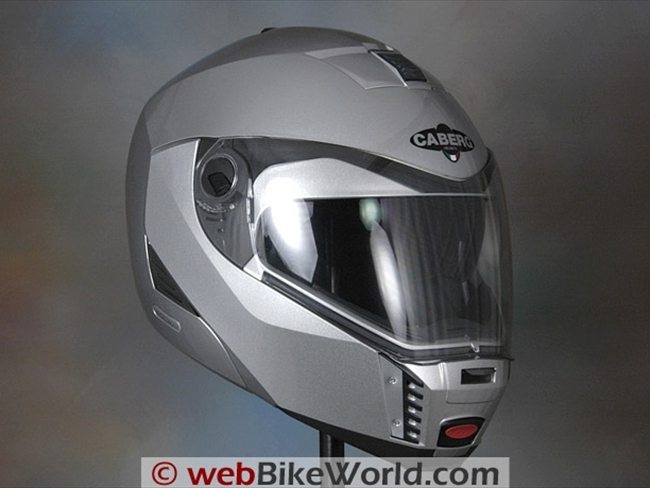
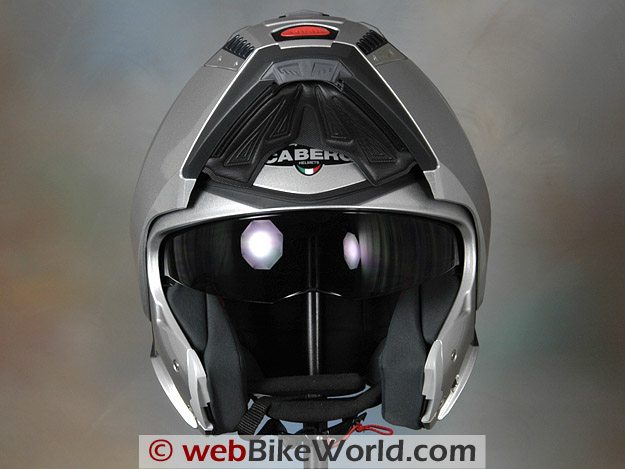
The Caberg Sintesi is comfortable and it has modern styling and many interesting features. It can be worn with the rotating visor down or up and it meets the ECE 22.05 safety standard for use in both positions. The helmet is very heavy, however, and our example also has a few minor quality issues.
Caberg is a relatively small Italian motorcycle helmet manufacturer probably best known for its stylish flip-up helmets, two of which are very popular with webBikeWorld visitors.
The Caberg Justissimo (review) is a solid helmet that’s been available for several years but is still very popular. It was considered to be a leading-edge design when it first arrived and it still feels more solid than most of the other flip-up helmets available today.
The Caberg Rhyno (aka Caberg Trip) (review) is another one of our all-time favorite flip-up helmets; it combines light weight (especially for a flip-up) and modern styling at a very reasonable price.
Now we have the Caberg Sintesi, another much-anticipated and pretty cool-looking helmet, this time from the “angles” school of design that looks more German than Italian to me.
An analogy that immediately came to me when I opened the box is the Sintesi is the Italian version of the SCHUBERTH C3 (review).
The Sintesi is sort of like the Moto Guzzi Stelvio (review) compared to the BMW R1200GS (info); that is, it has more style and although it may be slightly more off-beat, it’s a worthy and more passionate competitor.
Our Italian friends say that “Sintesi” is an Italian word meaning “synthesis”. They also told us that Sintesi is pronounced SEEN-tee-zee. We hope we got it right in the video!
It’s an apt name for a helmet that was designed to be used with the rotating visor in either the closed and locked position or with the visor rotated all the way up, where it snaps into place to keep it from closing.
This capability makes it a good candidate for touring. The Sintesi has many other interesting features, so let’s take a look…
Caberg Sintesi Paint, Graphics and Overall Quality
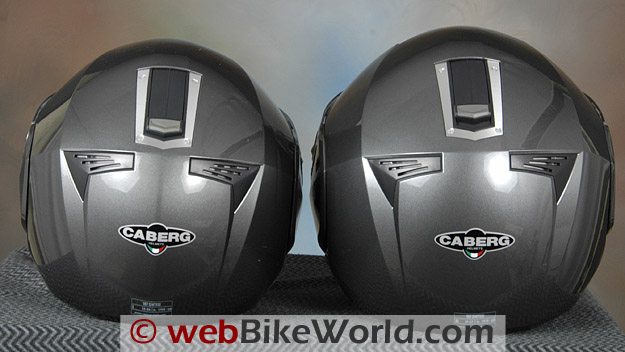
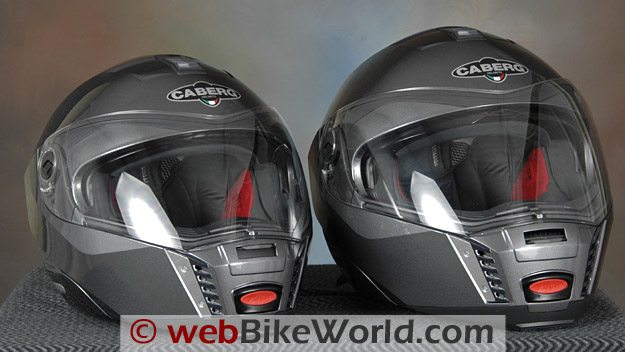
The Sintesi is currently available in what’s become the “standard” flip-up muted color palette: Silver, Metallic Black, White, Matte Black and Gunmetal.
The paint on this Silver version is very nicely applied, with tiny but thick metalflake mixed in and a decent clear coat that gives the surface a quality feel.
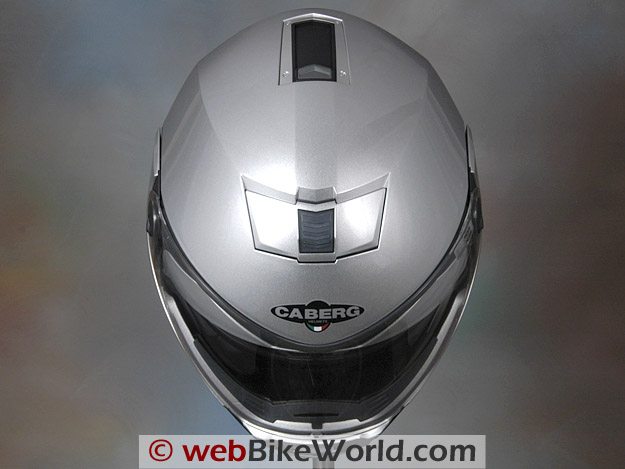
We like the Caberg decal also, which is understated and adds just a touch of flair, with the Italian flag colors peeking out from underneath.
All of the moving parts on this example work well and are solid enough; however, a couple of quality issues were apparent right from the start.
Besides the louder than normal creaking sounds that are all too common in flip-up helmets, the rubber breath guard is loose, as is the backing that holds it and which also serves as the inside lining of the chin guard.
Also, the large chin curtain underneath is loose, so it must be tucked in behind the outer shell on just about every ride.
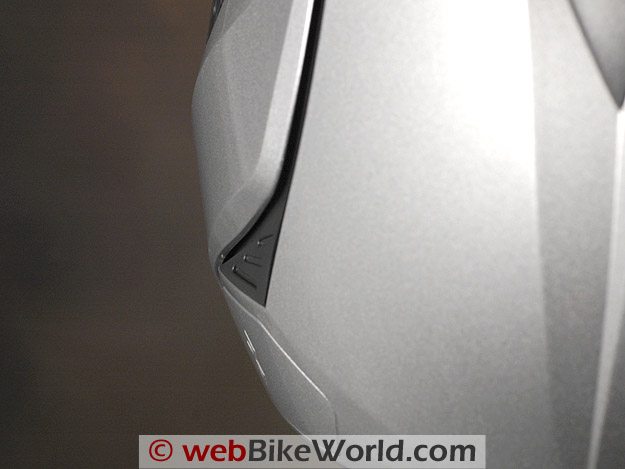
The side plates that form the rear edges of the rotating visor also have more play and a larger gap than expected and this may be causing some of the noise issues we encountered, which I’ll describe in a later section.
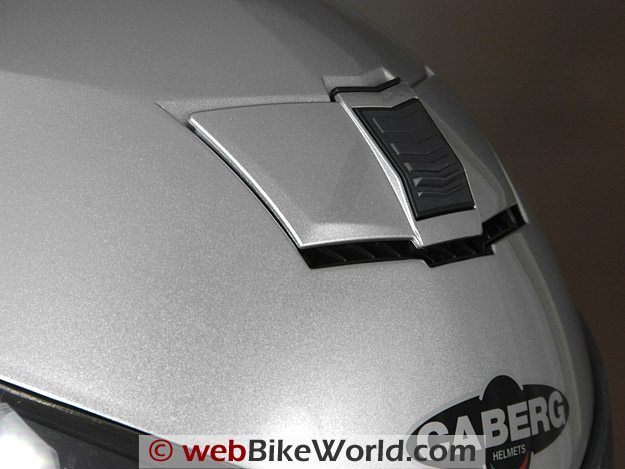
Some loose threads here and there in the liner are also apparent. The top vent assembly also has too much lateral play (see the video below), although this seems to be caused more by the design than from a fault in quality.
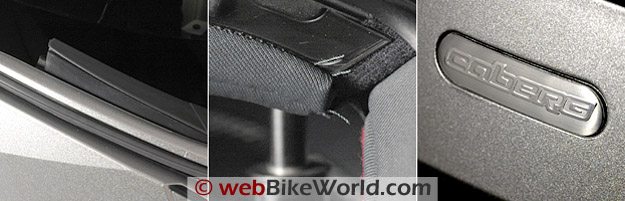
Caberg Sintesi quality issues (L to R): Loose breath guard; loose threads; glue and mis-aligned name plate.None of these issues are deal-breakers, and in general the helmet feels fairly solid (as it should, considering the weight).
But it’s as if the quality is only 90% there and if Caberg would tighten up some of the design and manufacturing standards, they should easily be able to push that last 9.999% that can make a big difference.
The Sintesi isn’t an inexpensive helmet either; it lists for �229.99, which is about $378.00 USD or 264.00 EUR at current exchange rates.
Score: When all is tallied up, I’ll give the Caberg Sintesi a “Very Good” rating for overall quality. See the Summary Table at the end of this page for a description of our rating system.
Helmet Fit, Comfort and Internal Shape
The Sintesi has a comfortably generous fit I’d characterize as just to the round side of neutral, so I’ll classify it as a “Slightly Round” shape in the webBikeWorld helmet fit system.
It should fit a majority of head shapes (see our chart that lists the helmet weights of webBikeWorld reviewed helmets by shape on our new Motorcycle Helmet Shapes page).
The size XL shown here fits just as expected, so we can assume that all sizes run true. My feeling is that the size XL will fit a 61-62 head size, which is correct for a size XL.
The shell used in the size XL seems huge; it gives even large-headed riders like me the dreaded “fish bowl” effect (i.e., tiny head in a too-big helmet).
The upside is that the Sintesi, unlike the Justissimo, has plenty of front/back headroom, including lots of room in the chin bar area.
As far as I know, Caberg only makes the Sintesi in sizes XS to XL, but let’s hope there’s a smaller shell size for the smaller head sizes, or owners will look like they’re wearing a beach ball.

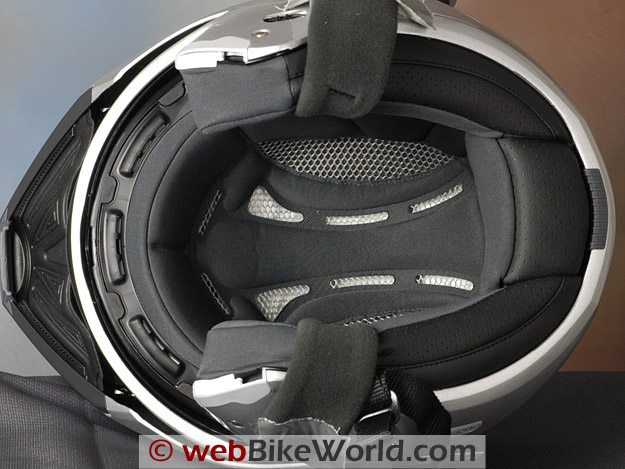
The removable liner is very comfortable and the padding feels thick, with no hard edges poking through. The only place where the padding does feel slightly thin is up around the temples, but it doesn’t seem uncomfortable in that area nor have I experienced any problems when I’m wearing the helmet.
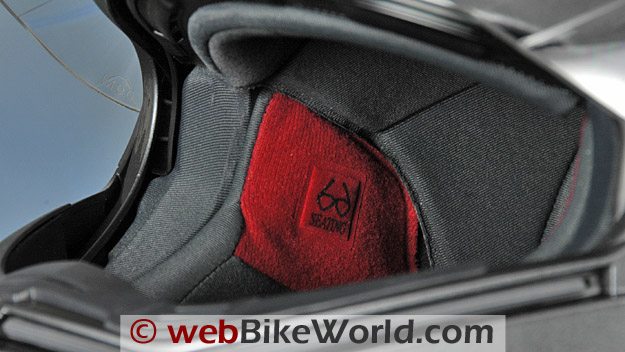
I assume this means the red fabric or that section is designed to accommodate eyeglasses, and my wire-framed eyeglasses and sunglasses fit inside the helmet, but I don’t really notice that the Sintesi deals with eyeglasses any better or worse than any other flip-up helmet.
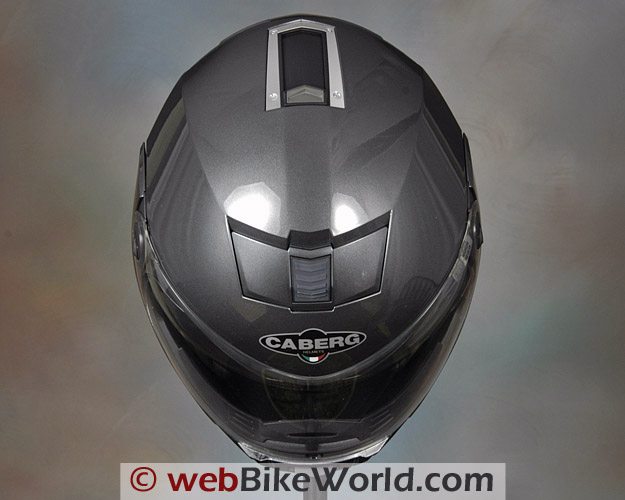
The upper part of the lining has some mesh sections running fore and aft, but I don’t see a direct air vent through the EPS liner, although there are 4 indirect vent holes located in a radial fashion around the crown.
Score: I’ll give the Caberg Sintesi an “Excellent” for overall comfort and fit.
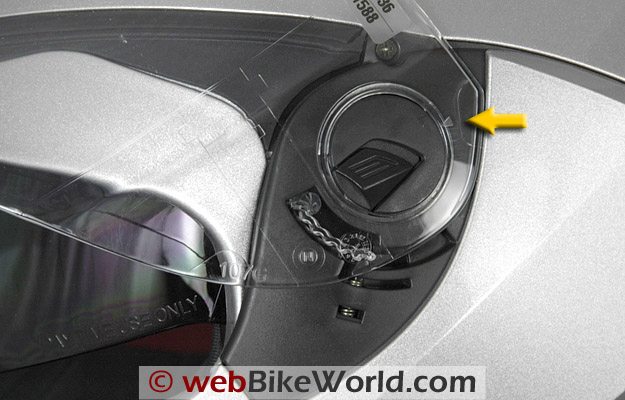
Line up the arrows on the face shield and the round black release to remove the face shield.Caberg Sintesi Face Shield
One of the most noticeable features of the Sintesi — besides its angular styling — is the large face shield that also covers a portion of the brow and is sealed by a thick gasket that also adds a bit of design accent along the top.
With such a large face shield, you may think the visibility out the front of the helmet is excellent, but the edgy styling interferes slightly here, and the angled sides of the chin bar serve to limit the side vision, or at least limit it more than what I’d consider average.
Also, due to what seems like a very large shell size for an XL, my head feels like it’s sitting farther back inside the helmet than normal, so the outer edges of the eye port limit my outward vision along the top, sides and bottom.
I’ve become used to it, after a fashion, but I do think the helmet’s design will interfere with outward visibility for some.
The face shield has a small central snap to lock it in place when it’s closed, and it has small lifting tabs on either side; both are nice features.
The face shield lifts through 5 detents and overall it feels sturdy and non-flexible; not as firm as some, but better than average, in my opinion. The removal mechanism is slightly fussy, but acceptable.
It’s yet another new design; this time, the small arrows etched on the face shield must be lined up with the arrows on the black release.
Note that the face shield can only be removed when it is in the second-to-last notch, rather than all the way raised. This is apparently designed to keep the face shield from coming loose if it is in the uppermost raised position.
Once the arrows are lined up, push upwards on the spring-loaded button and the face shield should come off. Replacing it is a bit more difficult, as the small tabs molded into the clear face shield plastic have to be placed under the round release button.
Be careful with these — we’ve seen systems like this before (e.g., on a KBC helmet) where the little plastic tabs are too easy to break.
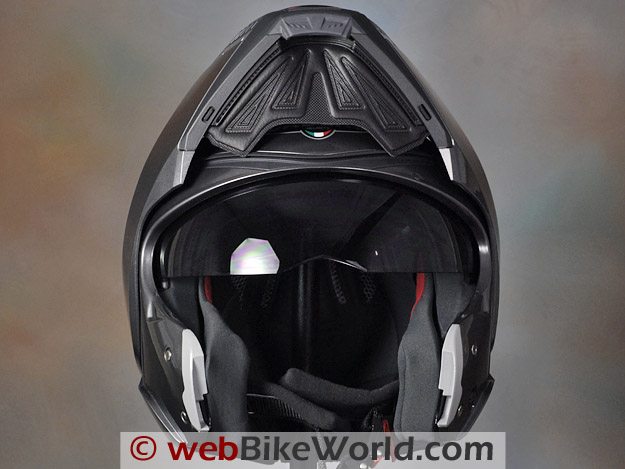
The Sintesi (Synthesis) in the Rotating Flip-up Visor
The rotating visor feels smooth and it uses metal hooks to hold it in place.
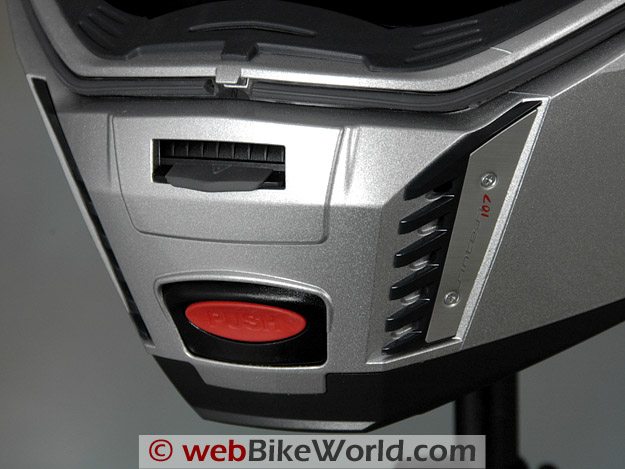
The centrally located release button has a sort of grab handle underneath, and once the visor is lifted all the way up, it locks by snapping into place in a notch when it reaches the fully raised position.
To lower the visor, it must first be pulled outwards against the spring tension, then it can be rotated downwards. When I first took the helmet out of the box, I opened the visor and then could not rotate it back down.
I thought it was broken, until I discovered that it must be pulled forward first. I read the owner’s manual twice, but didn’t catch this and I’ll have to go back and look at it again to see where this is addressed.
The reason for all this? Well, the “Synthesis” name is because the Sintesi is ECE homologated for use while riding with the visor in either the fully closed and locked position, or with the visor pushed all the way up and “locked”.
Other flip-up helmets are not designed for use with the visor in the raised position, so this is a definite Sintesi advantage.
It’s especially useful when riding behind a touring bike windscreen at lower speeds or in hot weather, where the visor can remain in the raised position. It works surprisingly well also on a motorcycle without a windscreen, as I discovered.
The large chin curtain apparently is designed to prevent lift, by blocking the air from coming through when the visor is raised. I was very skeptical at first, but it seems to work.
Internal Rotating Sun Visor
The bonus is that the internally rotating sun visor provides more and better coverage than others I’ve tried, because it is designed to also serve as the face shield when the helmet is being worn with the visor in the raised position.
This is the first flip-up or full-face helmet I’ve tried where the internal sun shade is large enough to use instead of my sunglasses. Too bad they all weren’t like this…
The internal sun visor is rotated by a large slider on the top rear of the helmet, which is a bit clumsy, but it works. The shade can also be stopped in any position, rather than the on/off spring-loaded types that I don’t care for.
Note that when the sun visor is rotated down and the helmet visor is closed and locked and the face shield is closed, the air stream coming from the chin vent gets blocked by about 50%, with half the air going up in front of the sun visor.
There’s a noticeable difference in cooling capability when the sun visor is rotated down, which is somewhat of a curiosity.
The clear face shield and the internal sun shade both seem to have excellent optical qualities.
Score: I’ll give the design, the face shield and the internal sun shade all a score of “Outstanding”, albeit with the recognition that the design of the Sintesi helmet shell seems to limit outward vision slightly.
Caberg Sintesi Ventilation and Air Flow
One of these days, some manufacturer will get it right and combine excellent controllable air flow with low noise levels.
Air flow seems to be a particular problem with flip-up helmets in general, and unfortunately the Sintesi doesn’t break any new ground here either.
The large chin curtain — which, by the way, is so large that it rests against my neck, making it slightly uncomfortable — keeps the air from flowing up underneath the front of the helmet, which is where most of the fresh air seems to come from in helmets anyway.
The small chin vent and side openings direct the air through a very small and narrow opening just at the top of the rubber backing for the chin bar.
When the internal sun visor is not lowered (see note in the visor discussion in the previous section), some air can be felt on the rider’s face, so the system does work, but could be better.
The top vent, however, is a very small horizontal slit covered by a very large slider. I couldn’t find any direct venting holes through the EPS in back of the top vent, and what air comes through isn’t directly felt.
In 80 degree F (~27 C) weather, the best I can say is that while I’ve felt warmer helmets, it’s just too bad that the top vent, which appears to be large in size with its big slider, isn’t more efficient.
The Sintesi has a pair of always-open rear exhaust vents, which hopefully are adding (or subtracting) something by drawing the air out the back in the region of low pressure.
The large clear face shield can be opened a notch for defogging or ventilation.
But the shape of the face shield and the helmet somehow forces the air right into my nose and eyes (when I’m riding on a motorcycle without a windscreen), so this position doesn’t work for me in anything other than low-speed riding.
Score: Overall, I’d have to rate the air flow in the Sintesi as “Poor” on top and “Good” from the chin vent.
Noise Control
The Sintesi promises SCHUBERTH C3-like noise control, and it delivers in all respects except one.
The helmet has low noise levels from the vents and visor, but it has what I consider to be an elevated level of wind rushing noise at or below the ears.
Whether it is the loose gap in the side plates or the angle where the sides of the rotating visor are raised against the back of the helmet (photo above), or perhaps the design of the neck roll in back, the helmet just seems to have a continuous volume of wind rushing noise which comes from just below and behind my ears.
In most cases, it’s fairly easy to isolate the source of helmet noise, whether it’s from a vent or a gap in the liner, by covering different areas with the hand when riding.
But I’ve tried blocking the padding around the liner in back of the Sintesi, which helps some, but I just can’t seem to find the main cause of this noise, so I’ll have to figure it’s caused by the overall design of the helmet.
What’s also strange is that the noise level seems to be the same at most road speeds and while riding a variety of different motorcycles, with or without windscreens or fairings.
It’s too bad, because I think otherwise the Sintesi would be a fairly quiet helmet, with the large eye port gasket doing a good job at sealing the face shield, and the rest of the design promising efficient air flow.
Note that our helmet evaluations are a combined effort of several riders over time on different types of motorcycles with and without windscreens.
Evaluators wear correctly fitted, high quality ear plugs (even when evaluating motorcycle intercom systems).
Always protect your hearing when riding a motorcycle. See the wBW Earplug Reviews for more information on choosing and wearing earplugs.
Note also that perceived noise levels will vary, depending on the individual.
Noise can be caused by many factors, including helmet fit, the type of motorcycle and windscreen, wind speed and direction and even the rider’s clothing.
For more information on helmet noise, visit the wBW Motorcycle Helmet Noise page.
Score: I’ll give the Sintesi a “Good” score for noise control, which would probably raise to Excellent if only the side noise was more controlled.
Helmet Weight
This Sintesi in size XL weighs in at a massive 2,034 grams, or 4 lbs., 7-3/4 oz.
Just as an aside, the weight of this helmet is such that it raised the average of the 119 helmets reviewed prior to this by 3.2 grams and the median by 1.5 grams.
That may not seem like much, but when you’re talking about 120 helmets and that amount of weight effect on the average and median, it’s significant.
The weight of the Sintesi is basically unacceptable in my book.
Although some of the mass disappears when riding (much like the mass of a diving bell is less apparent when it’s submerged), this is the first helmet I’ve ever worn that actually gives me a neck muscle ache after about 45 minutes or so. I’ve heard about this happening before with other riders, but it’s a first for me.

The weight is complicated by the sheer size of the helmet. When I turn my head, I can literally feel the entire thing swinging back and forth with a lot of momentum that then takes what I think is significant muscle power to control, thus the sore muscles I suppose.
For comparison purposes, see the wBW Motorcycle Helmet Weights page for a listing of all of the helmets we’ve reviewed along with their weight and internal shape. The Sintesi is #120 out of 120, not something to be proud of.
Of course, unfortunately all of the heaviest helmets we’ve reviewed are flip-ups, holding 16 of the last spots in terms of weight. And it doesn’t seem to be getting any better, despite modern materials and technology. It seems that each flip-up is heavier than the one before.
For those of you who don’t think helmet weight is a problem, wear, say, an Akuma Phantom II or even Caberg’s own Trip and then put on the Sintesi.
Weight makes a huge difference in comfort and reduced fatigue. Sorry, but 2 kg is a barrier that should not be crossed when it comes to motorcycle helmets.
Score: Unacceptable weight.
Miscellaneous
Note that the Caberg Sintesi is ECE approved only and is currently not sold in the U.S.
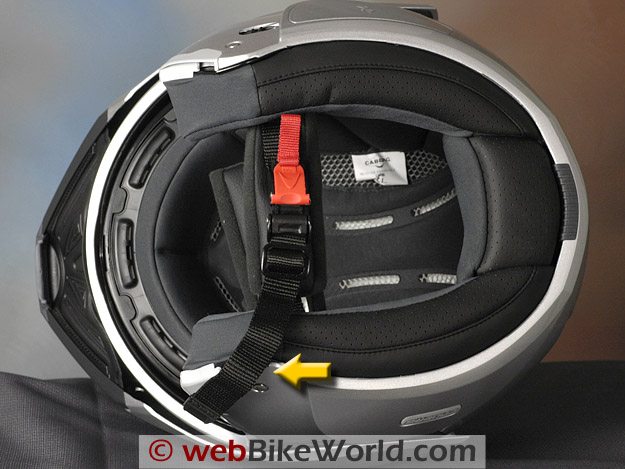
The helmet has a “quick release” chin strap, which only adds more weight (albeit not much) and complexity to the helmet.
In this design, the extra length of chin strap has nowhere to go when the strap is adjusted correctly, so it flops in the wind or must be tucked up under the rest (see photo above). It also interferes with the large chin curtain.
The padding under the chin strap is plush and thicker than normal, however.
Also, the Sintesi has a built-in door and housing for a Bluetooth intercom, along with a slightly recessed molded pattern on the inside of the chin bar padding, apparently designed to accommodate some type of Bluetooth intercom system.
Conclusion
I have mixed feelings about the Caberg Sintesi. One one hand, I like the design and some of the features; while on the other hand, the quality issues, the noise factor and certainly the weight are disappointing.
We expected more after the very nice Caberg Rhyno (Trip).
We’d like to hear from other Sintesi owners; see the comments section below.
UPDATE (December 2009): Caberg Sintesi follow-up report featuring the most recent versions of the helmet.
Owner Comments and Feedback
See details on submitting comments.
From “P.P.” (June 2015): “I bought 2 Caberg Sintesi directly from Germany to Portugal. One of the helmets was for me and one for my friend.
We both opted for this model, among other reasons, after the review made by webBikeWorld.
After a few kilometres to roll at speeds between 80-100 Km/h realized that this helmet is very, very, very noisy. Above 100-110 km / h is deafening. Unable to use headphones or any communication system.
When circled with a closed helmet, we hear a deafening wind to pass beneath the helmet. Even using earplugs is difficult circular for long periods.
Being something common to both helmets bought, with all due respect to professional analysis you did, I can not agree with your statement “The Sintesi promises SCHUBERTH C3-like noise control (…)”
From “F” (4/10): “I have recently bought a Sintesti and all in all I am very pleased with it, but have two comments.
First, about the annoying sound in the review “coming from underneath the ears”. I think I know why — I also heard that sound, clearly, from 30km/h and up, but only from underneath the left ear.
The right side was really quiet compared to all my previous helmets. I don’t have the Just Speak installed, and remembered that the space for the Bluetooth unit is….just below the left ear.
So I opened the Bluetooth box, found an empty hole, filled it with foam, and the sound disappeared! Why didn’t Caberg think of that?!
The reviewer seems to have heard the annoying sound from underneath both ears. In that case, maybe a bad example cause mine have always been quiet from the right ear side.
Second, yes the visors are anti-fog treated, but my glasses are not:) Since the helmet doesn’t let almost any air in from underneath the chin, or any other places, they get foggy when I’m riding below 50km/h.
The easy solution is to take away the chin-guard, but since the interior of the helmet feels really comfortable, and the chin-guard really blocks the chilly wind from coming in when riding in cold temperatures, I’ll try to find another solution.
All in all, the best helmet I have owned. Really pleased with how all the controls work (build quality and design) and that the soundproofing is really good, and not to forget, the good looks!”
From CABERG srl (10/09): “As premise I would like to say that in respect to fair information towards your numerous readers and in respect to the work done by Caberg especially during a very complicated market situation, your article is incomplete and a bit misleading; it has been omitted one of the major features that characterize the product, that is the double shell and chin guard size.
Our idea to produce (a larger) size (helmet shell) has been dictated by our intent to offer an adequate room, fitting, comfort, and maneuverability also to those riders who usually wear not only a XL but also XXL and even the XXXL. The small shell (fits the size range) from XS to L.
We do agree with you with regards to some manufacturing imprecision you highlighted, that have been already solved, but that unfortunately can often be part of the first development steps of a new and innovative project.
As far as the weight, we are aware that the large shell is penalized by it, but we are working to reduce it by a dozen grams without compromising the safety of the product.
Moreover, we think that the decision to offer two shells and two chin guards dimension match anyway fairly the weight and dimension of the helmet with the real ones of the motorcyclist.
We do strongly believe instead that it is necessary to work to offer an helmet for the small sizes that do not overcome the 1900gr.
As far as the difficulty you encountered while trying to close the chin guard, you just need to pull outwards the small grey plastic thumb-grip right below the chin without having to press also the opening red button.”
Editor’s Note: Caberg said they will be sending us updated versions of the Sintesi in size L (small shell size) and XL (large shell size) for an upcoming follow-up review.
From “P.C.” (9/09): “I have had a Sintesi for a couple of months now (I am in the UK) and would like to give you my opinion.
My helmet is a (size) large, which is the biggest size in the small shell type. I have found the fit and visibility good, and looking at your site photos, I can see why the XL would affect your vision as the large shell appears a good bit larger overall.
I have the Caberg Bluetooth kit fitted (my partner has a Sintesi as well) which works OK under about 30 mph but just about useless above that. I may get some earplugs with speakers and adapt those which should improve things.
We have been unable to get the integral radios to work at all. Have tried repeatedly but the radios don’t even sound like they are trying to find a station, all we get is a constant low hiss.
The straps on our helmets have a much shorter end, about an inch and a half past the buckle so we have not had the same problem as (you).
I have just weighed my helmet, and including the Bluetooth kit fitted, came to 4.1lb. Heavy but feels about the same to wear as my old Roof Boxer. Agree with you about the front vents and inner visor.”