

Summary
Applied to a motorcycle face shield, Raincoat repels water.
After the face shield is treated, the water will bead into tiny drops and roll off.
When riding a motorcycle, the air moving over the helmet quickly evacuates the water droplets from the face shield.
Introduction
Roll your eyes to the right-hand column on this page and you’ll see a gaggle of reviews.
They cover everything from motorcycle helmet visor cleaners to anti-fog treatments to reviews on tinted and photochromic face shields.
There’s even a report describing how motorcycle helmet face shields are manufactured.
Think that’s enough?. Hardly.. Here’s another product to add to your arsenal: Raincoat motorcycle helmet face shield water repellent.
Raincoat is a new product from MotoSolutions, the company who brought you Fogtech visor anti-fog coating (review). Raincoat is applied like a wax or polish to the outside of a visor.
Wipe it on, let it dry, buff it off. The coating is hydrophobic; that is, resistant to wetting, so any water that hits the visor forms little tiny beads and rolls off. Add a little wind blowing across the visor and the little droplets quickly to disappear.
In comparison, the water on an untreated visor seems like it “sticks” to the visor in larger drops or sheets.
On a visor treated with Raincoat, the water doesn’t veer away like the visor had some kind of ion anti-matter protection barrier — depending on conditions, a few drops may stick here and there, but compared to an untreated visor, the effect is pretty dramatic.
Raincoat Water Repellant Coating
MotoSolutions has been working on the Raincoat formula for several years; I know this because they would occasionally send me a sample for an opinion. I’d get a sample and try it and then I wouldn’t hear anything for several months; then another sample, and another..
You’d think it would be easy, but apparently not.
“What about Rain-X?”, you might ask — and I did too. But apparently Rain-X is designed to be used on glass only, not polycarbonate motorcycle helmet visors.
Raincoat is just the opposite: it’s specifically designed for use on polycarbonate motorcycle visors and goggles, not glass. In fact, MotoSolutions says that Raincoat will not work on glass.
We usually try to take photographs or video to illustrate the products we review on webBikeWorld, but Raincoat poses some unique recording difficulties.
Treat a visor and drip some water on it and the effect is apparent, but how to capture that effect on film?. UPDATE:. See video in Comments section below.
Dripping water on the visor through a pipette in the kitchen doesn’t really do justice to the product and doesn’t really illustrate the effect.
Burn, who is Mr. Video, couldn’t quite work out how to capture it when we’re riding.
After some head-scratching, we thought we’d wait until a rainy day, then hold the helmet out the back window of a car while someone took the video out the front window and third person drove.
Well, you can imagine trying to get three willing and able people coordinated and ready to go at a moment’s notice whenever the “perfect” rainstorm swept by.. We just couldn’t get it done.
Finally, I threw on the helmet and took off on one of the wildest, rainiest Spring days I’ve ever seen to check it out for myself. So this will be a subjective analysis; i.e., you’ll have to take my word for it!
Raincoat seems to me to be the motorcyclist’s equivalent of Rain-X, the automotive glass water repellent product. I’ve been a Rain-X user for many years; after I wash and dry the car, I apply it to the side and rear windows and the mirrors.
After an application, the water beads up and rolls off very nicely and, I think, provides better visibility.
I have tried it on the windshield of the car, but I’ve learned that it doesn’t last as long, because the wipers will eventually rub the treatment off and the rubber wiper blades will stick and chatter until all of the Rain-X is completely gone.
However, it works great while it lasts.
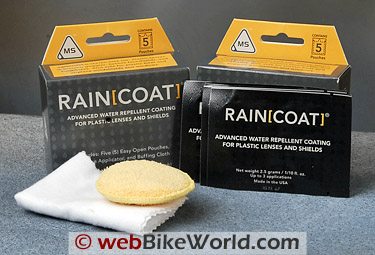
Raincoat comes in a box with 5 packets; each packet will treat three visors.
It comes with a soft polishing cloth and a microfiber applicator, although the instructions are specific about not using microfiber with Raincoat.
They read: “Important: Do not buff the coating with any microfiber cloth or the included microfiber sponge. Microfiber materials may remove the Raincoat. Buff with only a soft cotton cloth for best results.”.
Hmmm..so why is a microfiber applicator included?. And is the cloth cotton?. I assume so.. UPDATE:. See the Comments section below for the explanation.
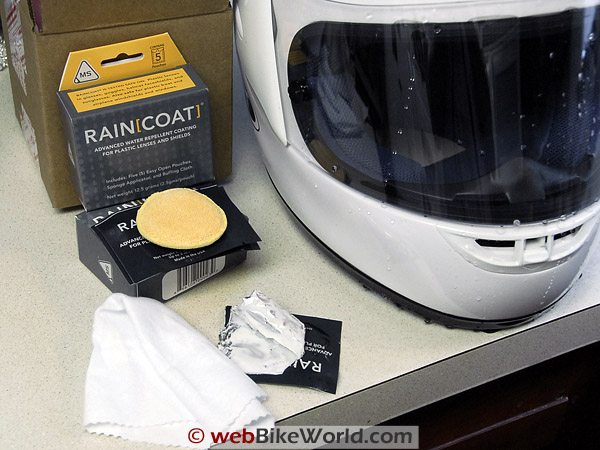
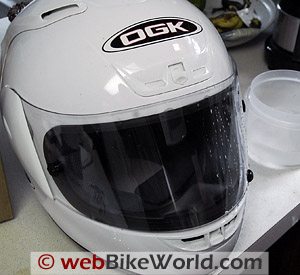
It was nearly impossible to take photos of the Raincoat effect in the “lab” (i.e., kitchen), but here are a few that I hope illustrates the process.
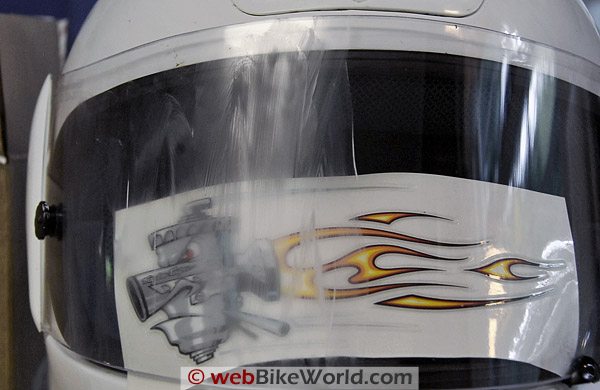
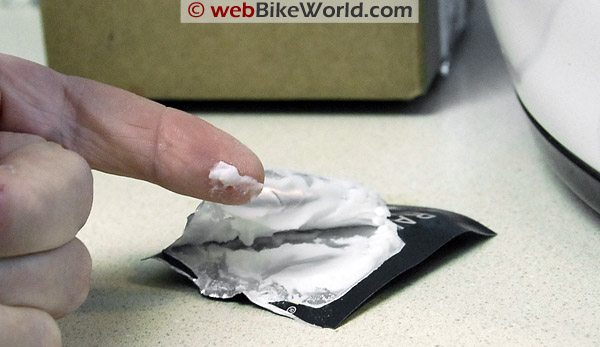
The right side of the visor (the side nearest to the Raincoat box in this photo) was treated with Raincoat. The water drops can be seen sticking to the untreated side of the visor on the far right, with just a few drops on the treated half. Note that dripping water on the treated visor with a pipette doesn’t really represent the way raindrops hit the visor in nature, so this isn’t really a good representation of how the product works. Raincoat is a soft white paste, much like toothpaste. One packet treats three visors, but once the packet is opened, all of the contents must be used. I’m not sure why it doesn’t come in a bottle, or a screw-top jar, or individual squeeze packets. If you’re not treating three visors, 2/3 of the packet is wasted. UPDATE:. See theComments section below for the explanation. Raincoat is applied in a thin layer (left) like a polish or wax. It takes 3-5 minutes to dry and then it can be buffed with a clean, soft, cotton cloth.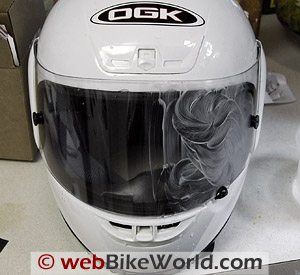
I happen to know from using some of the prototype Raincoat treatment that several different carriers were tried. I’m assuming there is a scientific reason why the final version was packaged in 2.5 gram foil packets.
It’s too bad it couldn’t be packaged either in, say, 1 gram, single-use packets or in a bottle. The leftover Raincoat dries up into a powder when the packet is left open; I’m not sure if it can be reconstituted with water.
Conclusion
Raincoat definitely works to repel most water from polycarbonate motorcycle helmet visors and other plastic visors and goggles.
The effect is very noticeable when riding in the rain, where the water simply beads up and rolls off the visor, greatly assisted by air moving over the visor.
MotoSolutions claims that Raincoat can also help keep the visor clean because water drops that may contain dust or dirt don’t stick to the visor.
It doesn’t seem to have any effect on bugs sticking to the visor initially, but it does seem easier to clean the visor afterwards. I use lukewarm tap water to clean the visor by simply rubbing the water on the visor with my fingers.
I think the product might not be something that would be required for every day use, but I definitely plan on keeping a couple of packets under the seat to have on hand in case of rain.
| wBW Review: Raincoat Face Shield Water Repellent | |
|---|---|
| Manufacturer: MotoSolutions | List Price (2008): $6.00 for one box of five 2.5 gram packets. |
| Colors: N/A | Made In: Unknown |
| Review Date: April 20081 | |
Owner Comments and Feedback
See details on submitting comments.
From “S.G.” (10/08):. “I ride with a full fairing with a tall windshield and look thru it rather than over. When it rains, the drops collect on the windshield and create a safety hazard.
I have been a longtime RainX user, and was very interested in a product that would work the same way with plastic.
When I read your review I immediately ordered some online. When I received it I immediately applied it to my visor and windscreen.
I have mixed feelings about this product. First, it truly does work as advertised.
After a proper application, water just falls off as though it was magnetically repelled away from the windshield. What else can I say, in that aspect it truly shines.
However, the application is not easy, and it doesn’t last very long. It goes on like any other automotive wax product; rub on with applicator, dry to a haze, buff until clear.
The problem lies in the buffing step. The haze is not easy to buff out. I had to use an undue amount of force and vigorous scrubbing to remove the haze.
The good news is that in the process I didn’t pick up any grit or anything and grind it into the plastic. Perhaps if I started with a smaller section of the windshield it would have been easier to buff out.
Anyway, after buffing, I noticed a lot of streaking. Imagine a thin layer of petroleum jelly rubbed onto plate glass. Turning the cloth often and using long, light passes, I was able to eliminate them, or so I thought.
The next day, I took her out for a ride, and the sunshine revealed every swirl and motion I had made with the buffing cloth. I found myself staring at the pretty swirly marks instead of the road. Back to the garage to straighten them out.
Seeing as the window was still clean, I grabbed a clean, soft cloth and rubbed the coating lightly and briskly not stopping in the middle. This helped tremendously.
A couple days later, I got into a light rain on my commute and was pleased to see the raindrops falling off like little marbles. A few more days and it was time to clean the bugs off.
This is where I met stage two of the swirl monster.
I only used warm water and a soft cloth, and the bugs came off really easily. However, the water seemed to re-activate the raincoat, and I had a whole new canvas of streaky swirls.
Using the itty-bitty cloth they provided me seemed to worsen the situation, because the cloth was still holding a lot of the oily/waxy coating from when I first applied it.
The next time I cleaned the windshield I used a regular plastic-safe window cleaner and didn’t have the swirling, but it also seemed to remove what was left of the waterproofing.
Thru the whole process, I didn’t notice any of the swirling on my visor, maybe because it sits so close to my face, or maybe I did a better job of rubbing it out.
I’m sure I will use this product again on my visor, but maybe there’s a better solution for the windshield.
My conclusion is that when used sparingly, this is a wonderful product, but it’s maybe too much work to apply every time, just in case you get caught in the rain.”
Follow-up From “S.G.” (11/08): .”I took your suggestion and contacted Motosolutions about my issues with the Raincoat product. Gene was friendly and helpful, and his response is (below).

I followed his instructions precisely and had a much much better result. There is almost no swirling now. The key is diluting the paste and applying as thin of a coating as possible. I had way, WAY too much product on last time.
I’m used to wax products where if you put too much on, it’ll just buff off anyway and look just the same. Not so with this product. Less is more.
I actually soaked the sponge first, then applied a pea sized dab to it and sort of smeared it around the sponge with my thumb before squeezing out the excess water and applying to the shield.
It went on flawlessly this time. I also used a giant cotton cloth (not the teeny one that comes with the product) to buff it off so it wouldn’t get filled with product. It rubbed off really nicely as well.
I have a new respect for this product.”
Response from MotoSolutions to S.G.:. “Thank you for writing and the feedback. I may be able to help.
I have changed instructions to make sure you apply a thin, thin coating.
The new instructions call for you to dampen the applicator cloth or sponge, then apply the product thinly to the shield. One of those pouches will do a windshield several times.
I would start with a large pea sized amount onto a very damp sponge (The water in the sponge makes the coating thinner). Do maybe half the shield with that. Buff, then do the other half.
The product will then dry very quickly. Use a large clean cotton towel to buff off after it dries in perhaps 1 to 2 minutes. Turn the towel often.”
Feedback From MotoSolutions
1. Why that packet and not a bottle?
The carrier in Raincoat is combustible which makes it difficult to ship. By packaging in small sealed packets, Raincoat fits into exceptions to the rules. That lowers shipping costs immensely.
2. Resealing a packet.
The packet in Raincoat will be modified soon to include a longer spout. Currently the spout is only ½ inch and you don’t always tear across it. With the new pouch the spout will be about 1 inch long and tearing straight across will be easy.
You will be able to squeeze the product out the spout then fold and clip the spout to reseal.
This is important as I am finding that a pea sized glob is all it takes to cover a face shield. It also appears that moistening the applicator first with water allows for a thinner and more even coating, so you may see that instruction change too.
This means that you should be able to get 10 or more face shield applications out of a single packet which makes it very cost effective.
3. Microfiber buffing.
Some microfiber cloths can remove much of the Raincoat. I bought those sponges from China and a microfiber cover seemed like a good idea. The sponge should only be used for applying product then cotton used to buff.
But some people were using the sponge to buff. The next batch of sponges will be cotton covered.
4. Bug cleaning.
You are exactly right here. I have about half a dozen reports that bugs are easier to remove with Raincoat.
(I suspect that you will get less bug guts sticking too, but I can’t prove it). Also, I have many reports that their shields stay cleaner from road grime or salt spray.
5. Video of drops is difficult.
The action is more easily seen on a dark visor with a diffuse light source to reduce reflections. I have a video on my website that shows the effects on a dark Arai shield quite well.