

Ducati Announces the New RR
The Ducati Desmosedici RR production prototype was launched at Mugello on the eve of the Italian Grand Prix.
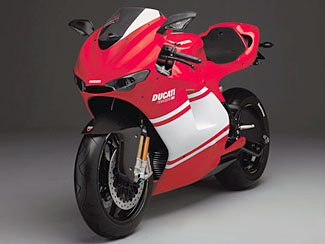
Available starting in July 2007, this MotoGP replica motorcycle can be reserved through your local Ducati dealer!
UPDATE: December 15, 2007 – Ducati has announced that the entire production run of 1,500 Desmosedici RR’s is now sold out!
Every single one of the 1500 Ducati Desmosedici RR bikes, the first true MotoGP replica which the Borgo Panigale manufacturer decided to produce in a limited number, has been sold.
Since the official presentation in June 2006, hundreds of requests have poured in, proving the success of this bike from the beginning. Today, the Ducati Desmosedici RR, whose production began a few weeks ago, is ready to be delivered to the first clients who will receive their motorcycles in January 2008.
Ducati Desmosedici RR: The Ultimate Ducati Experience
Ducati has chosen the magical atmosphere of the Italian Grand Prix at Mugello to launch the Desmosedici RR production prototype.
The dream of a true GP replica has finally come true and the Desmosedici RR will be the first-ever road-going motorcycle to offer such a stunning wealth of performance and technology that comes directly from Ducati’s experience in MotoGP.
The RR derives from the Ducati Corse Grand Prix racing Desmosedici GP6, the same bike with which Loris Capirossi and Sete Gibernau are competing with in the 2006 MotoGP World Championship.
The Mugello launch is the perfect occasion to reveal the shape and the technical characteristics with which the bike will go to market, confirming the high technological features of this exclusive and esoteric machine.
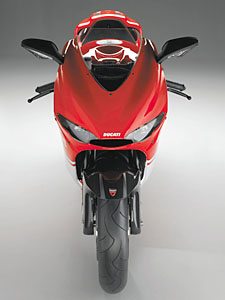
The body design and the aerodynamics faithfully reflect the Desmosedici GP6. The color scheme, the fittings, the materials used in its construction as well as the technical features of the powerful four-cylinder desmodromic engine built by the Borgo Panigale factory engineers, leave no doubts whatsoever: the Desmosedici RR is the ultimate expression of the most extreme MotoGP racing machine today.
The project is currently in the industrialization phase and, as previously announced, it will be a limited edition motorcycle, with approximately 400 bikes being produced a year. The RR is scheduled to arrive in the market in July 2007, while from June 2nd 2006 it will be possible to reserve the bike through the official Ducati dealer network, with Ducati 999R owners receiving priority.
This is the new frontier of Ducati technological evolution, a dream come true, demonstrating once again the courage and the passion of Ducati, as well as the ability to transfer the experience of the racing world to a machine that is destined for road use.
Federico Minoli – Chairman and Managing Director of Ducati Motor Holding – and Claudio Domenicali – Product Director of Ducati Motor and Managing Director of Ducati Corse – together with Ducati Corse riders Loris Capirossi, Sete Gibernau and Vittoriano Guareschi were at Mugello to unveil Ducati’s latest jewel of technology.
“This is an important moment for us, another dream come true. Producing the Desmosedici RR means offering the ultimate expression of Ducati technology, while remaining faithful to the tradition of every one of our road and racing bikes,” declared Federico Minoli.
“It is a challenge that we wanted to accept and although relatively few bikes will be made, the RR will be a true object of desire for all Ducatisti. It will be the ultimate Ducati experience, one that best exemplifies the passion and the ingenuity for which we are famous. Meanwhile the twin-cylinder remains and will continue to remain Ducati’s traditional engine, having equipped all of our production models in the past and equipping them in the future.”
“The Desmosedici RR is a true Grand Prix replica,” commented Claudio Domenicali. “The technological level of this bike is extraordinarily high and for the first time ever all the authentic performance and technology of the ultimate MotoGP racing machine have been transferred to a road-going motorcycle.”
“Over 200 hp of power for a bike that features exclusive components and quality materials, destined to become the new point of reference for production motorcycles. There couldn’t have been a better place than Mugello for the unveiling of this new bike and who better to take the wraps off it than Loris, Sete and Vittoriano, because this bike is also their bike and all of their experience has gone into developing this road-going motorcycle.”
Engine
The Ducati Desmosedici RR features advanced technology and aerodynamics that are derived from the GP6 currently being raced in the 2006 MotoGP World Championship.
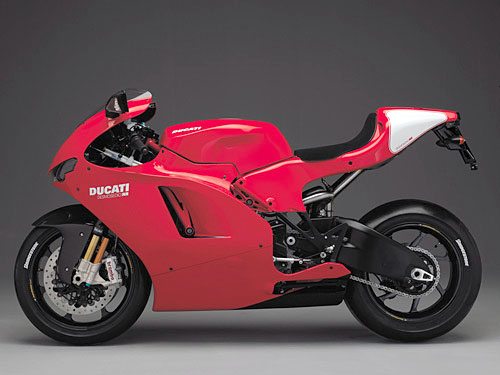
The engine of the Desmosedici RR accurately reflects that of the MotoGP bike: Ducati’s traditional desmodromic distribution, guaranteeing precise valve control up to the highest revs, is perfectly matched to the 989 cc four-cylinder ‘L’ layout, with four titanium valves per cylinder, in asymmetrical Twin Pulse configuration, producing a masterwork of precision engineering.
The double overhead cams are gear driven, a sophisticated and reliable solution that enables precise valve timing in all conditions. This authentic copy of the Grand Prix engine is completed by a six-speed transmission, which retains its ‘racing’ characteristic by being cassette type, and a hydraulically actuated dry multi-plate slipper clutch.
The aim of producing a light but robust engine has led not only to an unrivalled quality component design but also the use of exclusive racing-derived materials: sand-cast, aluminium crankcase and cylinder heads, titanium connecting rods and valves, sand-cast magnesium engine covers.
Four 50 mm Magneti Marelli throttle bodies are present, with 12-hole ‘microjet’ injectors. For sophisticated management of the powerful four-cylinder engine a Magneti Marelli 5SM ECU and high-speed CAN line electronics have been used.
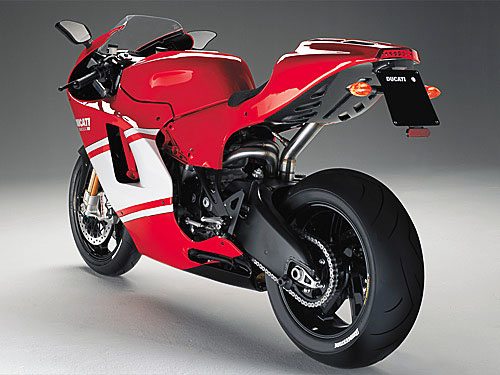
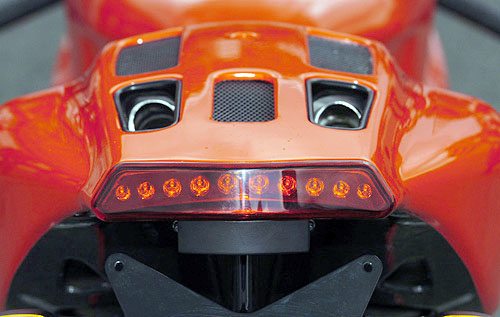
An all-time ‘first’ comes with the use of a ‘4 into 2 into 1’ exhaust, with “vertical exit” silencer, hidden in the tail cover. These are all benchmark performance features for a MotoGP replica bike, which is capable of delivering more than 200 hp of power with the 102 dB racing silencer and dedicated CPU race kit. Amazingly the Desmosedici RR with its catalytic oxygen sensor exhaust, homologated for road use, fully complies with Euro3 emissions regulations.
Chassis
The engine clearly represents the beating heart of this fantastic motorcycle, but the technological advancements also extend to the chassis: a signature tubular trellis hybrid frame, refined components, and a superb carbon fiber body. This is a motorcycle that is destined for an expert rider, someone who is always looking for extreme sporting performance, as well as being an exclusive, esoteric, reliable product that is more than capable of track racing.
The colour scheme of the Desmosedici RR was the work of Alan Jenkins, the designer and one of the men behind the Desmosedici MotoGP, who was also responsible for the aerodynamics package which is aimed at achieving maximum speed and excellent handling.
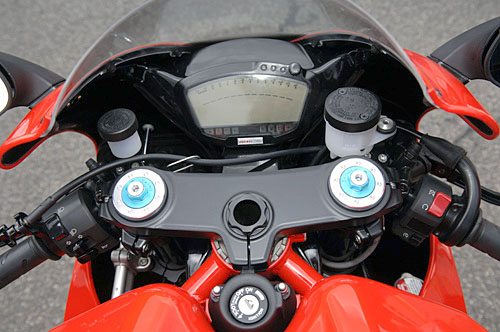
The bike is totally inspired by the racing machine, the Ducati Desmosedici GP6, from which it inherits all the aggressiveness of its lines. It is fitted with a new lightweight multifunction dashboard, developed in collaboration with Ducati Corse, the same one that will be fitted to next year’s racing machine, the Desmosedici GP7.
The bike’s development could not have been made possible without the significant collaboration of Vittoriano Guareschi, the official Ducati Corse tester, whose riding abilities and hundreds of hours of track time have made a fundamental contribution to the evolution of the project.
For the first time the Ducati Desmosedici RR uses a new welded tubular steel trellis hybrid frame (ALS 450) with the frame geometry that is the same as that of the Desmosedici GP6.
This construction guarantees an excellent stiffness to weight ratio, allowing superior maneuverability and riding precision. Attached to the red frame is the rear seat support in high temperature resin type carbon fiber. This material, normally used only on racing bikes, has the characteristic of being extremely lightweight but exceptionally rigid.
The Desmosedici RR sports a new extra-long, cast, forged and pressed aluminium alloy swingarm. The geometry and the technology of this component derive directly from the MotoGP bike, and give the RR a high level of traction control, and excellent weight distribution as well as a superb stiffness to weight ratio.
In the suspension department the Ducati Desmosedici RR features the most advanced technical components. The rear suspension geometry and layout is the same as that of the GP6, with the rear shock attached above the swingarm and to a rocker, which is hinged to the crankcase.
The front suspension features 43 mm upside-down Öhlins FG353 pressurized forks (PFF), with TiN coated sliders. The forks, which come directly from competition use, as well as being pressurized thus ensuring excellent track performance, are fully adjustable in preload, rebound and compression.
The rear shock is also Öhlins and has rebound, low/high speed compression adjustment and hydraulic preload adjustment.
For the first time ever, this Ducati production motorcycle features Marchesini forged and machined magnesium alloy wheels, with 7 spoke design as on the GP6. This helps to reduce unsprung weight and inertia, all the while improving handling and suspension response.
With the aim of producing the ultimate track performance, Ducati in collaboration with Bridgestone is developing special tyres for the Desmosedici RR. The tread pattern, construction and profile are being specially developed and produced by the Japanese tire manufacturer.
The numerous racing components of this high-performance machine also include its Brembo brakes. Up front the Desmosedici RR features a new pair of radial ‘monoblock’ calipers with four 34 mm pistons: monoblock technology, until now only used for racing calipers, allows calliper stiffness to be increased, thus improving braking response; the front brake system is completed by a radial master cylinder, with hinged lever and remote ‘quick’ adjuster.
The pair of front brake discs are the same as those used on the GP6 in its wet weather race set-up: two semi-floating 320 mm x 6 mm discs, with machined flange. The Brembo rear brakes are made up of a 240 mm fixed disc and a floating caliper with two 34 mm pistons.
The Desmosedici RR will be available with a special race kit that includes a 102 dB racing exhaust, a dedicated CPU, bike cover, paddock stand.
For this exclusive Ducati, a new dedicated service plan is included. Each Ducati Desmosedici RR owner can benefit with a three-year warranty and three years of scheduled maintenance, free of charge.
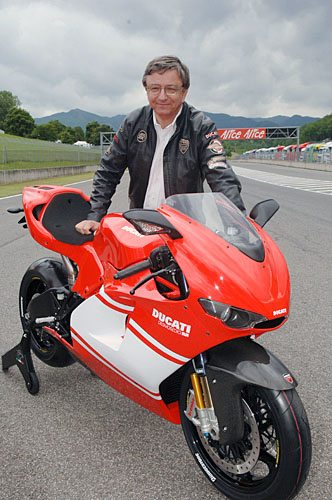
Two versions of the RR will be available: 1) the Desmosedici RR – painted in ‘Rosso GP’, with a white number plate on the tail section; 2) the Desmosedici RR ‘Team Version’ – painted in ‘Rosso GP’, and as with the factory Corse bikes, has a broad white stripe on the fairing.
A team sponsor decal kit will be provided with each bike.
The Ducati RR: Background
Without a shadow of doubt, courage, ambition, pride, ingenuity and heritage all form the basis of the Ducati Desmosedici project. This important venture has simultaneously marked the return of Ducati to the MotoGP World Championship, and enabled the company to confirm its tradition of manufacturing successful, high-performance, four-stroke racing motorcycles.
In the past Ducati racing motorcycles have been victorious at circuits throughout the world in every category of production-based racing: World Superbike, Formula 1 TT and World Supersport.
Ducati abandoned the Grand Prix racing scene at the start of the 1970s. For many years the 500 class was essentially a class for two-stroke bikes, an engineering technology that was far removed from the four-stroke road-going machines sold by Ducati. The technical rules changed in 2002, giving priority to four-stroke machinery and turning the 500 class of World Road Racing into the MotoGP Championship. This convinced Ducati to make a much-awaited return to the track in the new MotoGP class.
The 2002 Italian GP at Mugello was the venue for the unveiling of the Desmosedici, the bike that was to make its official MotoGP racing debut at the start of the following season.
2003 would see the Italian manufacturer make a spectacular return to the championship with a project that had begun two years earlier and which had been developed by the Bologna manufacturer’s racing department. Vittoriano Guareschi, the Ducati Corse test-rider, followed every phase of the Desmosedici’s development process from early testing to track debut and the project’s evolution.
While still fully committed to Superbike racing, Ducati was also embarking on this exciting new challenge, taking part in the MotoGP World Championship for four-stroke prototype machines with the Ducati Marlboro Team of Loris Capirossi and Troy Bayliss.
In its debut year, the Desmosedici GP3 immediately scored a series of fantastic results with Loris Capirossi, who stepped onto the podium in the opening round of the championship in Japan and who won the GP Catalunya in Barcelona. The Italian finished fourth in the final championship standings, the Australian Troy Bayliss sixth, while Ducati finished second overall in the Manufacturers’ standings.
In 2004 the Desmosedici GP4, again in the hands of Capirossi and Bayliss, underwent a series of major modifications. A large part of the season went by before the bike became competitive, but the season concluded with both riders on the podium.
The evolution of the Desmosedici continued and the GP5 version lined up for Ducati’s third season in MotoGP. This time the big difference lay with the tires; thanks to a collaboration agreement with Bridgestone, Ducati could finally contribute to the development of new tires and by the end of the season it had become a very competitive machine indeed. Capirossi took two fantastic wins in the Grand Prix of Japan at Motegi and in the Malaysian GP at Sepang, while Carlos Checa, who had replaced Troy Bayliss, scored a brace of podium finishes.
After encouraging winter tests, the Desmosedici GP6, again in the hands of Loris Capirossi, took its first win of 2006 in the opening GP at Jerez de la Frontera, Spain, a result that was immediately followed by a podium in Qatar. Loris’s team-mate for the 2006 season is Spain’s Sete Gibernau.
“The philosophy of the Ducati Desmosedici project,” declared Filippo Preziosi, Ducati Corse Director General, “is best expressed as total integration between engine, chassis and rider. This basic concept has been our philosophy from the very moment that we decided to tackle this new challenge. The bike represents an important evolution over the Ducati Superbike and is the result of new design techniques that have allowed us to integrate ‘virtual’ modeling and analysis with our considerable racing experience. This has speeded up design and development time and enabled us to immediately obtain surprising results. Ducati is fully committed to this project, which has allowed us to grow quickly and transfer new technology to our streetbike product range, which as a result has become increasingly reliable, thrilling and high-performance.”
At first, Ducati’s MotoGP technicians (a group of passionate engineers with an average age of 28) had considered the possibility of creating a MotoGP ‘super-twin’, a latest-generation V-Twin prototype, taking advantage of the regulations that give twin-cylinder machines a considerable weight reduction over four, five or six-cylinder bikes.
However, detailed analysis, including numerous computer simulations, indicated that a twin-cylinder engine would just not have been able to produce the required amount of power (more than 230 HP), without excessively increasing the number of revs. A Twin would have had to rev at over 17,000 rpm, but this would require a very short stroke and a very large bore, as a result producing possible combustion problems.
Ducati therefore opted for a brand-new V4 engine, which continued the traditional layout of its 90° L-Twin engines, together with desmodromic valve control. This marriage of tradition and innovation proved to be the path to follow. The engine was called Desmosedici because its 16 valves were controlled by the desmo valve train system, a key factor in Ducati’s numerous successes on the track.
The tried and tested V-90° layout offers a number of advantages that have contributed to Ducati’s success on the track and allowed the Desmosedici project to achieve major results. The layout of the cylinders guarantees perfect primary engine balance, an important characteristic for an engine that is required to rev up to 17,000 rpm with minimum vibration, thus improving mechanical efficiency and reliability.
The desmodromic system, designed for Ducati by the legendary engineer Fabio Taglioni, uses rockers both to close and open the valves, and this allows the engine to function with extraordinary precision at all rpm.
For the first tests, Ducati Corse produced two versions of the Desmosedici engine, one with a regular firing order, and the other with paired cylinders firing simultaneously (Twin pulse). It soon became clear that the latter version put the engine components through excessive strain, so it was decided to use the first configuration. Subsequently, starting from the 2004 Dutch TT at Assen, thanks to the evolution of the engine, the irregular firing Twin pulse version was used which gave better driveability.
Ducati has also always aimed at excellence in performance through courageous and innovative choices, such as the chassis of its bikes. While other manufacturers race with different versions of an aluminium box frame, the Desmosedici has a tubular steel trellis structure, similar to the one used with great success in World Superbike.
During the May 2004 WDW (World Ducati Week, the massive rally held every two years that attracts Ducatisti from all over the world), the much-awaited announcement was made that Ducati would develop a Desmosedici Racing Replica!
A road version of the all-Italian MotoGP bike from Bologna would soon be available and on sale throughout the world.
For this new project, Ducati decided to transfer the Desmosedici RR the developments and advancements of the Desmosedici over the past two years in order to offer the general public the closest thing possible to the GP6.
| Engine | |
| Type | L-4 cylinder, liquid-cooled, DOHC, Desmodromic, 4 valves per cylinder, gear driven camshafts |
| Displacement | 989 cc |
| Power | More than 200 HP @ 13,500 rpm (with racing exhaust (102 dB) – without catalytic converter) |
| Torque | n/a |
| Fuel injection | Four 50 mm Magneti Marelli throttle bodies, 12-hole “microjet” with injectors over throttle, manual idle control |
| Exhaust | ‘4 into 2 into 1’vertical exit exhaust/silencer |
| Emissions | Euro 3 |
| Transmission | |
| Gearbox | 6-speed; Cassette type |
| Clucth | Dry multi-plate slipper clutch, hydraulically actuated |
| Vehicle | |
| Body | Full carbon fiber bodywork |
| Frame | Tubular steel trellis hybrid, carbon fibre seat support, aluminium swingarm |
| Front Suspension | Öhlins ‘FG353’ PFF forks USD 43 mm pressurized, with preload, rebound and compression adjustment, TiN coated sliders |
| Front Wheel | Marchesini forged and machined magnesium alloy wheels, with 7 spoke design as GP6 |
| Rear Suspension | Öhlins rear shock, with rebound, low/high speed compression adjustment, and hydraulic preload adjustment |
| Rear Wheel | Marchesini forged and machined magnesium alloy wheels, with 7 spoke design as GP6 |
| Tyres | Bridgestone |
| Front Brake | Two Brembo radial “monoblock” calipers with four 34 mm pistons; two semi-floating 320 mm x 6 mm discs, with machined flange: the same as GP6 wet race set-up |
| Rear Brake | 240 mm fixed disc, floating caliper with two 34 mm pistons |
| Fuel tank | aluminium alloy |
| Dry Weight | n/a |
| Instruments | New lightweight Corse electronic multifunction dashboard with LCD ‘bar’ graph tachometer, trip/odometer, anti-theft immobilizer, lap time measurement, oil pressure, fuel reserve, EOBD, clock, air temperature, rev counter |
| Version | |
| Colors | Two versions – 1) Desmosedici RR: Rosso GP with a white number plate on the tail section; 2) Desmosedici RR “Team Version”: Rosso GP with broad white fairing stripe. A team sponsor decal kit will be provided with each bike. |
| Versions | Single-seat |
Note: For informational use only. All material and photographs are Copyright © webWorld International, LLC – 2000-2011. All rights reserved. See the webBikeWorld® Site Info page. NOTE: Product specifications, features and details may change or differ from our descriptions. Always check before purchasing. Read the Terms and Conditions!
Other WebBikeWorld Brands Posts