

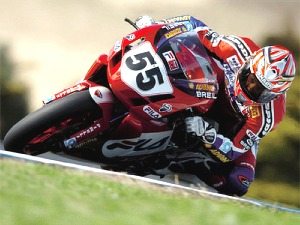
An evolution of power, aerodynamics and style, for a dream Ducati which is more competitive and powerful than ever.
Based on the motorcycle representing Ducati in this year’s American Superbike Championship (AMA), the 999R has been significantly upgraded for the American market. A new front fairing, new rear swing arm and suspension, a major upgrade to 150 horsepower for the engine are all intended to reinforce the bike’s Superbike status.
AMA technical regulations allow fewer modifications to the engine than the international Superbike regulations so Ducati, which returned to the AMA championship this year, has produced an engine with technical characteristics that are much closer to those of the racing version.
The new 999R is yet another step forward in Ducati tradition, which has always been characterized by the manufacture of series production bikes similar to their race versions not only in styling, but also in technical features.
Project features
The basic dimensions of the Testastretta engine used on the new 999R remain the same as those of the previous version. However, the maximum power and torque have been greatly increased. Compared to the previous model’s 102 kW (139 hp) at 10000 rpm, the new engine produces 110 kW (150 hp) at 9750 rpm. The torque itself has been increased from 108 Nm (11 kgm) at 8000 rpm, to 116.7 Nm (11.9 kgm) at 8000 rpm.
New cylinder assemblies
In order to improve performance, the cylinder heads and pistons have been completely redesigned and should really be regarded as completely new components, designed specifically for racing. The pistons are forged and constructed from an aluminum alloy with high mechanical specifications to ensure outstanding geometrical stability during the wide thermal excursions to which they are subject. The heads have undergone a radical fluid-dynamics redesign. In order to make it possible to use larger diameter valves, their centre distances have been increased which means that the routing and dimensions of the intake and exhaust ducts have also had to be modified. The result of these modifications is evident from the significant improvements in overall performance of the road version, which means with absolutely standard exhaust system, silencer and intake system.
Valves
The Testastretta engine of the new 999R uses titanium valves, both on the intake and exhaust. The weight saved is considerable, especially if we consider the strong accelerations imposed by the high engine speed.
The use of titanium has obliged Ducati to use special valves seats and guides.
The intake and exhaust systems
Nothing has changed in the new 999R’s intake and exhaust systems compared to the previous version. There is a single, large volume silencer, and the manifolds have no intersection points.
Frame and two-member swing arm
There have been no substantial modifications to the frame used on the previous 999R, which is still the hallmark trellis frame constructed of high strength steel tubing. The suspended engine is a bearing component and contributes to the torsional rigidity of the assembly. The cross-member supporting the starter motor on the series production bike is removable to enable use of a larger capacity fuel tank, as provided by the championship regulations. The footplates can be moved to two different positions. A great deal of attention has been paid to weight distribution and the location of every single component, which plays a fundamental role in transferring the loads experienced during dynamic riding (braking, acceleration, curves)..
Forged aluminum alloy wheels
The rear and front wheel rims are made of forged aluminum, a technology which enables weight reduction while maintaining resistance to mechanical stress. Compared to castings, it is possible to use thinner sections since the material is distributed evenly throughout the component. The lower weight of the rims not only reduces the suspended masses (which significantly improves suspension performance), but also greatly reduces the gyroscope effect and improves the handling of the bike at high speeds (the bike is more agile when entering curves).
The front forks and the new rear shock absorber
The calipers of the front brakes are radially mounted to special mounts on a new Öhlins fork, the legs of which are surfaced in TiN for improved sliding. The two legs have modified, smaller diameter springs and the spring guide is now in plastic rather than metal. This reduces the formation of detritus which tends to pollute the oil. The lower section of the cartridge rod is fitted with a counterspring, which counteracts the main spring at maximum extension during violent acceleration.
Fairings: the new front fairing
The headlamp mount and the new mirror mounts are now in magnesium alloy. The fairings with scoops, front fairing between the two side fairings, the front mudguard, chain guard, silencer heat shield and windshield fairing are all in carbon fiber. The tail section, on the other hand, is in techno-polymer. The forms of the fairings are identical to those on the 999R, while the windshield fairing has changed and now lacks the upper flow guides while featuring a Plexiglas windshield with a new shape. Overall, apart from improved aerodynamics, the new system provides better rider protection at high speed (when crouched over the fuel tank) and better visibility of the instrumentation (the black rubber surround of the Plexiglas windshield does not block the rider’s view of the instrument panel warning lights).
Electronics
More sophisticated engine ECU
The new 999R’s engine ECU uses the same sensors and actuators as the preceding version. However, the ECU itself has been changed to the IAW 5M2 unit, again produced by Magneti Marelli, and is now capable of handling a larger number of inputs and outputs, to allow for future expansion of the regulation strategies.
| Engine | |
| Type | Twin-cylinder L-configuration, Desmodromic timing, 4 valves per cylinder, liquid cooled |
| Engine bore | 104 mm |
| Stroke | 58.8 mm |
| Total displacement | 999 cm3 |
| Maximum power | 150 HP @ 9750 rpm |
| Maximum torque | 11.9 kgm @ 8000 rpm |
| Gear ratios | First 15/37; Second 17/30; Third 20/28; Fourth 22/26; Fifth 23/24; Sixth 24/23 |
| Final transmission ratio | 15/36 |
| Clutch type | Multi-disk, dry sump |
| Electronic ignition/injection ECU | IAW 5M2 |
| Injectors | one per cylinder, IWPR2, 12-jet |
| Theft alarm | Immobilizer integral to engine ECU |
| Chassis | |
| Frame | steel tubing, trestle-type |
| Trail | 91 – 97 mm |
| Steering head angle | 23°30’ – 24°30’ |
| Wheelbase | 1420 mm |
| Front suspension stroke | 120 mm |
| Front fork leg diameter | 43 mm |
| Rear suspension stroke | 71 mm |
| Rear wheel travel | 128 mm |
| Front rims and tyres | rim MT 3.50×17” tyre 120/70 17 |
| Rear rims and tyres | rim MT 5.50×17” tyre 190/50 17 |
| Minimum ground clearance | 125 mm Seat height 780 mm |
| Rider footplate height | adjustable to 387 mm and 410 mm |
| Maximum width | 730 mm |
| Handlebar width | 671 mm |
| Maximum length | 2095 mm |
| Steering angle | 28° 30’ right/left |
| Dry weight (without fluids and battery) | 181 kg |
| Front brake disks (diameter) | 320 mm |
| Rear brake disk (diameter) | 240 mm |
| Radial four piston front brake callipers | 34 mm (piston diameter) |
| Two piston rear brake calliper | 34 mm (piston diameter) |
| Front brake master cylinder piston | 18 mm (piston diameter |
| Rear brake master cylinder piston | 11 mm (piston diameter) |