The Dakar Rally: January 2007 is here! Our
2006 Dakar Rally pages and reports were very popular and we hope to
bring you the same information during the 2007 Dakar Rally, with updates
provided by three teams and edited by webBikeWorld..
Following are the initial rally preparation reports from
KTM, Team Rally PanAmerica and Yamaha.
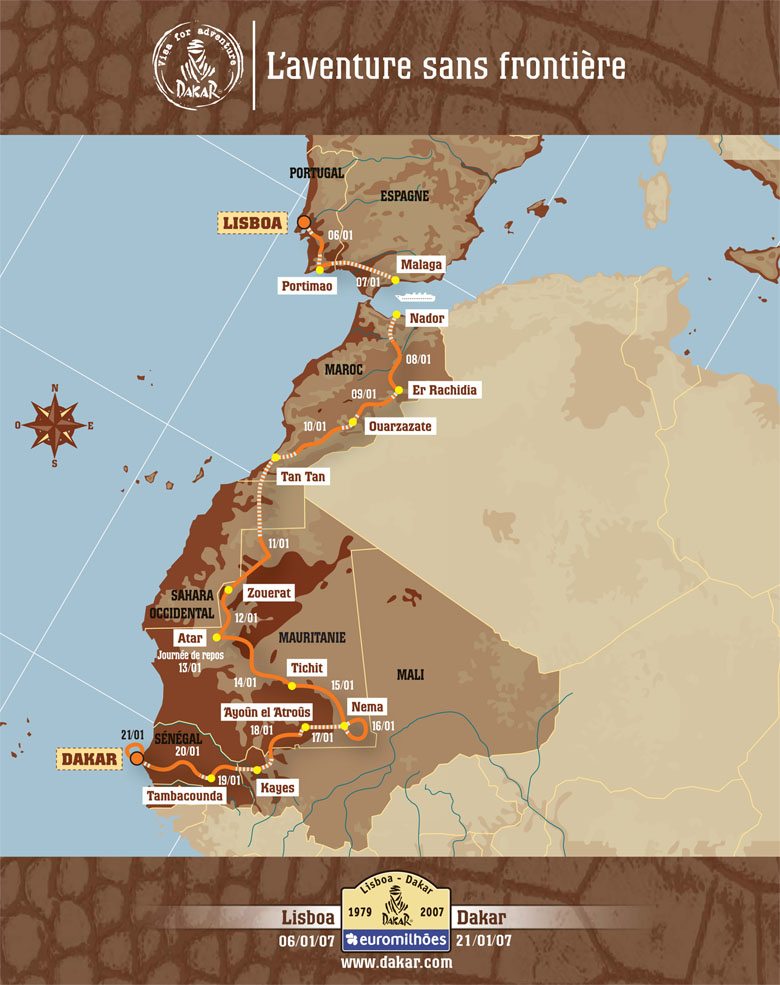
2007 Dakar Rally Route Map
(opens JavaScript window)
-
January 6, 2007: Stage 1 Results
-
January 7, 2007: Stage 2 Results
-
January 8, 2007: Stage 3 Results
-
January 9, 2007: Stage 4 Results
-
January 10, 2007: Stage 5 Results
-
January 11, 2007:
Stage 6 Results
-
January 12-13, 2007:
Stage 7 Results and KTM Rally Report
-
January 14, 2007:
Stage 8 Results
-
January 12-13, 2007:
Stage 9 Results
-
January 12-13, 2007:
Stage 10 Results
-
January 16, 2007:
Stage 11 Results
-
January 17, 2007:
Stage 12 Results
-
January 18, 2007:
Stage 13 Results
-
January 19, 2007:
Stage 14 Results
-
January 20, 2007:
Stage 15 and Final Standings
The History of the Dakar Rally
Shortly after the New Year, on January 6th, the 29th edition of the
Dakar Rally will traditionally kick off the 2007 motor sport season.
Ever since the first event "The Dakar" has been the most
grueling test for both man and machine, whereby for bike competitors things
are quite a bit rougher then for the car drivers.
For the second time in the event’s history the caravan will
start from the Portuguese capital Lisbon, when a total of 525 competitors
from 42 nationalities will embark on the intimidating journey across some of
the toughest desert landscapes on earth.
Formerly known as the Paris-Dakar Rally, the current race is
the lasting legacy of one man and his dream: the pioneering French
motorcycle racer, late Thierry Sabine.
Back in 1977, Sabine was a bike competitor on the tough
Abidjan-Nice rally who stranded in the deep Libyan sands. Although he
was defeated by the challenging conditions, Sabine fell in love with the
harsh beauty of the desert and vowed he would return.
One year later, on December 1978, Sabine’s unique event was
ready and the first Paris-Dakar took off from Place du Trocadéro in Paris.
Since then the event has withstood many challenging issues mostly connected
with safety and politics. In 1986 the number of entrants soared to
603, while the event nearly perished in 1993 when only 154 competitors
enlisted.
Since that low point the Dakar has recovered year by year
and although both the name and the routes have changed, the spirit of the
original event lives on. Sabine’s vision says it all; "it’s a
challenge to those who go; a dream for those who stay behind."
Definitions and Rules
You'll see the French word
piste used frequently in the Dakar Rally. A piste is basically a
dirt road.
Dr. Jim Jones of the West Chester University Department of History
defines it this way: "In the context of French West Africa, where most roads
were unpaved, a piste may be a major thoroughfare, such as those that cross
the Sahara Desert. Although they are unpaved, pistes are maintained by
smoothing out the surface after each rainy season, or by removing drifted
sand in the desert."
Documentation and Scrutineering: Every Rally starts
with a check of persons and bikes. All team members must be accredited
and all bikes must comply to the rules of the FIM.
Parc Fermé: After scrutineering, the bikes have to go
into Parc Fermé, a closed area where the bikes must not be touched until the
next day before the start. Only the rider may enter half an hour
before his start time and get ready for the start. This is to avoid
that modifications may be done to the bikes after the technical
scrutineering.
Prologue: The prologue is a first short special test
defining the starting order for the first stage. The time of the prologue
counts already for the general result.
Liaison: A liaison is the way to, between or after
special stages. The riders have a maximum time to go to the next check
point, and get penalized if they exceed that time for some reason. The
time of liaison does not count for the final result.
Special Stage: Timed race course, the times of the
special stages count for the daily result. The final result is made up
by the addition of the times of the special stages plus penalties for
exceeding liaison times or missing check points.
Check Point (CP): A special stage is equipped with
several check points where the riders get a stamp in their time card.
The check points prove that a rider is on the right track and in time.
Road Book: Every day the riders get a road book which
indicates the route of the day. The information on a road book
consists of pictures with arrows and short information (e.g. Danger!!!) as
well as the distance to the information on the next picture and the overall
distance.
GPS: The second device together with the road book for
the riders to find their way. The organizers set a few waypoints in
every stage which are on the road book and the riders have to pass
correctly.
Yamaha at the Dakar Rally
Yamaha is the most victorious motorcycle manufacturer with nine overall
victories and has been involved in the rally from the very beginning.
At the tender age 21 years old Cyril Neveu won the first event on the iconic
XT500, a feat he repeated in the following year.
Stephan Peterhansel
The Dakar’s most
successful competitor, Stephan Peterhansel, made the biggest contribution to
Yamaha’s victory tally which consists out of the following victories:
1979 Cyril Neveu (F)
1980 Cyril Neveu
1991 Stephan Peterhansel (F)
1992 Stephan Peterhansel
1993 Stephan Peterhansel
1995 Stephan Peterhansel
1996 Edi Orioli (I)
1997 Stephan Peterhansel
1998 Stephan Peterhansel
David Frétigné
After Peterhansel’s last win, Yamaha withdrew officially from
the rally to return to the event five years later putting their latest
groundbreaking technology to the ultimate endurance test.
Back then Dakar
rookie David Frétigné caused a stir by winning three stages as he challenged
the big capacity twin cylinder bikes on his revolutionary WR450F 2-Trac mono
cylinder, the first off-road competition motorcycle to have two-wheel drive. “Fretos” convincingly won the 450 class in 2004 and 2005, but on the many
long "flat-out" desert stretches the lower top speed of a 450 single
cylinder prevents it to fight for the overall victory, yet Frétigné managed
to finish fifth overall in 2005.
The Yamaha WR450F
For this year’s edition Frétigné (#12) is again one of
Yamaha’s favorites, although he saw his participation endangered when his
new Spanish team failed to put together a competitive team.
With two months
to go, Yamaha and other loyal sponsors came to David’s aid enabling him to
organize his own set up. With the support of long term technical partner
Franck Helbert, Frétigné is confident to score a career best result; “On
paper, one can’t win with a 450, but I still aim for podium finishes. With
the imposed top speed of 160 km/h for bikes on some of the very fast
stretches, two stages where no technical assistance is allowed and the 450cc
bonus points system, we can challenge the factory teams with the bigger
bikes. If we are smart in terms of management and race strategy we might be
able to close the performance gap completely
From the 230 motorcyclists, 57 will be equipped with WR450F
machines in either 2-trac or rear wheel drive specification. Some other
competitors to look out for are the 27-year-old Portuguese rider Helder
Rodriques (#10), who scored a ninth position finish overall in 2006.
Yamaha
Team Holland fields a strong effort with five times sidecar world champion
Daniel Willemsen (#233), who looks forward to enter his first Dakar
participation, while Daniel’s team mate Mirjam Pol (#93) aims to go one
better after finishing second in the female class last year.
What is sure is that the majority of the starters will not
make it to the finish, while the skilled and fortunate ones will see their
superhuman efforts rewarded when they ride on the Dakar beach, the
traditional finish of the monster event. On the 21st of January after 7.915
km, including 4.309 km of timed special stages we will know who made it and
who didn’t.
KTM Prepares for the Dakar Rally 2007
December 13, 2006 - There can be perhaps no better
confirmation of KTM’s status as the world’s leading producer of off-road
machines than a quick look at the starting list for Dakar 2007 -- the
ultimate rally and the ultimate adventure. Of the 250
motorcycles competing in 2007, 128 riders will be on the orange machines
made in Austria.
Orange will therefore be the dominant color for off-road
machines on the starting line of the motor sports classic when it leaves
Lisbon on January 6, 2007.
Competitors will cross Portugal, Spain, Morocco, Mauritania,
Mali and Senegal in a grueling adventure that puts man and machine against
some of the toughest elements that nature can deliver. This is a race
of endurance, bravery, determination and meticulous planning.
It is perhaps also the ultimate test for the new KTM 690
Rally machine, a product that has been developed in cooperation with the
company’s Rally Department. The new machine has already delivered good
results in recent international rallies and will be ridden by all KTM
Factory Team riders in the Dakar 2007.
KTM has dominated the start and the finish lines of the
Dakar classic in recent years to underline their superiority in the off-road
sector. But as overall team manager Hans Trunkenpolz points out, it
took patience and endurance to wait until orange emerged as the winning
color in the motorcycle division.
“We needed five years before we experienced our first Dakar
victory," Trunkenpolz said. “We were close a number of times with
second places but for various reasons it wasn’t until 2001 that we won and
then it was a five-fold victory.“
From that point on the story of the Dakar race has gone
hand-in-hand with the success of the Austrian company, which is now the
second largest producer of motorcycles in Europe.
KTM’s three factory teams (Gauloises, Repsol and Red Bull)
include eight factory riders supported by 43 team members, including a
doctor and two physiotherapists. Two of the world’s leading rally
riders, Marc Coma and Cyril Despres, are both top favorites riding orange
machines. Coma, in the Repsol team, won the 2006 rally after Despres,
the winner in 2005 who rides for Gauloises, dislocated his collarbone and
had to settle for second place. KTM riders therefore face a particular
challenge in 2007 to live up to the 9 of 10 top places in last year’s race.
This year it is safety first for every KTM factory rider who
will all wear the new neck brace protection developed for KTM by South
African doctor Chris Leatt and already tested in other international rallies
by top KTM riders.
But when the riders start their motors on January 6, they
are merely continuing the task that commenced months before as a massive
exercise in logistics. KTM not only services its factory teams but
also supplies customer package support for an army of other private riders
on KTM machines.
Accompanying the race for KTM will be five Rally Nissans,
two T4 Racing Trucks and four T5 Assistance Trucks. They are in effect
complete workshops on wheels ready to supply mechanical, safety and any
personal assistance in circumstances.
KTM transports between 36-38
tons of equipment for the race, including some two tons of selected spare
parts and equipment air freighted to cover the contingency of the late
arrival of a support vehicle, or if one is disabled during the event.
When riders cross the finish line of the 2007 Dakar they
will have traveled 8,696 km through some of the most rugged terrain in the
world. There is no better testing ground for the new KTM 690 Rally
machine in the hands of the most talented riders on the planet, and the
experience gained, as always, will directly translate into even better KTM
off-road motorcycles in the future.
|
KTM Factory Team riders for Dakar 2007 |
| Gauloises KTM |
| Cyril Despres |
| Isidre Esteve |
| David Casteu |
| Frans Verhoeven |
| Repsol KTM |
| Marc Coma |
| Giovanni Sala |
| Jordi Viladoms |
| Red Bull KTM |
| Chris Blais |
|
 |
|
2007
Dakar Rally. Jonah Street and Casey McCoy. |
|
|
Destination Dakar
The Dakar Rally is the most challenging motorsports event in the world.
This year, the organizers describe “Different stages every day, a
fast-changing pace, high-speed stretches alternating with technical legs,
intense navigation. . .
Racers have to be skilled, on the lookout for the
slightest traps, and shrewd navigators, or else they will loose a great deal
of time and energy. . . the Dakar will be an extreme challenge again this
year.”
Team Rally PanAmerica, an American privateer motorcycle
rally team backed by PAi and Top Oil, is a U.S. team that has prepared all
year for this event. Jonah Street (#25), no longer a rookie, looks
forward to his second Dakar: “I’m excited, especially since we’re much
better prepared this year. And, now I know what to expect.”
Teammate Casey McCoy (#232) has plenty of rallying
experience, but never in the Dakar, “Participating in the Dakar has been a
long time dream of mine that is now a reality. I am very excited to be
a part of a proven team that has years of Dakar experience.”
Team Manager Charlie Rauseo believes the team can do well,
“We have all the elements necessary to get on the podium: talented riders,
experienced crew, good training and equipment, and a passion for winning.
Hopefully a little luck and consistency will make up for what we lack in
logistical support and manpower.”
The Dakar Rally starts in Lisbon, Portugal on January 6,
2007, and finishes in Dakar, Senegal on January 21. In the United
States, it will be televised on Versus Network, schedule posted on the
team’s website.
Prologue
The Dakar Rally is the most difficult test of man and
machine on the planet. Hundreds of the world’s best will challenge the
African desert for sixteen days. Half may finish. Only ONE team
will win.
Team Rally PanAmerica aims to be the winning team in the
2007 Dakar Rally. We recently received this information introducing
their 2007 Dakar Rally Team; here's their press release:
We have the speed, the experience, and the determination.
We have assembled what we consider the best American rally team ever.
What could possibly go wrong?
Riders. Jonah Street again leads our Team. Now a
Dakar veteran with several stage finishes on the podium, Jonah has dedicated
this entire year to perfecting his rallying skills. Jonah proved his
speed in Baja and Nevada, riding for Honda and taking home a truckload of
trophies, including 3 overall wins in the Baja 500.
Casey McCoy joins the Team this year and brings many years
of rallying and racing experience, including stellar finishes in the
Australian Safari riding for Yamaha.
Wheels 2 Africa. In past rallies, the Team has
witnessed abject poverty and need, especially in Mali and Mauritania.
This year, we plan to do something about it. In cooperation with
Wheels 2 Africa, we will unload our race cargo at the end of the race in
Dakar. Then we will load up our assistance trucks with humanitarian
aid and medical supplies and drive back into the desert to distribute this
to people in need. Contact us if you would like to be involved.
Bikes. The Team is building specialized rally
motorcycles in our small San Francisco shop right now. Without factory
support, we are free to choose the best bikes, parts and services available.
Trust us; these will be some very unique race bikes.
Crew. We have the best crew in the business.
Niles Follin, Sid Milton, Robb McElroy and Charlie Rauseo are all Dakar
Rally veterans.
Follow the Team. We will update our fans in press
releases and on our website periodically in the next several months, and
daily from Africa during the rally.
Sponsorship. We have some great sponsors, and we are
looking to partner with one major company willing to lend its name to the
Team. To learn more about partnering with the Team as a sponsor, visit
the Team Rally
PanAmerica website or contact Team Manager Charlie Rauseo at charlie@charliedakar.com.
More:
Wheels 2 Africa |
Official Dakar Rally
information |
Team Rally Panamerica
is the U.S. team Dakar effort for 2007