TPro Forcefield vs. Bohn Back Protectors
The TPro Forcefield is the most comfortable and least obtrusive back protector we’ve tried so far.
We’re still in shock, but for some reason the reviews of the Knox Ricochet and Knox Stowaway back protectors we posted recently are among the most popular articles on webBikeWorld, generating lots of emails asking for more.
So let’s consider this as “Back Protectors, Part III”(We have a Part IV coming soon).
This time, it’s the Bohn Monza Back Protector vs. the TPro Forcefield body armor (or body armour) back protector.
What’s in a name? The TPro Forcefield shown here is actually a Joe Rocket Speedmaster back protector, which is widely available in the U.S.A.
The Bohn Monza Back Protector, also shown here, is distributed from Italy for Bohn by a company called Furmor Protect.
But it carries a “Soul Race” brand label.
Just as the Joe Rocket product information doesn’t mention TPro, the Bohn Monza Back Protector doesn’t mention Furmor, so who knows.
Our guess is that the Joe Rocket and Bohn names have much greater brand equity in the U.S.A. than other brands, in addition to the Rocket and Bohn established marketing and distribution channels.
So apparently this is what they call a symbiotic relationship for the benefit of all.
Hey – as long as we motorcyclists get good equipment at reasonable prices out of the deal, who cares?
TPro Joe Rocket Speedmaster Back Protector
The Joe Rocket website doesn’t mention the origins of the Speedmaster protector, and when a webBikeWorld visitor tipped us off that it was actually a TPro Forcefield, we weren’t so sure.
It looked like a TPro, but we didn’t know for sure until we purchased and received it.
When it arrived, it came with a TPro hanging label, a Ride Magazine (UK) “Best Buy” tag and a Davies Odell (the manufacturers of TPro products) official CE mark (Certificate of European Conformity) showing compliance to Level 2 of the European Personal Protective Equipment directive.
However, a close inspection of a colleague’s TPro Forcefield original and the Joe Rocket Speedmaster back protector indicate to us that the Rocket version may be slightly different.
Besides the logo on the back, the Rocket version seems to us to be slightly shorter at the coccyx.
So what’s different about these two back protectors when compared to the Knox versions we reviewed recently?
Both of the back protectors shown here meet the more stringent Level 2 of the 89/686/EEC Personal Protective Equipment (PPE) directive.
Both have been tested at approved independent “third party” neutral testing labs; the SATRA Technology Centre (UK) for the TPro Forcefield and Ricotest Srl (Italy) for the Bohn. Both have been tested according to the EN1621-2:2003 specifications.
If your head is spinning with all these Euro acronyms and secret engineering code, join the club.
Let’s just hope that somebody knows what they’re up to and that these numbers and standards actually translate to safer products for motorcyclists.
From our point of view, the only criteria we can evaluate is comfort, because we’d do most anything for our webBikeWorld visitors, we’re not about to crash test these babies any time soon. Voluntarily, that is!
This means that our comments will be focused on comfort and other features, like the shape and amount of surface area that these back protectors offer.
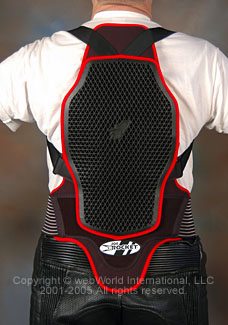
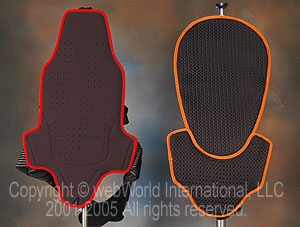
We’ve created a series of side-by-side photos following that illustrate the features of these two brands of back protectors.
Size, Shape and Comfort
As you can see, there are some differences.
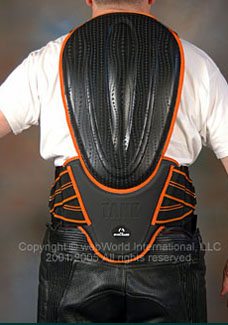
The Bohn Monza Back Protector in the left photo above carries most of its coverage (the section that meets Level 2 certification) much higher on the back than the TPro Forcefield in the right photo.
The Bohn protector is medially and laterally stiffer than the TPro, which, when combined with its higher mounting position, makes it less comfortable, in our opinion.
It feels rather like wearing a piece of plywood or a Boogie Board on your back.
This is somewhat mitigated when it’s corralled under a leather jacket, but it’s noticeable nonetheless.
The TPro Forcefield (aka Joe Rocket Speedmaster) back protector is hands-down the most comfortable we’ve tried.
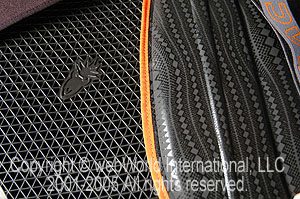
It’s about 15/16″ thick and it sits perfectly flat, but the special TPro “Nitrex” shock absorbing foam and the TPro “waffle” back are very flexible and will conform to the shape of the rider’s back without needing molded-in curves.
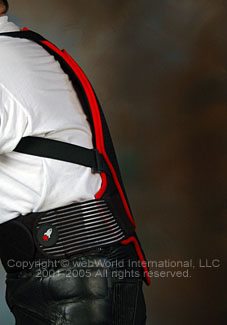
Adding to the comfort is the design of the shoulder straps on the TPro.
They originate closer to the top center section of the protector, which helps to keep the TPro closer to the rider’s body because the straps pull it against the rider’s back and help to hold it (the protector, not the back!) in place.
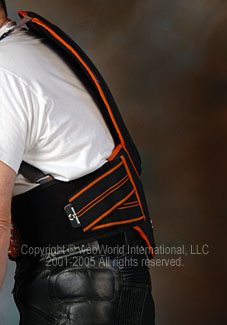
The Bohn’s straps are located at the top on either side of the curved section of protection.
And since the protector rides so high on the user’s back, the straps are located higher than the rider’s shoulders, so they don’t offer the same secure feeling of holding the protector close to the rider’s body.
See the photos above and below and note the difference in the shoulder strap locations where they wrap around the model’s shoulders.
Belt and Adjustment
We also found that the belt on the Bohn Monza Back Protector does not seem as comfortable or adjustable as either the Knox or TPro products.
The Bohn belt has some elastic on the sides, but its design seems to prevent the elastic from flexing when the belt is secure around the front of the rider’s stomach.
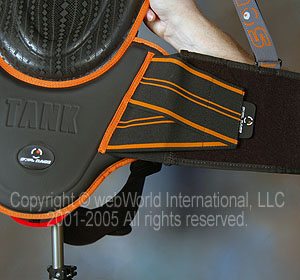
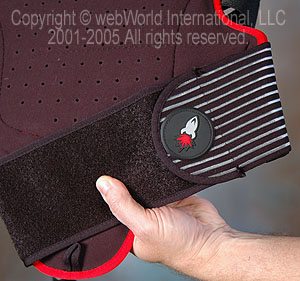
The TPro belt has a wide section of elastic, and it seems to stretch farther and more secure than the Bohn.
The belt on the TPro also seems longer than the other back protectors we’ve tried and it fits over a too-big waistline with room to spare, although the difference in length between these two is negligible, so it must be the design.
Padding
As we mentioned in the previous reviews, all of these back protectors seem stiffer (harder) than we expected. Apparently, this is normal.
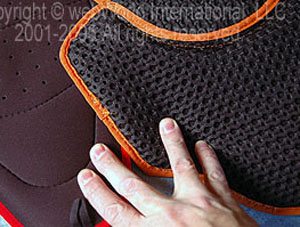
But the TPro Forcefield stands out in this regard also; although we wouldn’t call its padding plush, it is slightly softer than the rest and when combined with the flexibility of the entire protective section, it’s more comfortable than the others.
Conclusion
Any of these back protectors are probably 100% better than no back protector at all, although we can’t comment on their ability to actually reduce trauma.
For that, we have to trust the European PPE directives, because there is no standard for this type of equipment in the U.S.A.
After riding with these for several weeks on different types of motorcycles, with different types of clothing and in all sorts of weather, our consensus is that the TPro Forcefield is the most comfortable and least obtrusive back protector we’ve tried.
But wait — there’s more! We’re in the process of evaluating the Knox Cross Shirt and Knox Cross Sport Shorts, which are “wearable” armor. The shirt has a built-in back protector in addition to elbow and shoulder armor.
We’re very pleased to learn that many of our visitors are very serious about motorcycle safety and learning about the best protective equipment they can afford.
We’ve read some testimonials from riders who claim that they would have been severely injured if not for their full leathers, back protectors and other equipment.
More webBikeWorld:
| wBW Review: TPro Forcefield Back Protector and Bohn Monza Back Protector | |
|---|---|
| Manufacturer: Action Stations (Bohn). Davies Odell (TPro ). Joe Rocket (Speedmaster by TPro) | List Price (2005): $139.99 (Joe Rocket); $149.99 (Note new lower price for the Bohn Monza). |
| Colors: Black. | Made In: Unknown. |
| Review Date: December 2005 | |
Owner Comments and Feedback
See details on submitting comments.
From “G.K.” (5/09): “I just found your review on the Bohn vs. Joe Rocket (Forcefield) back protectors and wanted to let you know the Joe Rocket protector is only Level 1 & not a Level 2 certified protector.
I, as you, thought the same thing on inspection.
So i sent a email to Forcefield inquiring about the difference between their T-Pro sold on their website and through Johnson Leathers here in the USA and the Joe Rocket version.
Aand the reply was that the regular Forcefield was Level 2 & the JR is only Level 1.
Now before this gets confusing they are both EN1621-2, but there are 2 levels within that standard which are Level 1 and Level 2 based on the Joule rating.
So basically the Joe Rocket style Forcefield is the same Level 1 as most other back protectors on the market (e.g. Alpinestars Tech, etc.) and fall into the basic CE back protector EN1621-2.
But that (-2) is not Level 2, it is just the section that defines back protectors, not the actual sub-level of rating based on Joules i.e.. Level 1 or Level 2.”
From “Oleg S.” (1/09): “As someone who bought the Forcefield a couple years ago I just wanted to chime in on long-term use of the protector.
All in all it holds up well (I haven’t had a chance to actually “test” it) but one problem area I noticed is with it’s Velcro straps.
The underside of the the strap where the “loop” or “wool” material attaches is not stitched through, and is held only at the edges, so after even minimal amount of wear the straps have become deformed and the material on the underside has turned baggy and bunched up.
I’m assuming I will solve this problem myself by stitching through it to hold it in place, but it seems like it should have been a simple fix on the manufacturer’s side. I can provide images if necessary to illustrate the issue.”