

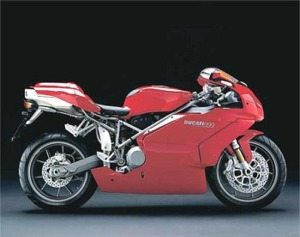
DUCATI 999 MOTORCYCLE
The new Ducati 999 is the motorcycle of the future. It is the most advanced, highest performance production twin-cylinder motorcycle ever produced at the Ducati factory in Borgo Panigale, Bologna, Italy.
Moreover, the Ducati 999 is a powerful symbol that encompasses the history of Ducati racing and represents the evolution of the formula that has dominated the world of Superbike racing for more than a decade.
Red is the symbol of Italian racing, the ultimate expression
of Ducati’s racing spirit, and the signature color of countless victories clinched in circuits around the globe.
The debut of Marco Lucchinelli in 1988 riding a Ducati 851, the progenitor of the Ducati 999, marked the beginning of the domination by twin-cylinder motorcycles in the World Superbike Championship.
The 851 was not just another step forward in the evolution of Ducati 90° L-Twin, Desmodromic engine design philosophy, but also a great leap forward in racing technology.
From the time of its introduction, the 851 left competitors far behind on the racetracks of the World Superbike Championship and has left manufacturers behind in terms of product development.
The 851 evolved to the 888, 916, 996, and 998; a series of iconic vehicle designations that have left a permanent imprint on the history of motorcycling. These motorcycles were the weapons of choice for Superbike pilots like Raymond Roche, Doug Polen, Carl Fogarty and Troy Bayliss on their way to historic victories and a record number of World Championship crowns.
Since the beginning of the World Superbike Championship in 1988, Ducati has had more race victories than all other competitors combined: 192 race wins, 105 Pole positions, 9 rider World Titles and 10 Manufacturer Titles in twelve years. The introduction of the 851 in 1988 seems long ago. Since then, the rules, the riders and the tracks have changed, but Ducati red continues to dominate.
Evolution
The first 851 had little in common with the Ducati twin-cylinder racers of earlier years. It’s styling was elegant and sumptuous compared to the sparse lines of the Ducati racing bikes of the 70’s. Under the fairing was concealed a quantum leap in performance engineering. The liquid-cooled, 90° L-Twin with Desmodromic twin-cam four-valve fuel injected engine launched a new era in motorcycle powertrains. Over more than a decade of development, the Corse engines have evolved from 128 hp at 11,500 rpm for the first 851 to the 188 hp at 12,500 rpm of the Testastretta Ducati 998 racing. Even today, the full potential of this engine is still being discovered. The Testastretta engine is the evolutionary result of Ducati’s dual strategy of producing motorcycles that will win races around the world and still deliver an incredible street-riding experience.
Revolution
While maintaining Ducati’s trademark features, the Ducati 999 is a revolutionary motorcycle. It contains hundreds of improvements and innovative technological solutions, and represents a true generational leap forward. With the Testastretta engine at its core, it is a pure sports bike: purposefully long, low, and narrow, with the ability to cheat the wind at speed. Its beauty is conveyed through the simplicity of its shape and exciting well-executed details. Adapting the motorcycle to the rider is the key to comfort, control and confidence and the 999 is engineered to allow each individual rider to establish a perfect symbiosis with the machine.
The Ducati 999 accomplishes this with adjustable controls such as foot pegs, which offer five different positions, and on the single seat version a seat/tank unit that slides fore and aft to adjust to the height of the rider. The Ducati 999 is also a triumph of rationalization. Simplification and ease of maintenance were primary design goals. For example, the Ducati 999 has approximately 30% fewer individual parts compared to its predecessor and requires less routine maintenance time. The Ducati engineers have also applied new technical solutions to the vehicle. The exhaust system has been designed with an asymmetrical configuration. The exhaust pipes are of different diameter and lengths to simulate a symmetrical length system, which allows maximum and balanced output from both the front and rear cylinders. The entire system terminates in a futuristic mono-silencer positioned under the tail section.
A summary of key DUCATI 999 innovations:
- Design and Form
- Narrow, highly aerodynamic fairing
- Stacked polyellipsoidal headlamps
- Turn signals integrated into mirrors
- Quick release mirrors/indicators
- Maximum “daylight” between rear tyre and exhaust
- Methodologies and Design
- Designed using 3D CAD technology
- Comprehensive computer simulation of components and systems
- Rapid prototyping
- Rapid production tooling development
- Ergonomics
- Adjustable riding position
- Adjustable controls and levers
- Adjustable seat/tank unit on the single seat version
- Ultra narrow tank/seat assembly
- Aerodynamics
- Innovative mid and lower air conveyors
- Reduced slipstream dimensions
- Turbulence-reducing forward air vents
- Rear silencer utilized as an active aerodynamic component
- Maintenance
- 30% fewer components
- Improved access for maintenance operations
- Reduced time required for routine service
Frame
- Signature Ducati Trellis frame
- Adjustable steering head angle
- Adjustable “trail” measurement
- Rigid, double sided swing arm
Engine
- 90° L-Twin Testastretta Desmodromic engine
- Longer maintenance intervals
- Improved power and torque curves
- Simplified layout
- Equipped with catalytic converter forcasted-Euro2 compliant
Electronics
- Simplified electrical system
- CAN (Controller Area Network) technology
- Total electrical system weight reduction
- Direct ignition, spark plug mounted coils
Technical Details
Design
High performance and style
The priority of the design of the 999 Testastretta privileged function over form. Our goal was to create a Ducati Superbike that improves rider ergonomics, makes maintenance easier, reduces machine complexity, and of course, offers performance second to none. The aerodynamics, mechanical and electronic components, chassis and running gear were developed first and styling followed. That said, the 999 confirms Ducati’s longtime reputation for creating striking, iconic motorcycles. The new Ducati Superbike is an innovative combination of the latest high performance technology and unique, stunning design. Each component is elegantly designed and interacts with the others in a logical and complimentary way.
The project methodology
Ducati’s approach to the 999 project was unique and innovative. Throughout the process, special attention was paid to the integration of the individual elements of the motorcycle and to the details of each component. The cutting-edge technological tools utilized for the design of the Ducati 999 are the same as those used to design the Ducati GP bike. The Ducati 999 is the first Ducati designed entirely with the use of 3D Computer Aided Design (CAD). Specific software was chosen for each design phase. Alias Studio Paint for digital sketches, Alias Studio for the 3D modeling and Unigraphics for the mechanical components.
Ergonomics as a priority
Great attention was paid to perfecting the interaction between rider and machine. The designers developed a riding position and control adjustability that allows optimum ergonomics, performance, handling, and control on the road and track. Fitting the bike to the individual rider’s size and preference is accomplished with five way adjustable footpegs and a seat/tank combination on the single seat version that is adjustable fore and aft by 20mm. Tests with riders ranging from 1.6 meters to 1.95 meters were made to help determine the range of adjustment required to optimize the ergonomics of the 999. The layout of the 999 “loads” the front end of the bike appropriately for optimum handling without putting excessive weight on the rider’s hands. The rear of the tank is rounded with a low and narrow area where the knees rest making the bike feel extremely compact. This ensures that the rider is comfortable and in control – key factors in building rider confidence. This ergonomic formula works so well that it was applied to the Ducati GP bike. Ease of maneuvering at low speeds was also improved by increasing the steering angle to 28.5 degrees.
The integration of parts
Pierre Terblanche notes that, “the integration and modularization of all the parts that make up the Ducati 999 has resulted in clear benefits such as ease of assembly, ease of maintenance, lower weight, and keeping the bike visually clean”. The 999 was designed with component quantity reduction as one of the key goals. In fact, a reduction of 230 pieces, a 30% decrease, was realized. This was achieved by breaking the bike down into seven key sub-assemblies and creating multi-function modular units.
A few examples of the integration of multiple components into modular units and the resulting benefits are as follows:
- Headlamp unit/front sub-frame Fuse box Twin headlamps Instrument CDI unit Mirror mounts Mounting points for fairing and fresh air ducts
- Monocoque tank/seat unit Single piece unit Adjustable 20 mm fore and aft (monoposto model) Removable as a single unit
- Electronics Battery Voltage regulator Engine CDI unit Relays Starter solenoid Fuses
- Cooling system Innovative double core radiator Integrated coolant fluid manifold (eliminates conventional hoses) with integral thermostat Cooling fans mounted directly to radiator core
- Intake system/Airbox Advanced sealing to lower contaminant entry Fresh air duct and coolant tank integrated into one unit Helmotz resonator
- Exhaust system Asymmetrical balancing Unequal length Variable diameter Single unit silencer
- Main frame/engine running gear Narrower frame Double sided swingarm
Aerodynamics
A high-performance engine, a sound frame, and an excellent suspension are all important, but nothing is as critical as the aerodynamics of the vehicle. The Ducati 999 form was designed to minimize air resistance at high speeds and to precisely distribute aerodynamic load. The front fairing and the mirrors protect the rider from the wind and the elements. The mirrors were designed for maximum rearward visibility, minimum wind drag, and ease of removal for on-track riding. The vents on the front fairing eliminate vortices of air in the handlebar zone, while the “air conveyors” improve the aerodynamics of the motorcycle by limiting the horizontal dimensions of the slipstream. The high volume single exhaust muffler completely fills the space underneath the tail section. Its volume maximizes the expansion of exhaust gasses, reduces noise, and its compactness optimizes the aerodynamics at the rear of the bike. Similar to the GP bike, the lower part of the fairing extends to the swingarm, which produces an even, turbulence free airflow past the partially shielded rear wheel.
From design concept to production
In the initial design stages of the Ducati 999, design and R&D constantly discussed and exchanged information on the various sketches and drawings. The 999 was designed from the inside out. The definition of the visual and stylistic characteristics of the design was completed only after the arrangement of the chassis and mechanical components was finalized. A simplified outline of the key steps in the design to production process are as follows:
Project brief
Identify key goals – Improve ergonomics – Simplification and reduction of number of parts – Rational packaging and ease of maintenance – Weight reduction – Improved aerodynamics
Chassis
Handling and stability
The highly advanced frame, brakes and suspension on the Ducati 999 allow the rider to fully exploit the Testastretta’s exceptional torque. “The design achievement of the Ducati 999’s chassis is its rideability, which is hard to find in other motorcycles in the Superbike category,” says Ing. Mengoli, Ducati’s Technical Director. Precise handling and stability are perfectly matched on the Ducati 999, which guarantees consistency and predictability at high speeds and razor-sharp response when entering corners. The trellis frame is constructed of welded and mitered high-strength ALS450 steel tubing. The front fork rake is adjustable between 23.5 and 24.5 degrees due to a specially- designed eccentric in the steering head. The motorcycle’s 1420 mm wheelbase is unaffected by this adjustment, whereas the trail changes from 91 mm to 97 mm. The steeper head angle increases agility and the standard position gives improved stability. The 999 comes fitted with a steering damper as standard equipment (Sachs Boge for the Ducati 999 or an adjustable Ohlins for the Ducati 999 S and Ducati 999 R). Low speed maneuverability and handling have been improved by increasing the steering angle to 28.5 degrees.
The front fork
The Ducati 999 S and Ducati 999 R use Ohlins forks (wheel travel: 120 mm) and the standard Ducati 999 uses Showa forks (wheel travel: 125 mm). All fork models have 43 mm TiN coated legs to reduce friction and offer adjustable rebound damping, compression damping, and spring preload. The front wheel axle has a 25 mm diameter for rigidity; a key factor for precise handling.
The frame and double-sided swingarm
The Ducati frame uses the engine as a fully stressed member resulting in very high torsional rigidity in a lightweight package. Further, new engineering techniques allow stresses to be evenly distributed throughout the frame. Special attention was given to the weight distribution of the motorcycle. This is extremely important because the relative location of the center of gravity dramatically affects the dynamic response of the motorcycle during braking, acceleration, and cornering. The position of the engine, rider, and accessories determine the vehicle’s center of gravity, and in the 999 are located as close to each other as possible. Ducati designed each component of the motorcycle for maximum space utilization, which kept the motorcycle compact and improved accessibility for maintenance and suspension set-up operations. The double-sided, sand-cast, aluminum swingarm was designed to ensure optimum stiffness without increasing weight. The chain guard and rubbing block are integrated into one unit. The chain tension is maintained by two horizontal sliders that allow adjustment without changing the ride height or handling characteristics of the motorcycle.
The Rear Suspension
The rear suspension is fully progressive and fitted with a shock that is adjustable for rebound damping, compression damping, and spring preload. The 999 comes standard with a Showa shock and the 999 S version is equipped with an Ohlins shock. The rear suspension system of the Ducati Superbikes are unique in that they allow adjustment of ride height independent of spring preload.
The Brakes
The new, elegantly executed, ultra-low and compact front brake and clutch master cylinders were co-designed with Brembo to allow for increased steering lock angle and a lower front fairing. The clutch lever, the front brake, and the rear brake levers are all fully adjustable. The Brembo braking system consists of twin 320 mm steel front brake discs and a steel 240 mm diameter rear brake disk. The front discs are spaced farther outboard from the front wheel to improve the cooling efficiency of airflow. The thickness of the brake discs was reduced from 5 mm to 4.5 mm, and an increase of the inner diameter of the discs reduces unsprung weight and improves handling. The front brake calipers have four 34 mm pistons and four individual brake pads. Sintered brake pads are fitted to improve wet-weather stopping. The brake system was directly derived from extensive Ducati Corse racing experience. The Ducati 999’s aggressive stopping power perfectly complements the bikes amazing acceleration and top-speed capabilities.
Engine
The evolution of the Desmoquattro engine
The Testastretta is the latest evolution of the Desmodromic engine. Compared to the previous generation Desmoquattro, the new Ducati 999 engine incorporates multiple improvements including a completely redesigned crankshaft, cylinders, and cylinder heads. The Testastretta was first introduced in the 996 R and was raced successfully in Superbike competition. Since then the Testastretta has undergone extensive testing, development, and refinement. The heads have a steep included valve angle of only 25 degrees; 12 degrees for the intake valves and 13 degrees for the exhaust valves. This allows a very compact combustion chamber, and enables the use of flat top pistons while still having a high compression ratio of 11,4:1. Flat top pistons are the optimal choice for efficient combustion because they create the best environment for a smooth and linear flame front. The intake and exhaust valves have increased in diameter to 40 mm and 33 mm, respectively.
The Testastretta’s desmodromic timing system has evolved significantly with improvements in the design of components and the use of advanced surface treatments, which result in longer maintenance intervals for the valve-train. The stroke of the Testastretta engine in the 999 is 63.5 mm. The shorter stroke lowers the average speed of the piston resulting in a higher RPM redline, maximum performance, and improved reliability. In addition, the lubrication circuit was engineered and developed directly from Ducati’s extensive racing experience. A new deep sump is integrated into the engine casing, which ensures constant oil pick-up even when the motorcycle is accelerating aggressively or cornering at extreme lean angles.
A revolutionary exhaust system
The exhaust system and single-muffler have an innovative non-symmetrical layout. The paths of the manifolds and the high-volume single-muffler have resulted in a significant improvement in torque at the middle of the RPM range. The L-twin engine configuration uses exhaust pipes of different lengths. Optimally, exhaust pipes should be equal length. The Ducati 999 solves this in a unique way by varying the diameters of the exhaust pipes to simulate equal length pipes. The front pipe diameter increases from 45 to 55 mm compared to the constant 45 mm diameter of the rear pipe to equalize pulse waves and back pressure. The Testastretta used on Ducati 999 is in compliance with Euro 1 clean air standards regulation, and is expected to comply as well with the forecasted Euro 2 which is still not defined at the present moment.
The air-intake system
The challenge of allowing enough air to the engine while keeping intake noise low has been accomplished by increasing the airbox volume to 12.5 liters and by fitting the fresh air intake tracts with a Helmotz resonator to reduce intake noise without sacrificing performance.
Fuel injection and engine control
The Ducati 999 has a fuel injection system that is directly derived from Ducati Corse race bikes. An advanced 5.9 M CPU engine control unit developed by Magneti Marelli controls the functions of the engine electrical circuit and the ignition system. The injectors are externally mounted on the intake funnels and are positioned directly upstream of the throttle bodies.
Electronics
Electrical system layout
Innovations in the electronic system strongly influenced the design of the Ducati 999. It is the first motorcycle to adapt new technologies from the automotive industry that simplify the layout of the electrical system and reduce overall weight. The weight of the electrical system on the Ducati 999 has been significantly reduced.
Controller Area Network
The major source of innovation on the electrical system is in the use of a CAN line (Controller Area Network) to which two nodes are connected: the instrument panel and the Magneti Marelli engine control unit. This limits the number of electrical cable bundles, and duplication of sensors on the motorcycle was eliminated. The information from each sensor is sent to the closest processing unit, which then transmits the information to the network and the CPUs. The CAN line is a network consisting of only two wires that transmits the digital information. The instrument panel and the engine control unit use special hardware to recognize whether a certain train of impulses contains information that is relevant to the unit. This technology made it possible to greatly simplify and reduce the weight of the electrical system on the Ducati 999.
Instrument panel digital electronics
The instrument panel used on the Ducati 999 weighs only 400g and is positioned vertically to compliment the narrow upper fairing. It is composed of a circular tachometer with a backlit dial and LCD panel, which indicates the engine coolant temperature, speed, odometer, battery voltage, air temperature and fuel consumption. The panel also indicates the time, routine service interval and anti-theft system status. New for the 2003 Ducati 999 is an on-board lap timer, which is activated by pressing the engine starter button or by an optional infrared sensing device. For each lap, the instrument panel stores top speed, top engine rpm, overrev occurrences, and the elapsed time. Above the tachometer are the lamps for signaling ignition system faults, turn signal operation, low engine oil pressure, neutral, high-beam on, reserve fuel warning, and an overrev indicator with signals for 200 and 100 RPM before redline. The instrument panel controls the lights, which turn off automatically when the starter motor is running, or when the motor has been stopped for more than one minute. The LCD panel also displays a set of codes in the event of an engine control system failure. The codes are translated by consulting a table in the repair manual. The lighting of the instrument panel is automatically adjusted according to the external light conditions to ensure display visibility.
Hybrid engine control technology
A 5.9 M CPU from Magneti Marelli controls the engine on the Ducati 999. The device is constructed to resist vibrations and temperature changes; very important attributes for reliability given its mounting point near the engine. The 5.9 M power unit is integrated into the unit that houses the battery, the main connections and the fuses which results in shorter electrical connections. The 5.9 M CPU also controls the starter motor, the radiator fans, the injectors, and the ignition system. The ignition coils are “direct ignition” type and are integrated with the spark plug caps, which eliminates possible electromagnetic interference by eliminating the spark plug wires.
Electronics
The Ducati 999 is the first motorcycle in the world to adopt a CAN line design for its electrical system. This important innovation enables future technologies for engine management or new user functions. New features can be added without complicating the electrical system or adding weight.
The Ducati 999 is theft-resistant
A built-in anti-theft device called an “Immobilizer”, which prevents starting the motorcycle unless the correct key is used, protects the Ducati 999. When the instrument panel is switched on, an antenna activates a transponder in the key grip. This element transmits a special signal, which is decoded by the instrument panel. If the CPU does not recognize the code, it will not enable engine start-up.
The charging and starting system
In a complex electrical system such as the one on the Ducati 999, power supply and generation are important design concerns. The airtight battery assures excellent starting power in hot and cold weather. While the engine is running, the generator supplies electricity to the on-board devices and the battery handles sudden spikes in demand on the electrical system. To maximize generator performance and limit the size and weight of the unit, the magnetic element is made of samarium cobalt. This methodology and construction is adapted directly from Ducati Corse motorcycles.
Riding Impressions
In this interview, engineer Andrea Forni, head of the Ducati Vehicle Testing Department summarizes the fundamentals behind the Ducati 999’s dynamic response.
How would you describe the dynamic characteristics of the Ducati 999 compared to the traditional handling of the models produced by Ducati?
“The dynamic response of the Ducati 999 reflects the tradition of the Bolognese motorcycling manufacturer in the field of sports motorcycles, and moreover improves some of the features that have won the fame of our Superbikes over the decades. First of all, the directional stability is at peak levels, giving the rider the reassurance of solid, safe steering, even in the most critical sport riding conditions on the track or road. On uneven stretches taken at top speed, around curves on the track or highway at full momentum and down hills at maximum throttle, the front of the bike obeys with exemplary precision the direction decided by the rider. This without triggering steering oscillations, an undesirable side effect of the “extreme” chassis of many late generation sport bikes selected for maximum agility, even to the detriment of stability.”
What were the basic design choices of the Ducati 999’s frame and chassis?
“Our new Superbike maintains that unique stability that all Ducati’s have, but it also improves some basic requirements of the super sport motorcycles thanks to specific design decisions. These include:
lowering the rider’s seat level by 15 mm lengthening the swing arm by 15 mm reducing the distance between the seat and handlebars by 10 mm
Was lowering the seat level done just to improve comfort?
This modification was not made, as one may think, just to achieve greater comfort; it significantly influences the dynamic response of the vehicle as well. In fact, lowering the rider’s seating level, implies lowering the whole center of gravity, which is significantly affected by the position the rider assumes on the motorcycle.”
Why does the special positioning of the center of gravity on the Ducati 999 greatly improve its dynamic response?
“In the first place, lowering the center of gravity produces a reduction of the shift in load during braking and acceleration. The result is a smaller tendency of the bike to pull up when accelerating violently (which reduces the performance during acceleration at lower gears), while the rear wheel tends less to lift during intense braking (limit to the decelerations of the vehicle).”
What are the parameters that assure the superb handling of the Ducati 999?
Lowering the whole center of gravity of the rider-motorcycle unit has beneficial effects on handling as well. In fact, the Ducati 999 is a motorcycle that bends over with little effort and extreme rapidity, demonstrating an enviable pace, even on the most tortuous stretches.
But how can handling and stability co-exist?
The modifications described above were obviously “calibrated” in order to enhance the benefits without encountering the natural contradictions. For handling purposes, the potentially negative effects due to the increase in the wheelbase are widely compensated for, and exceeded, by lowering the center of gravity. In addition, getting the rider closer to the center of gravity also reduces the moment of total inertia of the “rider-bike” assembly with respect to the roll axis, making the variations of the bike’s tilt faster and making it possible to take curves in rapid succession at high speeds and with minimum effort.
Does the swingarm length affect stability during braking and acceleration of the Ducati 999?
Definitely. A longer swingarm produces a variation in how the static loads are divided up on the wheels, increasing the share of weight weighing on the front and therefore limiting the pull upwards. So the excellent torque delivered by the Testastretta can be maximized even in the lowest gears without the front wheel losing contact with the ground too easily. The rider will always be guaranteed the greatest cohesion with his course. A long swingarm also improves the stability when braking because it increases the bike’s wheelbase (distance between the front wheel shaft and the rear wheel shaft). This increase ensures a reduction in the shift in load when accelerating strongly. In fact, the loss of grip of the rear during hard braking is countered by the limited transfer of load, although a good part of the weight is concentrated in the front of the Ducati 999. As a result, the motorcycle doesn’t “wag.”
But didn’t all these modifications to improve the dynamic response of the Ducati 999 negatively affect riding comfort?
“Lowering the seat level reduces the tilt of the torso with respect to the vertical and consequently the load weighing on the rider’s wrists. A very similar result is obtained through limiting the seat-handlebar distance. In this case, too, a part of the weight of the rider’s torso is shifted from the wrist to the pelvis. The overall result is less fatigue on the arms, with clear benefits on comfort, allowing a better and constant physical condition of the rider, indispensable for extreme riding.”
How does the shape of the fuel tank influence riding comfort?
“The shape of this component is extremely important. At the point where the abdomen rests, the tank is lower. This allows the rider to assume a perfect alignment with the bike in the most natural, less fatiguing way. Similarly speaking, its limited width in the area where the thighs are inserted allows the legs to find the most comfortable position possible. But since every effort to obtain the ideal riding position sooner or later comes up against the morphological differences between individuals, the Ducati 999 presents highly advanced ergonomic solutions. On the new Ducati Superbike, the rider can adjust, according to his riding style and physical structure, all parameters of the chassis (rake, height of rear), suspension (spring preload, rebound damping, compression damping of front and rear) as well as the position of the foot pegs (lengthways and in height) and the seat (lengthways on the single-seat version). The goal of the ergonomic adaptability is one of the greatest results achieved with the Ducati 999.”
Pilots’ impressions
Troy Bayliss
“I liked the riding position, you feel quite protected by the mirrors because they have been put in a position to fit right in front of your shoulders. So any guys out there who are going to have a 999 are really going to enjoy riding it.”
Ben Bostrom
“It was so nice for a sport-bike. The seat was lower and the handlebars higher and it had a comfortable seating position. In addition it was a very slim bike and this is good for your knees.”
Ruben Xaus
“The 999 is great, I already tested the standard 996 and the 998R and the new bike is much more stable in the braking points, it appears to have much more grip and it really looks like a Ducati.” “The Testastretta engine is the same, it gives the same style of riding but it seems easier to ride and I really like it a lot.” “Ducatis are always nice to look at. When new models come out, you are so used to seeing the old one, but see this one a few times and you will love it. It looks more futuristic, but the chassis is more stable and the bike is easier to ride. The 999 is as good as before but a lot of improvements have been made in the design”.
Range, Outfits, Prices and Technical Specifications
Outfits
DUCATI999 DUCATI999S
Engine Testastretta, 124 HP at 9500 rpm, die-cast cases, std sump Testastretta 136 HP at 9750 rpm, sandcast cases, deep sump Front Brakes 4 pad, 4 ‘triple bridge’ pistons, with hidden screws 4 pad, 4 ‘triple bridge’ pistons, with hidden screws Brake Master Cylinder Radial, with integrated reservoirs Radial, with integrated reservoirs Brake Discs 4.5 mm – in ‘Widened’ racing position 4.5 mm – in ‘Widened’ racing position Wheels Brembo, aluminum cast. New “Y” 5-spoke design Brembo, aluminum cast. New “Y” 5-spoke design Clutch Master Cylinder Radial, with integrated reservoirs Radial, with integrated reservoirs Suspension, Front Showa, fully adjustable with TiN Ohlins, fully adjustable with TiN Suspension, Rear Showa, fully adjustable Ohlins, fully adjustable Steering Damper Boge, Ducati design Ohlins, adjustable Fairing Technopolymer Technopolymer
Prices Key in hand (Local luxory taxes excluded): euro 17.000*
*markets: Italy, France, Germany, Holland, Belgium, Luxembourg
Technical Specifications
Chassis
Rake 91 – 97 mm Trail 23,5° – 24,5° Wheelbase 1420 mm Front suspension travel 125 mm Front fork leg diameter 43 mm Rear shock absorber stroke 71 mm Rear wheel travel 128 mm Weight, and weight distribution 199 Kg (50,7% front 49,3% rear) Size of front and rear rims and tires rim front MT 3,50×17″ rim rear MT 5,50×17″ tyre front 120/70 tyre rear 190/50 Minimum ground clearance 125 mm Seat height 780 mm Seat/tank fore and aft travel 20 mm (mono seat) Rider footpeg height (in all positions) posit. lower-central 395 mm posit. lower-rear 408 mm posit. lower-front 387 mm posit. upper-front 400.5mm posit. upper-rear 410 mm Width overall 730 mm Handlebar width 671 mm Length overall 2095 mm Maximum Steering swing 28,5° Weight of frame only 10 Kg Weight of swing arm only 4.9 Kg Front brake discs (diameter) 320 mm Rear brake disc (diameter) 240 mm Front brake calipers with four pistons: 34 mm (piston diameter) Rear brake calipers with two pistons: 34 mm (piston diameter) Pump front brake piston diameter 18 mm Pump rear brake piston diameter 11 mm
Engine
Bore: 100 mm Stroke: 63.5 mm Displacement: 998 cu. cm. Compression ratio: 11,4:1 Intake valves – diameter: 40 mm Intake valves – lift: 10.15 mm (999), 11.71 mm (999S) Material of intake and exhaust valves: steel Exhaust valves – diameter: 33 mm Exhaust valves – lift: 9.80 mm (999), 10.13 mm (999S) Valve Timing with clearance of 1 mm Intake: Open 4°(999) 16°(999S) BTDC Close 56°(999) 60°(999S) ABDC Exhaust: Open 53°(999) 60°(999S) BDDC Close 11°(999) 18°(999S) ATDC Connecting rod length between centers: 124 mm Connecting rod material: steel (999), titanium (999S) Intake manifolds – diameter: 54 mm Intake manifolds – length (to head inlet): 58.27 mm Front cylinder exhaust manifold length: 1336 mm (999), 1296 mm (999S) Front cylinder exhaust manifold diameter: variable 45 to 55 mm Rear cylinder exhaust manifold length: 635 mm Rear cylinder exhaust manifold diameter: 45 mm Air box volume: 12.5 l Primary drive ratio: 32/59 Secondary gear ratios: First 37/15; Second 30/17; Third 28/20; Fourth 26/22; Fifth 24/23; Sixth 23/24 Final drive ratio: 15/36 Clutch type: dry Oil pump type: gear Lubricant capacity: 3.5 l (999) 3.7 l (999S) Cooling system capacity: 2.3 l Electric coolant fans – cycle temperature: first fan at 101°C, second fan at 102°C Temperature at which thermostatic valve opens: 65°C Battery capacity: 10 Ah Generator. 480 Watt compact with Samarium Cobalt magnetic rotor Electronic injection-ignition ECU: IAW 5.9M Ignition coils: direct ignition, sparkplug mounted, one per cylinder Injectors: one per cylinder positioned above intake horn Anti-theft device: Immobilizer incorporated into engine control unit
DucatiPerformance: accessories & apparel
Accessories
The mission of Ducati Performance is to exceed the expectations of “Ducatisti” and provide products that increase the performance and beauty of their motorcycle. Continuous improvements in design, quality, and dependability will always be the trademark of Ducati Performance accessories.
The quality and performance of Ducati Performance products is the result of constant collaboration with the Ducati Research and Development Division.
The new line of Ducati Performance 999 accessories will be unveiled concurrently with the introduction of the Ducati 999 motorcycle this coming fall.
Ducati Performance will offer a full range of accessories including: engine upgrade kits, carbon fiber body parts and billet aluminum components. These accessories are designed to exceed the exacting standards of Ducati customers. Whether a technical or a purely aesthetic application, advanced material like magnesium, titanium and carbon fiber will greatly enhance the look and performance of the Ducati 999.
Ducati Performance’s focus on quality has resulted in partnerships with leaders in technology and innovation. A catalogue of accessories will be included with each new Ducati 999 motorcycle, so that accessorizing your new Ducati 999 will be easy and enjoyable right from the start.
And finally, you have the assurance that all the accessories in the Ducati Performance catalogues carry a two-year warranty.
Apparel
The Ducati Performance 2002-2003 Apparel Collection offers a wide range of technical and casual sport gear dedicated to the 2003 Ducati 999. The new line includes leather racing suits, leather jackets, fabric jackets and helmets, and sportswear including T-shirts, button-downs, polo shirts, sweatshirts, caps and bandanas. The 999 clothing line captures the innovative spirit of the motorcycle. The products are specifically designed for Ducati 999 owners and connect owners with their new Ducati Superbike through their gear and sportswear. The decision to plan a line of dedicated branded apparel for the Ducati 999 marks an important step in the evolution of Ducati apparel. The link between Ducati motorcycles and clothing is more direct and concrete than ever with new apparel now created for specific models. The drive to develop a “complete look” that guides the design of the clothing and gear is becoming ever stronger. The comprehensive style of the Ducati 999 collection reflects this passion.
Technical Gear
The Ducati Performance Apparel Collection offers garments with high technical content that can be worn on or off the track. The collection includes the 999 racing suit, the 999 leather jacket, the 999 fabric jacket and the 999 helmet. The racing suit, in trademark Ducati red and black, is as advanced as the motorcycle that carries its name. It is constructed of ultra-soft, full-grain leather, armor on the shoulder, elbow, knee and back, an elasticized piece that covers the chest and back, elastic Kevlar inserts on the arm and leg, a back protector, and an aerodynamic hump. The full-grain cowhide jacket, available in the same colors as the racing suit, also features composite armor on the shoulders and elbows, an airtight zipper flap, adjustable sides, elastic shoulder covers and a removable lining. The waterproof, wind-proof cordura jacket is made for riding comfortably and safely. Its technical features include composite armor on the shoulders and elbows, an adjustable waist, integrated air vents and a removable lining. Each garment bears the 999 embroidered logo and the logo of the trademark Ducati power plant: the Testastretta. The lightweight 999 helmet is styled with aggressive racing-inspired graphics and has been designed to assure maximum safety. The outer helmet is shock-proof composite laminate fiber, the interior is allergen-free fabric that is removable and washable, the visor is scratch-proof and fog-proof, and the strap has a racing fastener and a strap snap button.
Sportswear
Customers have a wide range of Ducati 999 sportswear to choose from for leisure use. T-shirts, polo shirts, caps and bandanas are available in Ducati red and white with 999 logo embroidery to allow riders to be with their Ducati 999, even when off the motorcycle.