

If you can remove a wheel from your motorcycle, you can take off the old tire and mount a new one.
It may seem like a job that’s beyond the ability of the average owner, but the task takes more brawn than brains.
We’ve covered just about all of the topics involved, including “the world’s cheapest motorcycle tire bead breaker” and removing and mounting motorcycle tires.
You may find that the task of removing and replacing the wheel takes longer than the tire change. At least that’s the case with a couple of the motorcycles we have on hand.
And the difficulties involved can’t always be determined by the size of the tire or the shape of the wheel.
Balancing a Motorcycle Wheel/Tire
We’ve found that the modern low-profile tires are easier to mount than the narrower, larger diameter tires on older bikes.
The only really specialized piece of equipment that’s required is a balancer.
Motorcycle tires aren’t anywhere near as sensitive to balance problems as most people would have you believe; nevertheless, it’s good practice to balance the wheel and tire to as close a tolerance as possible.
Again, this is not a complicated task in the universe of all of the different types of maintenance and repair jobs that could be performed on a motorcycle. All it takes is a modicum of patience.
It’s not necessary to use a computerized wheel balancer to balance a motorcycle tire.
Motorcyclists who mount and balance their own tires typically report paying off the expense of the necessary tools after 2-3 sets of tires.
Some tire compounds will only provide 5,000 – 10,000 miles of wear before replacement, so it doesn’t take much time before the savings start to add up.
Besides, it’s always fun to help out your friends or local club and to show off your knowledge and skill as a motorcycle tire and wheel wizard!
A decent balancer is going to cost a few bucks, although there are several alternative balancers that can be built with some ingenuity and not a heck of a lot of cash.
I’d rather save some time and pay a little extra to get something that I know will work a and that will hold up over time and take the abuse that my motorcycle riding friends will administer when they borrow it.
A motorcycle wheel balancer is basically a shaft, or axle, that rides on a couple of bearings.
Different sized adapters are usually required to fit the various types of motorcycle wheels, front and back.
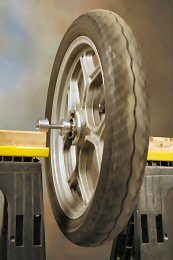
Slide the axle through the wheel, set it on the bearings, and spin it very slowly to find the heaviest spot, which will naturally rotate towards the bottom. Put a weight on the opposite, or top, side, check it again and you’re done.
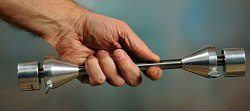
Marc Parnes has come up with a neat little wheel balancer that works very well, is adaptable to many different types of motorcycle wheels, and has the added bonus of portability, which makes it easy to stow in a toolbox drawer or tank bag.
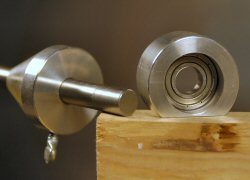
Marc’s balancer consists of an axle machined from tool steel, two 1.75″ machined cones that slide on either end and a couple of nicely machined bearing housings with high-quality sealed bearings installed.
In case you haven’t guessed, Marc’s a machinist and uses his own machine tools to manufacture his products.
Marc has many different adapters available, for front or rear wheels and for many different motorcycle brands, and custom axle lengths are also available.
Using the Balancer
Marc’s balancer doesn’t include the stand that it doesn’t need. Simply place the flat side of each bearing housing on a pair of automobile jack stands, a couple of chairs, or some portable saw horses like ours shown in these photos, and you’re ready to go.
The balancer is very easy to use.
Slide the machined axle through the wheel and fasten the cones up against the wheel hub with the 1/4-20 wing screws, then slide the bearing housings on each end of the axle.
Place the flat side of the bearing housings on your choice of stands and the wheel is ready to balance.
Here’s a balancing tip: after you remove the tire (and tube, if it has one), try balancing the wheel without the tire. You may find that the wheel itself is farther out of balance than the tire.
This is especially true with the first-generation cast wheels on motorcycles from the ’70’s and ’80’s. I find it easier to first balance the wheel and then to balance the wheel with the tire mounted.
Marc’s balancer is very sensitive. I tried it on a wheel that I thought was perfectly balanced, but the balancer showed that the wheel was very slightly heavy at one point.
It only took 2 grams of wheel weight to bring it into balance, which is far beyond what any rider would feel and is such a tiny piece of lead that it’s actually difficult to stick on to the wheel rim. But this illustrates the sensitivity of the balancer.
It’s not necessary to spin the wheel with anything other than a very light touch. After a little practice, you can probably balance a wheel in as few as 3-4 turns.
Conclusion
Motorcycle dealers in my area charge as much as $40.00 per wheel to mount and balance a motorcycle tire, which is truly outrageous.
At those prices, you can get a return on your investment in no time, especially if you split the cost with a friend or two. And you’ll get much more intimate with your motorcycle, which is a good thing!
More webBikeWorld:
| wBW Review: Motorcycle Wheel Balancer by Marc Parnes | |
|---|---|
| Manufacturer: Marc Parnes Products | List Price (2004): $105.00 Extra cones $25.00. |
| Colors: Silver | Made In: U.S.A. |
| Review Date: February 2011 | |
Owner Comments and Feedback
See details on submitting comments.
From “O.R.W.”: “Just a quick note on the Marc Parnes tire balancer review. I have had the pleasure of using this device for a year and found it to be more accurate than what my dealer can do.
Like you stated in the review, it is simple to use and will save $$$ compared to having tires balanced by a dealer.
It is amazing that in this day and age of electronic gizmo’s, a simple tool like that provides better accuracy than a $ 5k balancer!! Keep up the good work!!”