

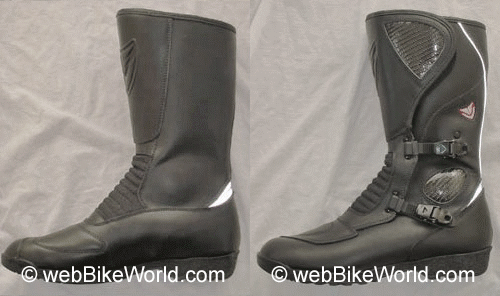
The Vendramini Marahton boots are made in Italy from real leather.
These are very comfortable boots!
The boots have a wide range of adjustments and include inner and outer ankle protection and shin protection.
Vendramini claims that the Marathon boots are waterproof.
But we haven’t used these boots in the rain so we can’t verify this information.
Giuseppe Vendramini first started making shoes by hand in the Veneto region of Northern Italy in 1919.
He soon became interested in making ski boots, and this led to an interest in making boots for outdoor sports, including motorcycling.
85 years later, in this incredibly competitive age of global cutthroat economics, Vendramini boots are still made by hand in Italy by the Vendramini family.
Their boots are well known in Europe and have an old-world reputation for attention to quality and detail that sets them apart from the crowd.
Think about it: when is the last time you found a product that boasts “Hand Made”?
Call me old-fashioned, but I think that’s pretty cool, and worth the few extra bucks, if only for bragging rights.
Many pairs of Vendramini boots have been brought back to the U.S.A. over the last few decades by motorcyclists who discovered them while touring Europe.
This has lent them a sort of cult status, but Vendramini products are now available through the American distributor.
The distributor also has the nice Italian made FAMSA tank bags and luggage, which will be reviewed soon on webBikeWorld.
They offer several styles of Vendramini boots for the U.S. market, and we obtained a pair of the Vendramini “Marathon” boots for this review.
The Marathon is Vendramini’s “top of the line” sport-touring boot, and it was designed to be comfortable over the long haul while still offering a level of protection that is often missing from a pure touring boot.
Many motorcycle touring boots seem to skimp on safety features, which is odd.
I would think that the serious mileage types would want the best protection possible during all that time on the road. Safety and comfort should not be mutually exclusive.
Protective Features
Sport-touring boots are theoretically designed with a greater range of comfort in mind compared to boots designed for motorcycle racing.
Race boots are angled forward for a reason.
They’re shaped to work when hunched down low behind a fairing with feet perched up on rearsets.
This makes race boots a poor choice to use for walking any significant distances. They also usually have very hard soles that help support a rider swinging back and forth over the tank in knee-down turns.
And they aren’t well suited for the more upright riding positions found on touring or sport-touring bikes.
That race boots that aren’t suited for touring is understandable, but why is it that so many other styles of motorcycle boots also seem to lack comfort both on and off the bike?
To be honest, I was prepared for more of the same with the Vendramini boots.
Comfort
But the Vendramini Marathon boots surprised me by being about as comfortable as a nicely broken in pair of street shoes.
They also offer a sense of security that makes my old flimsy Dainese touring boots feel pretty lame in comparison.
Comfortable boots make for happy feet; happy feet mean less stress; less stress makes it easier to concentrate on the job of piloting the motorcycle.
Real Leather!
Vendramini uses real leather (remember that?) in all of their boots.
They say that leather offers better protection in the unfortunate event of a slide on asphalt.
Vendramini claims that the 2.8 mm thick leather used in the Marathon can withstand temperatures up to 300° C, while some of the man-made petroleum based leather substitute products will melt during a slide and can cause serious skin damage.
2.8mm thick leather is pretty tough stuff; leather race suits are usually made from 1.4 to 1.8mm thick hides, so another 1mm adds an extra measure of protection.
They must know what they’re doing, because the Marathon is certified to the European motorcycle clothing standard EN 13634 “Protective Footwear for Professional Motorcycle Riders” (see below).
More Protection
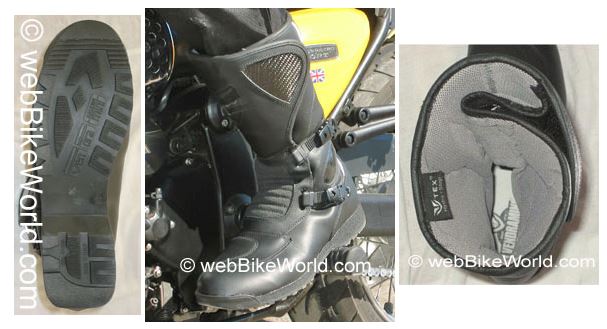
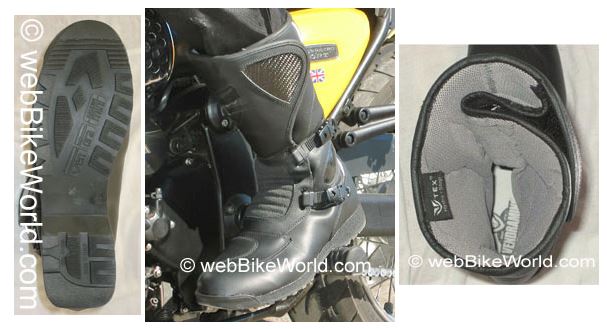
The Marathon boots have carbon-fiber ankle protection plates on both sides of the ankle.
The outer side of the boot has a slab of carbon fiber double-stitched into the leather, while the inner side houses the ankle protector underneath the thick leather.
The Marathon boots also have toe reinforcements and a big, wide shin protector that’s fitted under an extra section of leather that covers the shin.
The boots have an extra width of leather that wraps over the toes to help prevent wear from the bike’s shift lever (right or left!).
This is a common feature on motorcycle boots, but the shift protector on the Marathon extends all the way back along the inside exterior of the boot and wraps around the heel.
All of the leather on the boot is double stitched, and there’s some nice leather piping that’s stitched around each boot top, which prevents fraying and adds a bit of style.
The Marathon boots have another safety feature that’s usually only found on professional race boots.
There’s a layer of extra material between the leather inner sole and the inside bottom of the boot that helps prevent lateral crushing or movement during a crash.
This level of protection is standard on all Vendramini boots, from their basic scooter boots to the all-out race styles.
 Soles and Liner
The soles also seem to provide good traction on wet or oily surfaces; the good traction helps for situations when you’re seated on the bike and pushing it backwards into the garage or a parking space.
The soles offer a bit of cushioning, which helps make the boots fairly comfortable to use for walking.
Vendramini uses a nicely cushioned boot liner, which includes their proprietary “V-Tex” breathable membrane, and the boots are claimed to be totally waterproof.
While many shoes and boots that have waterproof liners can become very hot, we found the Marathon boots to be very comfortable, even after spending a couple of hours walking around in a motorcycle shop.
This is a pleasant surprise; motorcycle boots are notorious for getting hot and sticky.
I’m not sure if it’s the leather that’s more breathable than a man-made material or if it’s the V-Tex liner, but the combination seems to do the job.
Adjustments
There are two other unique features that help make the Marathon boots comfortable.
The large shin protector opens up all the way down to the top of the arch and the closure has a fairly wide swatch of Velcro, which provides some adjustment to fit different calf diameters.
This adjustability also means that the boots can be snugged up nice and tight on various sized legs or with tucked-in riding pants.
It’s an elegant design and it makes you wonder why other manufacturers haven’t done something similar.
Buckles and Clasps
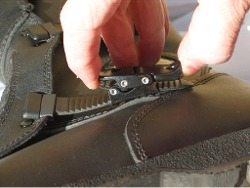
The boots also have an interesting feature that’s reminiscent of dirt/supermoto boot styling. There are two metal ratcheting clasps on the outside of the boot, above and below the ankle.
A serrated plastic belt is inserted into the ratchet, and can be cinched up by using one lever of the double-action ratchet.
To release the belt, work the reverse lever and the belt is fed back out of the clasp. It can be a bit of a struggle to get the straps lined up in the clasps when fully suited up; we suggest doing this while sitting.
The styling works rather well; this would be the perfect boot for all you new BMW R1200GS (report) owners!
The buckle system works well and offers a wide range of adjustability to snug the boot up tight in the critical ankle area.
It allows the boot to be virtually custom fitted; the combination of the Velcro closure at the top of the shin guard.
The two ratchets work together to fit in an almost infinite number of combinations.
We also found that the adjustability can provide some extra ankle support for walking and helps make the boot feel more comfortable and secure.
The only potential downside to this system would be if the serrations on the straps eventually become worn from the ratcheting action.
Weight
Each Marathon boot weighs about 1kg (~2.3 lbs.), which is about average for a motorcycle touring boot.
The weight is carried evenly, and is helped by the ability to secure the boot to each leg and ankle with the unique buckling mechanism.
Size and Fit
The manufacturer suggested that the Marathon boots run a bit small, but I think they run true to size.
I usually take a U.S. size 10.5 shoe and the Marathon boots we received are size 11, and they’re a bit big, feeling like a size 11 would on my feet.
This isn’t a problem; I’d rather have a bit more room for heavy socks in the winter, but based on our sample, I’d say that the boots run very close to true size.
Conclusion
Unfortunately, many motorcyclists in the U.S.A. don’t wear protective clothing when riding. Motorcycle boots seem to be one of the last items that a serious rider invests in.
The Vendramini Marathon boots are a bit expensive, but if you’re serious about riding or touring, I’ll bet these boots will last a long time and the quality and comfort seem well worth the money.
| wBW Review: Vendramini Marathon Motorcycle Boots | |
|---|---|
| Manufacturer: No longer in production | List Price (2004): $285.00 |
| Colors: Black | Made In: Italy |
| Review Date: February 2004 | Sizes: 40 to 48 Euro |
Owner Comments and Feedback
See details on submitting comments.
From “R.H.” (7/09): “I agree totally with the last poster. Bought mine in 2006 and have not looked back. I can’t tell you how many miles/Km I have ridden with them. But every time I put them on, I think “what a great boot”.”
From “G.A.” (5/09): “I purchased a pair of Vendramini Marathon Boots in August of 2006. I have worn them exclusively for riding since that time in all weather conditions and temperature ranges.
The Marathons were comfortable right out of the box. They felt broken in, they were that good.
The quality and attention to detail was first rate and met my expectations. I now have over 60,000 miles on these boots, with zero complaints.
The ratchet straps, Velcro, boot interior, all work as good as the day I took them out of the box.
The soles have held up as well as the rest of the boots. I mentioned the soles because I felt, and still do, that the soles lack much in the way of cleats to grip with, my only complaint.
That said, the boots have gripped the pavement in all weather and surface conditions.
I live here in a desert climate with summer temperatures often exceeding 100 degrees. My feet have never felt baked in these boots. Count me a happy customer.”
From “A” (10/08): “I purchased a pair of the steel Marathon boots. The workmanship quality is poor.
It seems that these are seconds where they missed the seam and punctured holes in the leather on the front toe protector.
After many phone calls to the store, they have not been very helpful. To bad not a way to check quality before ordering. Not so Happy.”
pr EN 13634:2002 – Protective Footwear for Professional Motorcycle Riders – Requirements and Test Methods
“Based on the wealth of available industrial footwear standards to draw from, prEN 13634:2002 provides an adaptation suitable to the demands motorcyclists place on their footwear.
There is a minimum height requirement of 160 mm, measured inside the boot from the footbed up the rear of the boot to its topmost edge.
The strength of the bond between the sole and the upper is tested, the thickness and cleat height (depth of “tread”) of the sole must both be above prescribed mimima and its resistance to abrasion is tested.
The sole is also required to demonstrate a minimum specified level of inherent rigidity.
Too soft a sole could collapse in an accident and increase the risk of severe foot injuries, which a more rigid sole might help to prevent.
The uppers of the footwear are subjected to the impact abrasion test described in prEN 13595 Part 2, although the impact cut test follows a different method to that used for garments.
The water absorption and desorption characteristics of the material worn closest to the wearer is also assessed.
Optional requirements include testing of impact protection which may be fitted to the ankle and shin, water resistance and fuel oil resistance of the outsole.”