

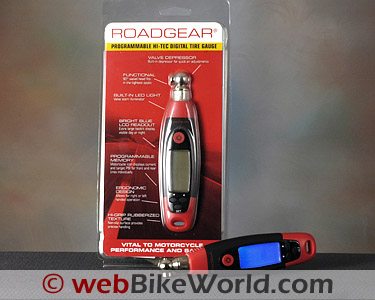
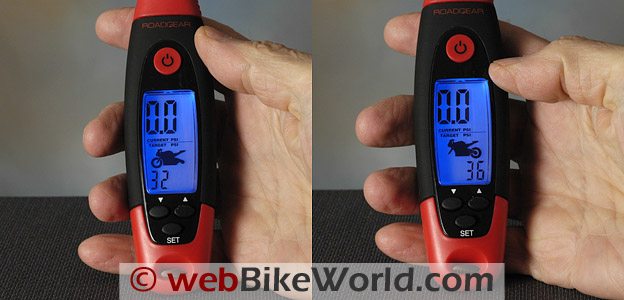
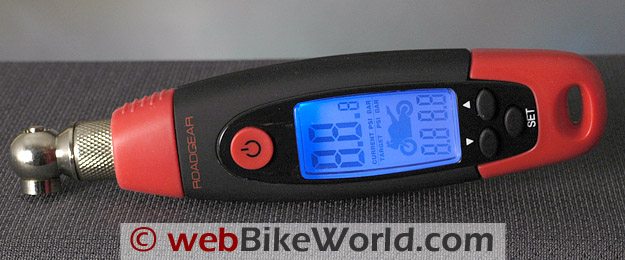
The Roadgear Digital Programmable motorcycle tire air pressure gauge is designed specifically for motorcycles.
It stores the recommended pressures for one pair of tires.
But as is the case with any digital item, if the batteries die and you don’t have spares, you’re out of luck.
If this Roadgear Programmable tire pressure gauge looks familiar, then congratulations, you’ve been a webBikeWorlder for more than three years.
I reviewed a nearly identical tire pressure gauge sold under the Sears Craftsman brand in April of 2006.
Roadgear recently sent their new Programmable “Hi-Tec” Digital Tire Pressure Gauge and the Editor asked if I’d like to do a follow-up.
And being the tool freakster that I am, of course I said “Yes!”.
The Roadgear gauge addresses one of the comments I had on the Sears model, because this one is specifically designed for motorcycles.
The Sears gauge had an image of a car and the front and rear tire pressures could be stored.
The Roadgear gauge features a motorcycle image on the LCD and front and rear tire pressures can be stored.
Like the Sears gauge, the term “programmable” does not mean that the tires can be bled down to a programmed pressure. It would be nice if the gauge had that capability.
A truly programmable gauge might work by first storing the recommended tire pressures in the gauge.
Then the tire could be overfilled slightly. When the gauge is attached, the air pressure in the tire would be released automatically by the gauge until it reached the programmed pressure and stop.
That would probably take a level of sophistication that would be significantly more expensive, however.
Like the Sears gauge, programming the Roadgear unit means storing the bike’s recommended pressure for the front and rear tire and then using that as a reference only when filling the tires with air.
Programming the Gauge
Programming the gauge isn’t difficult and it is demonstrated in the video below.
It’s a matter of pressing the “Set” button to turn on the gauge, holding down the Set button for about 3 seconds to enter the programming mode, then using the up/down arrow keys to change the numbers.
While in programming mode, the gauge can also be set to read either PSI or Bar.
Once the pressures are entered, the gauge is turned on by pressing the “Set” button.
The up/down arrows are used to select either the front or rear tire.
When the gauge is in use, the tire pressures show at the top of the display in large numbers and the programmed pressure remains on the display for reference.
The Roadgear Programmable gauge can store the tire pressure for the front and rear tire.And…A Flashlight!
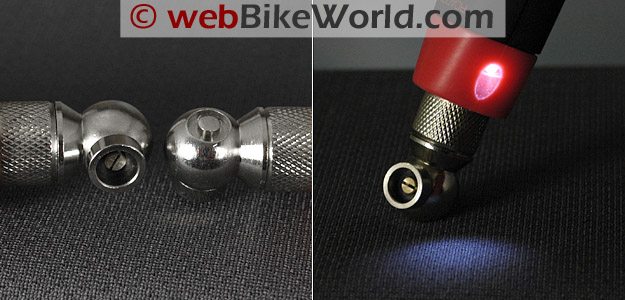
The Roadgear version has a small built-in LED flashlight, just like the Sears gauge.
The business end of the Roadgear gauge is made from metal and rotates 360 degrees and it also includes a valve stem bleed button on the opposite side.
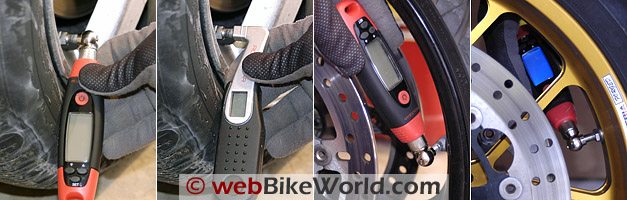
The shape and size of the gauge can make it slightly difficult to fit on some combinations of tires and valve stems.
If the valve stem is close to the edge of the tire rim on a car, as shown in the photo below, the sides of the gauge can prevent the head from reaching the valve stem in certain situations.
The orientation of the head can also make it somewhat difficult to reach the 90-degree valve stems on the Multistrada.
It can be done, by it may take a bit more twisting and manipulating to get the Roadgear (and Sears) gauge in the correct orientation to seat on the valve stem.
My favorite is still the “original” Roadgear Digital Tire Gauge (review) with its “L” shaped head because the L shape allows the head to fit on every valve stem orientation I’ve tried.
My all-time favorite tire air pressure gauge, or the one I use most often, is an Accutire gauge that for some reason was never reviewed on webBikeWorld. It has a big dial and a hose with a remote head, placed at 45 degrees or so.
I can get that head on any valve stem I’ve tried, on motorcycles, cars, trucks and trailers.
However, it’s nowhere near as portable as the original Roadgear gauge or even the new programmable gauge.
Rotating metal head features a valve stem air release on back (L). LED flashlight is included (R). (L to R): Roadgear gauge as used on a car tire. Roadgear “L” shaped gauge on car tire. On the 90-degree valve stem of the Ducati Multistrada. On the valve stem of the Carrozzeria wheels (review) of the GT1000. The buttons on the gauge are not recessed.More Features
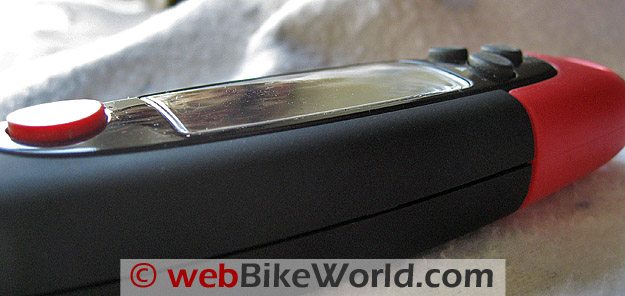
One other feature that doesn’t work for me on the Roadgear gauge are the buttons, shown in the photo above.
They are not recessed, nor are they flush to the body of the gauge, and I noticed right away that whenever I took it out of my pocket, the gauge light was on.
I’m concerned that this may prematurely run down the battery or damage the buttons.
On a tool like this, the buttons really should be recessed.
The display is very bright, but like the Sears gauge, I think it’s probably overkill to have all this technology simply to store the air pressure for two tires.
Warranty
The Roadgear Programmable Digital Tire Pressure Gauge does come with an extraordinary 5-year warranty however.
Basically what this means is you send it back to Roadgear with $5.00 (I guess to cover shipping) and they’ll send you a new one.
Display and Batteries
The gauge displays in 0.5 PSI increments from 5.0 to 99.5 PSI, a wide range.
Roadgear says the gauge will compensate for temperature, humidity and altitude variations.
It has a claimed accuracy of ±1%, which is excellent.
Like the Sears unit, this one uses two CR2032 batteries and it has the same four tiny Phillips head screws that must be removed to access the battery box.
I think the batteries on something like this will last a long time, so it’s not a big deal, although Murphy’s law says just when you need it most on a trip that the batteries will die.
More Details
The gauge is very well made and feels very solid. It has a rubbery soft-feel coating all over.
It weighs 106 grams, which is two grams more than the Sears gauge. The Roadgear Digital Tire Gauge at weighed 46 grams when we reviewed it.
Conclusion
The Roadgear Programmable Digital Tire Pressure Gauge is basically the same as the Sears gauge I reviewed in 2006, with the inclusion of a motorcycle icon replacing the car.
It’s still well made, has a rotating head, a large and backlit LCD and a bonus LED light. The downside is the same: weight, size and cost — this one is now $32.90 (the 2006 price of the Sears gauge was $24.99).
I’ll repeat what I said back then: My favorite portable “pocket” digital tire gauge is the Roadgear Digital Tire Gauge with the 90-degree bent head.
It’s lightweight, small and hasn’t failed me in 4 years. I use it before every ride and it’s always in my pocket during a trip.
More webBikeWorld:
Owner Comments and Feedback
See details on submitting comments.
From “J.S.” (February 2010): “Having blown through a couple of digital gauges, my only concerns are:
1. No display backlighting. This is no big deal until you check pressure in the dark or poorly lighted area. This probably isn’t an issue if the display is vivid enough (but see #2, next).
2. The design beats many others but isn’t fumble-foolproof (see the opinions of the Accutire version on Amazon) whether dial or digital.
But that can be made easier if the gauge has a “good reading” audible beep for hard-to-reach-and-see situations (once available on a Brookstone version of the Accutire gauge, but no longer). A beeper also reduces the importance of a good backlit display.”
Editor’s Note: The Roadgear gauge shown above does have a lighted display.
From “R.T.” (January 2010): “Just purchased this tire gauge. Easy to use, kinda’ fun…….makes you check your air pressures more often!”