

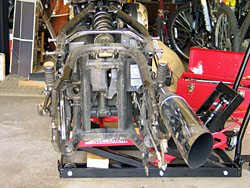
Works well but is not a replacement for a proper motorcycle lift table. It may be hard to find a safe balance point on some motorcycles.
Just about every motorcycle I’ve ever owned had a center stand.
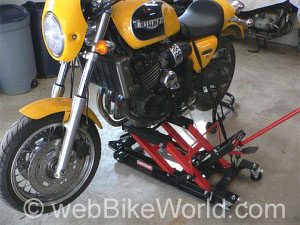
When I purchased the Triumph Thunderbird Sport shown here, it crossed my mind that the lack of a center stand might be a problem, but my emotions took over and I bought the bike anyway.
I love the bike, but after living with it for a while, I’ve come to the conclusion that every motorcycle should have a center stand as original equipment, no doubt about it.
I had no idea how hard it would be to perform the most basic maintenance tasks on a motorcycle sans center stand.
Easy projects like an engine oil or fork oil change, a chain lube, tire change or even cleaning the wheels are more difficult or, in some cases, nearly impossible without extra lifts, stands or jacks.
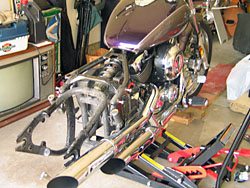
A rear swingarm (aka paddock) stand, like the Steel Horse unit that can just be seen in these photos (see the wBW review of the Steel Horse swingarm stand) is a must-have for a motorcycle without a center stand.
But even the Steel Horse stand can’t help when it comes to front end work.
I cobbed together a wooden box-like structure that I used to place under the engine to hold the Triumph steady for front end work, along with the swingarm stand holding up the rear.
But it’s very hard to balance the Triumph’s engine over the wooden structure. It would take me longer to get the bike set up on the box than it would to remove the front wheel, and I never felt safe doing it.
This job should be a no-brainer with a center stand, as it is on my BMW R65.
The Sears Craftsman “Motorcycle/ATV Jack” stand has been available for a couple of years, and I had it in the back of my mind that one day I’d buy one when it was on sale. When this product first came out, it was selling for something like $149.95.
The price has dropped to around $119.00, and it can occasionally found on sale for $99.00.
I belong to the Craftsman Tool Club, which means an extra 10% discount during the frequent Tool Club sale weeks. Sears was having a sale recently on the jack for $90.00, and with my discount, I ended up paying right around 80 bucks.
The Sears motorcycle jack (or motorcycle lift, as I prefer to call it) comes packed in a hefty box.
The unit weighs in at 90 pounds.
Some assembly with a 14 mm wrench is required, but the instructions are rather straightforward (if a bit sparse in detail) and the unit can be assembled in about 10 minutes or so with frequent references to the line drawings printed in the instruction manual.
Using the Sears Craftsman Motorcycle Lift
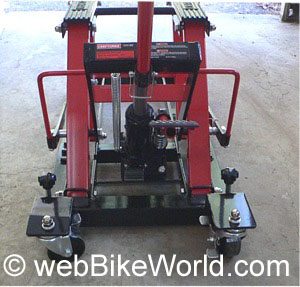
The basic concept is to slide the lift under the motorcycle, lock the two revolving rear wheels and slowly jack up the bike by pressing on the foot pedal that operates the hydraulic jack.
There are two vinyl coated parallel lifting surfaces that contact the underside of the bike or engine and lift straight up.
They don’t lift in a precisely vertical plane; there is some sideways movement, but it’s easy enough to compensate for the drift.
We found that the lift works best when the motorcycle is positioned vertically with the rear end up on a swingarm stand.
There are way too many motorcycle configurations for us to try, but for the most part, if you don’t own a swingarm stand, the motorcycle should be parked nearly vertical with something like a piece of wood under the side stand to minimize lean.
If you can do this, AND if you have enough clearance under the right side of the motorcycle without fouling the exhausts, the lift can be pushed under the engine from the side of the bike opposite the side stand.
The jack is released by lightly stepping on the release pedal.
The lift is designed to hold a maximum of 1,500 pounds, according to Sears, which should be enough for just about any motorcycle out there.
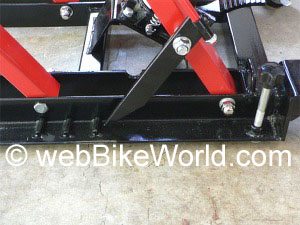
The lift has a built-in safety feature, which is basically a pair of spring-loaded ratchet levers that can be placed in one of 3 positions to prevent the jack from collapsing (see photo, left).
The knobs on the right in the photo can be screwed down to the floor to help steady the lift.
It all works very smoothly, and I was impressed at the accurate feel of the pedals when lifting or releasing the bike. Very accurate positioning can be obtained, so the hydraulic cylinder must be specially designed for this application.
The lift works much better under a motorcycle with a pair of full-length frame tubes, like most cruisers and many older bikes.
The Triumph, however, uses its engine as a stressed member, and there are no frame rails underneath.
We did not try using the lift under a sportbike, but I think a horizontal four-cylinder engine might be too narrow (front to back) to fit on the lift’s rails.
The short length of the Triumph’s engine means that the lift must be precisely centered under the engine to balance the motorcycle on the stand. The only point of contact on this bike is the oil pan, which is very narrow.
The Thunderbird Sport’s exhaust hangs off the right side and sits slightly lower than the engine, so the use of a swingarm stand is a must and the lift must be rolled under the left side of the bike.
This is something to consider if you plan on purchasing a lift. The Triumph’s engine is just barely wide and long enough for the lift to fit underneath, and the bike will balance on the lift’s pads, but just barely.
The lift easily slides underneath most motorcycles, because it collapses to 5-1/4″ high under the lifting surfaces. Sears recommends raising the lift to one of the 3 safety catch levels only, which engage at 11-3/4″, 14-1/4″ and 16-1/2″ high.
The problem, at least with a motorcycle without under-engine frame rails like the Thunderbird Sport, is that the balance point (of the motorcycle) is located in a very narrow window, both front-to-back and side-to-side.
Sears provides two ratcheting tie-downs in the box (which can also be used to tie down the bike on a trailer or pickup truck bed). The tie-downs attach to one of four welded-on points on the frame of the lift.
But the tie-downs don’t really do much to hold the bike. They’ll hold the bike to the lift, but if the whole shebang decides to topple over, the straps will probably do nothing other than keep the lift attached to the bottom of the bike.
When the bike is on the lift in the raised position, it’s steady enough to do some minor repair like an oil change or cleaning, but most of the time if you need to lift a motorcycle, it’s for some heavy work, like removing the front tire or forks.
After trying the lift under a couple of motorcycles, I’m not convinced that it will hold a motorcycle steady enough to perform anything other than very light maintenance.
The bikes just seem too unsteady and the balance point is too sensitive.
I can easily rock a motorcycle back and forth or side to side when it’s on the lift, so I would certainly expect it to fall over backwards if, for example, the weight of the front tire is removed.
I don’t think the Triumph could be successfully balanced on the lift without the front wheel, because the engine is not wide enough front to back to allow the lift to be relocated to account for the lighter weight.
There’s only one location where the lift will fit, and it doesn’t take much to unbalance the bike when it’s raised.
The two vinyl coated parallel lift surfaces are 13-1/4″ wide to the outer edges, and each flat is 2-1/2″ wide.
This means that if your engine is shorter (front to back) than the lifting surfaces are wide, there many not be any leeway for adjusting the position of the lift to stabilize the bike under various weighting scenarios.
My opinion is that a motorcycle on this lift may not be safe enough to perform anything other than light maintenance. For example, the front axle nuts on the Triumph take some muscle to remove, and that kind of jerking around could upset the balance.
Your fear factor may vary; I’m conservative when it comes to working around heavy machinery.
Conclusion
My opinion is that the product is definitely not a replacement for a proper motorcycle table lift, nor is it a replacement for a rear swingarm stand.
It does work better on motorcycles with frame rails underneath, like those found on most cruisers.
However, the potential problem of side-to-side and front-to-back balance still exists. The motorcycles we tried just seem too unbalanced for me to feel comfortable.
I’m not sure what types of maintenance jobs the lift is designed for. An oil change, perhaps, or maybe to clean the wheels?
If anyone has experience using the Sears motorcycle lift and is interested in relating their experiences, send me an email to editor@webbikeworld.com and I’ll post your comments.
More webBikeWorld:
| wBW Review: Sears Crafstman Motorcycle Lift Review | |
|---|---|
| Manufacturer: Sears | List Price (2005): $80.00 USD |
| Colours: Black or Silver. | Made In: China |
| Review Date: February 2011 | |
Owner Comments and Feedback
See details on submitting comments.
Editor’s Note: Many cruisers have double-cradle frames, which work much better with the Sears lift because the bike sits on the lift via the frames looping under the engine.
Motorcycles without frames looping under the engine have a much smaller surface to sit on the lift; in some cases, the entire motorcycle must be balanced on its oil pan. This can cause an unstable platform for serious work.
From “L.H.” (May 2016): “I have trouble with mine bouncing when I lower the bike? I have filled, bled and everything else I can think of and it still does it. Anybody else have this problem??”
From “D.K.”: “I’ve owned this lift for 3 or 4 years now. I regularly lift my 850 pound Harley-Davidson Electra Glide. I use it to change tires, brakes, etc… I also use it to level the bike for general maintenance since H-D does not have a center stand.
It’s also nice to raise it up and sit on my wheeled stool for cleaning and maintenance.
I have not had a problem with the jack. I always set the lock bar and throw a ratchet strap over the frame spine of the bike for safety. When I remove one of the wheels I place a jack stand at the other end. Thanks for a great and useful article.
BTW – as of this writing the jack is on sale for $69.99 at sears.com. The sears web site has customer reviews posted. Most of the complaints are of bottle jack failures. Sounds like they need to heed S.P.’s advice (see comment below).”
From “P.”: “Read your review of the Sears motorcycle lift. I have what I believe is the same lift, but sold by Harbor Freight. It’s made in China, appears rather crude but identical to the lift in your pictures.
I bought it from a fellow on Craigslist for $35, to work on my Suzuki DR650 dual sport bike (about 350 lbs.). I’ve used the stand to lift the bike while I straightened the forks (twisted in a fall due to ice) and to lube the chain, and intend to use it for oil changes and further maintenance. The bike is quite stable when lifted, the stand works fine for me.”
From: “S.P.”: “I’ve had mine for about a year now and it has malfunctioned twice. The rubber plug leaks and a threaded plug would be desired, but wall thinness may prohibit this. Plug access is a pain as it’s location is under the return spring and on the side, rather than on top when the jack is fully retracted.
Going to wrap electric tape around the jack, covering the plug to see if this helps …poor design.
When it works it is a back saver. I have a classic GT750 and doing the points and timing on the jack is very convenient. Or any maintenance on the carbs, air cleaner, etc. Anything to keep me out of a unright fetal position is a plus.
Got spokes to polish rims to clean …on the jack it goes.”

Update From “S.P.”: “I finally found the reason my Sears Motorcycle jack keeps failing and is probably the same issue on some of the other responders issues with this jack. The oil fill plug does not vent properly.
As the jack is raised a vacuum develops in the outer chamber causing a pressure differential great enough to overcome the ball valve seating. Oil will not feed to the piston and the jack feels like it’s low on oil.
Put more oil into the jack (removing the plug (and the pressure differential along with it) and it may start working again but the plug (and extra oil) will blow out the fill hole when retracting the jack. Making a #$%^ mess.
Replacing the rubber plug with a 5/16″ grommet, inserting a plastic tube to fill the grommet hole (and provide a positive vent) enables the jack to work flawlessly, full piston strokes to the full height of the ram.
Hope this alleviates someone else’s frustration, a $0.43 fix.”
From “D.F.”: “I ride a 2003 V-Star 650 – I lowered the rear 4-5″ and the forks are 2″ longer, thus reducing the ground clearance. After these modifications I bought this lift from Canadian Tire, apparently for $102.59 including tax.
These modifications prevent the lift from easily sliding under the bike, but a 2 x 4 plank under each wheel provided the required clearance. I found the lift arms were not horizontal, in fact I needed to shim them up at the end furthest from the hydraulic cylinder.
In fact I had to shim up both sides (of each arm) in order for the belly of the motor to clear the lift. Setting up the lift is time consuming to be sure.
However, once the bike is off the ground I was comfortable working on the bike, although mindful of the big picture. Most recently I removed my rear wheel/hub/driveshaft/fender while using the lift. Worked great.
Incidentally. there is no rule book associated with this lift so that said, I added additional load carrying/stabilizing components (more wood) to steady the bike (photos below). Weighing the significant factors I believe this lift is the best bang for the buck.”
From “G.S.”: “Firstly, congrats on a magic site. I own a Harley Heritage and as Harley heads do, I needed to clean the spoked wheels. This was only possible with some sort of jack.
I got onto the web and found the plans for the jack and built myself a basic jack that worked really well. I then thought that it would be better to get hold of a commercially available one from Sears that had all the bells and whistles.
This I did at great expense, only to find that the Sears jack was at best, extremely unstable and the bike did not look safe at all. The jack is not well made and the width has not been very well thought out.”
From “K.W.”: “I tried the same model as you and also the new aluminum model and had to return both. The all metal model was no where near what I would call a safe device to use for anything other then cleaning etc.
The other problem was, I have a Victory TC and the distance between the frames are approximately 13″.
This does not leave a lot of room for error as the lifting plates are only 13.5″ on both models. However, the aluminum model was a little more stable on a test bike (Honda Shadow) that I used.
I could’ve reworked the all aluminum one and added another 1″ to each end of the lifting plate, but here your getting into changing stress points as well as balance points. So I opted not to do that.
So I’m currently trying to gather information on the OTC Model 1545 lift that has 17″ lift plates.
The whole process is problematic when you have to purchase on line. If the product does not measure up to be sound and safe then you end up eating the shipping charges back to the supplier.
So I send quite a few emails inquiring about the product first.
If it wasn’t for people like you with reviews, it would be worse then what it is. This I thank you for.”
From “J.B.”: “I paid even less for the jack – I borrow my friends. 🙂 I ride a Triumph Bonneville America and I’ve used the Sears jack for major operations like removing the wheels to take them in to the shop for new tires (saves me $50 per wheel).
And last year I replaced the chain and sprockets with a QPD belt drive, necessitating the removal of the rear swing arm.
I do use the straps but it seems to me this is akin to putting your arm in a sling – it’s not really there to help keep your arm safe as much as it is there to *remind* you to watch out for it.
I agree that the jack seems unstable but it’s really not once you understand the balance point concept. I suppose the true novice could get into trouble with it but it has handled everything I’ve thrown at it just fine.
Considering it costs a small fraction of the cost of a “proper motorcycle lift,” its the only realistic option for many enthusiasts who want to do their own maintenance.”
From “B.C.”: “I have used this lift for 2 years for winter storage of my Honda Valkyrie interstate. (There is an adaptor made for the Valk).
My bike is the Blue silver Interstate. Tires, brakes, oil change, etc. have all been done on this lift. Very stable for a big bike.”
From “P.A.”: “I too purchased the sears lift for about $80. I assembled it and was a little skeptical about lifting Goldwings. I have two 1500 models and it worked great. I had to leave the center stand up and place it as close as possible to it.
It was a tight fit sliding it underneath from the right side but it does go if the side stand is propped up slightly.
I did extensive maintenance to the one bike ( front wheel and forks removed, rear wheel removed along with the trunk and bags.
As I was working on it I was a little fearful at first but as the worked progressed the bike was much more stable than I anticipated.
After awhile, I had complete faith in it and did not even think about the jack while performing the work. It was money well spent. I am 100% satisfied knowing it has some limitations but does what I need it to do.”