

We counted 18 different pairs of Joe Rocket motorcycle gloves available for sale in their 2007 catalog.
The list includes everything from full race gloves (Speedmaster 6.0) to Supermoto gloves and everything in between.
Joe Rocket has settled on a few different branded clothing lines.
These include the “Speedmaster”, as the “flagship” race brand, followed by brands like Blaster, Ballistic, Atomic and the Phoenix mesh line, among others.
They sell jackets, pants and now gloves in each of the clothing lines, hoping to target all of the marketing niches that develop.
It’s interesting to note that they apparently had to play catch-up to Icon, who was first to recognize and capture the stunt community, with the Joe Rocket “Rocket Nation” lineup.
The Phoenix brand first emerged several years ago with the Joe Rocket Phoenix mesh jacket, which we reviewed when it first appeared. A year or two later came the Phoenix pants, and the Phoenix gloves are now in their third generation, thus the “Phoenix 3.0” appellation.
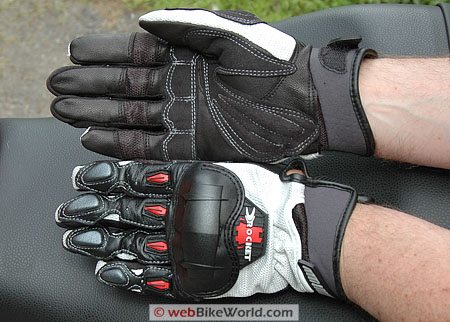
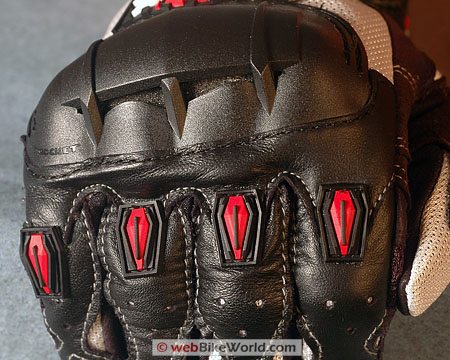
The Phoenix 3.0 gloves use what appears to be the same Joe Rocket “Free-air” mesh that’s used in the latest version of the Phoenix mesh jacket. But there’s a lot of leather on this glove, which is used on the palms and over the tops of the fingers. Combine that will the big plastic knuckle protector and it would probably be more accurate to consider the Phoenix gloves as leather with traces of mesh, rather than all mesh.
Read the label and you’ll discover more — a veritable laundry list of fabrics is used in their construction, including 40% Nylon, 25% goatskin, 15% cowhide, 15% synthetic leather, 5% Aeroprene (a breathable neoprene) with a 100% polyester lining. I wonder what cube dweller was assigned the task of calculating all these percentages?
Synthetic fabrics are normally used in motorcycle gloves to either lower the price or increase protection. Normally it wouldn’t be a problem to use whatever type of fabric or material will offer better protection, but when you start seeing lots of Nylon and other synthetics used in the body of the glove itself, with leather used only for the areas that have to do the work of protecting the rider’s hands, it’s usually a sign of cost cutting.
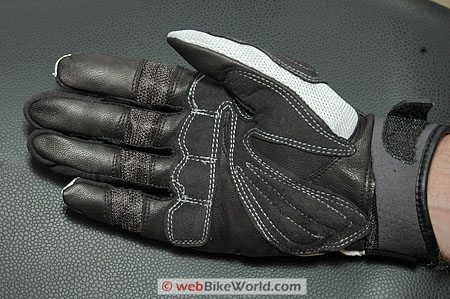
The Phoenix gloves have leather palms and what appears to be a type of synthetic leather (Clarino?) over the palms as a wear barrier. The fingertips and the back of the fingers have what feels like a very thin leather (possibly goatskin), but overall these gloves feel very thin.
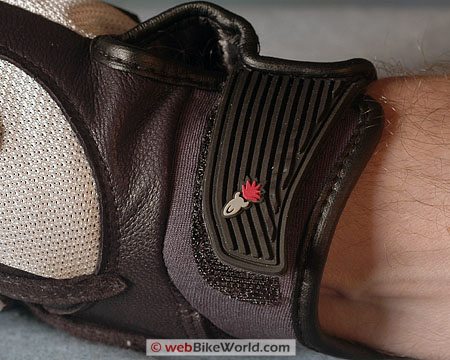
The Aeroprene material is used on the cuff, which also has what feels to us to be an almost vestigial rubber-like strap with hook-and-loop on the back, used to secure the cuff. The strap looks, feels and works like someone really tried hard to lower the cost as much as possible, giving us no confidence that the strap will either last or hold up during a crash.
We’re also very disappointed with the way the Phoenix gloves feel inside. The word “hinky” comes to mind, because these gloves simply feel awful. There are all sorts of threads, seams and plasticky-feeling pieces that press against the rider’s hand. Perhaps it’s more noticeable because the gloves don’t have a full-length liner?
A great motorcycle glove will be constructed in such a way that allows a seamless feel between the rider’s hands and the grips that provides maximum sensitivity for the controls so the rider can feel what the bike is doing. These gloves have exactly the opposite, in our opinion. There’s too much going on inside that shouldn’t be felt.
The fingers also seem rather tight and smaller than normal for a size large and the pinky finger especially feels tight and it hurts over the knuckle when the hand is curled in a grip on the handlebars.
Most of the mesh is covered by leather, and the leather has only 3 perforations on each finger. Thus, the gloves don’t seem to flow much air. When the hands are lifted off the bars, more air seems to flow in on the palms than through the tops of the gloves. The plastic knuckle protector looks like it’s supposed to be an airfoil or scoop that would flow air into the gloves, but it’s backed by some foam padding that prevents any air from entering, rendering it ineffective.
Conclusion
Our opinion is that the Phoenix gloves offer an uncomfortable feel with too many uncovered seams and sections inside. The cuff is small and it doesn’t provide a secure feeling of safety and the gloves just don’t seem to flow much air, which is really a problem in what is supposed to be a premier summer glove.
We’re usually impressed with Joe Rocket products and we’re not sure what happened here. We place these last after the Alpinestars Sledge gloves.
Owner Comments and Feedback
See details on submitting comments.
From “E.H.” (12/09): “I had the opportunity to try these out after purchasing a pair last summer. At highway speeds, they’re very cool in 70-90 degree temps. A neutral wrist position lets that scoop on the back bring in plenty of air even with the foam padding.
I’ve worn them on unheated grips down to about 35 degrees for several hours too, though my tolerance levels are probably a bit wider than most people’s. It was doable, but hardly comfortable.
The wrist strap locks securely enough under the base of the thumb for everyday use, and kept the glove right where it’s supposed to be during a 30 MPH low-side fall. Unfortunately, after 6 months of semi-regular use, the wrist strap on the glove that never touched the ground came apart. The glue connecting the rubber piece and Velcro failed, leaving both parts dangling uselessly. I can’t imagine this glove holding up under a fall like that.”