

See the updated information at the end of this article regarding the tire sizes for the 1986 BMW R65 (and possibly other Airheads!)
It won’t fit… or will it?
It was that time again — the every-few-thousand-mile decision. New motorcycle tires!!
My 1986 BMW R65 was ready for new skins.
This is the time when every owner probably thinks the same thoughts — is there a better tire, brand or size of motorcycle tire that will transform my bike into a MotoGP-style handling machine?
I know there can be some confusion over motorcycle tire sizing, especially when it comes to fitment for older bikes. But I was surprised at what I found…
Like any conscientious owner, the first thing I did was to check out the owner’s manual, which tells me to fit a 90/90-18 front and a 120/90-18 rear.
But the motorcycle was already running a 100-series front — the previous owner had mounted a 100/90-18 Metzeler ME33 up front, and an el cheapo 120/90-18 Yokohama rear.
Not to worry, because the 100-series front is a common retrofit for R65’s; I guess it gives a tiny bit more contact patch.
I’ve heard that the 100-series can slow down the steering a bit, but I hadn’t noticed – the bike, with its low bars and the 100 front tire feels like it steers pretty quick to me. And the ME33 was worn nice and even, without any of the cupping that can be a problem with this particular tire.
So I figured a 100-series would make a fine replacement. A 90 just sounds so skinny in these days of 120 fronts and 180 rears!
Note that there’s not necessarily a free lunch here — wider tires can mean that other tire dimensions will change, sometimes not for the best. In the old days, a tire was a tire and the sidewalls were about as tall as the tire was wide.
The term “aspect ratio” was unknown. But today, a 90/90-18 means that the tire has an aspect ratio of 90%.
That is, if the tire is (nominally) 90 mm wide, and the aspect ratio is 90%, then the tire is 90% of 90 mm, or 81 mm tall. In other words, the second “90” means that the tire’s profile is 90% of its width.
Which means that a 90/90 is a theoretical 81 mm tall at the sidewall; a 100/90 is 90 mm tall, and a 110/90 is 99 mm tall. Here’s a table that shows the differences in millimeters and inches:
| Motorcycle Tire Aspect Ratio Calculations | |||
|---|---|---|---|
| Tire Width | Tire Profile | Height (mm) | Height (inches) |
| 90 | 90 | 81 | 3.19 |
| 100 | 90 | 90 | 3.54 |
| 110 | 90 | 99 | 3.90 |
| 110 | 80 | 88 | 3.46 |
The problem arises when the tire sidewall heights are dramatically different than stock — they can start to affect the stock suspension or chassis setup.
In this case, if the bike was originally designed for a 90/90 tire, with a sidewall height of 81 mm, changing to a 110/90, even though the width will fit, changes the ride height by raising it a theoretical 18 mm, or .7″.
That’s almost 3/4″. Is that a dramatic difference? I think so.
This issue can be mitigated somewhat by raising the fork tubes in the head clamps (or triple-tree). This lowers the front end a bit, and to a certain extent, can restore the bike to somewhere near factory specs.
The catch in all this is that the numbers are sort of theoretical. We’ll see (I’m getting to it!) that even though a tire claims to be a 100 or 110 or whatever, the manufacturers may be stretching the truth a bit.
Which means that, yes, in theory, a 100/90 has a 90 mm high sidewall. But in real life, it depends upon the design, construction and other factors in the tire.
Which Tire?
Back to our story: After checking the prices on the Internet, it’s off to Speed’s Cycle in Elkridge, Maryland.
An email to Speed confirmed that his prices aren’t much higher than one could find on the ‘net, and I’m always interested in supporting the local guys when it doesn’t hurt my wallet too much.
After looking at the limited varieties of tires available for the R65, I ended up figuring on the safe bet: another set of Metzelers – the ME33 front in 100/90-18 and the ME99 rear in the 120/90-18 size.
However, Speed had a rear but he didn’t have the front in stock. He mentioned that a lot of Airheads have been mounting Bridgestone BT45’s recently and have been saying good things about them.
I know the Metzeler combo works pretty good and is a sure thing, but I’m always willing to try something different. So I figure “why not, I’ll go with the Bridgestones”.
As we’re walking over to Speed’s tire racks, he told me that for the BT45, the 110/90-18 front is the correct size, as they run narrow.
Was this yet another “urban legend”? Looking at the un-inflated tires on the rack, I could see that the front BT45 did look pretty narrow when compared to other tires of the same size.
So I figured Speed must know what he’s talking about. But just to be on the safe side, when I got home I did some snooping around on the various tire manufacturers’ websites and with a Metzeler brochure I had picked up, and found out something pretty interesting.
Opinions about tires are like opinions on motor oil — everybody has one. I read on one of the R65 websites that you can’t go wider than the 90-series. That may be true for some of the older R65’s, but not the ’86.
Even the Metzeler site recommends the 100-series ME33 for the front. But 110? Just looking at the numbers, and thinking about the warnings I’ve heard, you’d think you were committing a sin or something.
Common wisdom seems to think – as I did – that a 100-series is a 100-series. But guess what? It ain’t!
Unfortunately, not every manufacturer lists the dimensions of their tires, probably for some nutty legal reason. Even Metzeler doesn’t have dimensions on their website, but they list some numbers on their hard-copy brochure.
But Bridgestone does, and here’s what I found: The BT45 100/90-18 (V-series) is listed at 3.9″ wide. That’s interesting, because the Bridgestone Spitfire 100-series is listed at 4.2″ wide.
Checking the other sites, I found that the Dunlop K491 100-series is listed at 4.06″ wide; the GT501 is claimed to be 4.15″ wide; and just for comparison’s sake, the 100-series Metzeler ME88 and the 880 both check in at 4.0″.
Here’s a chart for comparison:
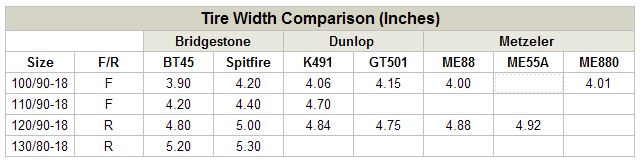
Am I the only one who finds it interesting that a 100-series tire can really be anything from 3.9″ to 4.2″? And a 110-series can end up being the same width as a 100?
So, what’s the moral of this story? I guess it’s that you can’t take anything for granted. Just because someone says a certain tire size won’t fit doesn’t mean that’s a true statement.
As you can see, the 110-series BT45 is the same width as the 100-series Spitfire, and about the same size as the GT501.
The implications of this are that you may have more tire choices for older Airheads than you thought there were. But make sure you take into consideration the aspect ratio problems as described above — the height of the tire may be more of a limiting factor than the width.
When I pick up the wheels this week, I’ll put some miles on them and relay my impressions.
Update
An email to Speed confirmed that he had the tires mounted and balanced right on schedule. I had also requested that he replace the front wheel bearings, which was done.
After I got the wheels home, I took the opportunity to clean them up a bit before I mounted them. I mounted the rear first with no problems. But I found that I had a bit of trouble mounting the front.
The 110 mm wide front meant that I now had to take off the single front brake caliper to get the tire on, which meant a bit of extra work (the old 100 mm wide Metzeler came off without having to remove the caliper).
But everything finally mounted up and went on ok — and I was surprised to see that the front tire could spin around with no clearance problems!
The 110mm wide Battleax doesn’t really look any wider than the Metzeler — in fact, the ME33 looked very wide, probably due to the chevron-shaped grooves; their horizontal arrangement probably tends to make the tire look wider than it really is.
After about 50 miles, my impressions are that the Bridgestone BT45’s turn in quickly — probably a touch quicker than the Metzeler ME33’s, but they have a nice, progressive feel after the initial turn-in that makes me feel more confident in them than the ME33’s.
My experience with the Metzelers, after using them on two bikes, has been that when the bike first initiates a turn (after the first push of the bar to initiate the turn), the bike quickly falls into the turn.
But that there is a definite feeling that you quickly reach a point where the tire all of a sudden hits another profile and wants to lean farther than you originally intended.
This was a serious problem on the K75, which normally feels top heavy and like it wants to “fall in” to the turn, because after the initial turn-in, the bike would feel like it was falling over, and you would always have to make corrections to keep the bike from leaning over farther than you intended.
This means that you’re always having to concentrate on corrections in mid-turn, which is both dangerous and exhausting.
On the R65, the ME33 gave the same feeling, but it wasn’t as pronounced, so I figured I could live with it. I guess some owners think this makes the bike feel lively; I think it feels scary.
The Bridgestone gives as quick or quicker initial turn-in, but feels very controllable after that.
Maybe it’s due to the wider size — maybe there is more contact area, which gives a progressive feel, or maybe the radius is now spread over a wider area, due to the tire’s width, so it the feeling is smoother.
I suppose I’d have to mount a 100 mm wide Bridgestone to give a true comparison. But anyway, I like what I feel so far.
As for the rear, who knows? It feels ok! I had a problem with the el cheapo Yokohama that the PO had mounted (they don’t even make motorcycle tires any more, as far as I can tell).
The bike definitely felt like the front and rear were “fighting” each other, and I could feel the bike weave at certain speeds. The new Bridgestone feels smooth and like it’s working with the front (whatever that means!).
In any case, I didn’t want to push it, because there seemed to be plenty of mold release on these new tires, and you really need to scrub them in slowly over a couple hundred miles to make sure you’re down to the real rubber.
I usually wait until all the little nubs are worn off across the whole tire before I get radical. After another 50 miles or so, I’ll start to slowly test the limits and I’ll report on what I find. But so far, I like them!
Update #2
I now realize that the 110/90 front looks pretty thick — it’s almost as wide as the rear 120/90 — and it does seem to make the bike feel taller than before.
I tried to raise the fork tubes, but it’s not as easy as on other bikes — there is a fairing mounting bracket attached to the top of the tubes and so far I haven’t been able to figure out how to easily raise the tubes.
I was hoping that doing this would restore the rake/trail settings to somewhat closer to original specs after mounting the 110/90.
If I would have thought this through a bit more, instead of going for the 110/90, I should have mounted a 110/80-18, which is available as a Battleax V-rated tire.
This would give me a sidewall height of 88 mm, pretty close to the original specs. Anyway, I’m still happy with the 110/90, but now I wonder how the bike would handle with a 110/80…
Update #3
I notice a lot of headshake at certain speeds with this tire. Not sure if it’s the tire or something else with the bike, but a couple of times it was actually scary.
I took my left hand off the bars once to scratch my shoulder and it really started shaking bad. Gave me a good scare!
Update #4
I finally got around to mounting the 110/80-18 Battleax. What a difference! After trying this tire, there’s absolutely no way I could recommend the 110/90-18.
The 80-series restored everything I liked about the R65: it gives excellent feel in the turns; it really lightens up the front end, yet never feels twitchy, always secure; and it completely took away the headshake that was apparent with the 90 series.
I can feel the bumps a bit more, probably because of the lower sidewall with less flex, but it’s never a problem, and actually makes the bike feel more responsive.
As far as the fit goes, it actually went on better than either the 100/90-18 Metzeler or the 110/90-18 Bridgestone. Highly recommended! I’ve finally found the perfect set of tires for the R65!
Update #5
Not so fast…I ended up going back to the original size Metzeler Lasertec tires (review) and these are definitely my favorite!
Publication Date: June 2009
Owner Comments and Feedback
See details on submitting comments.