BMW Celebrates 25 Years of the BMW GS
It was an inspired concept, and BMW is still capitalizing on it to this day. In September of 1980, the launch of the latest BMW two-wheeler revealed a fully-fledged motorcycle with a classic flat-twin Boxer engine, yet it was very different from any BMW that had gone before.
The new model stood tall and was distinguished by a lighter tail end and larger front wheel than road-going machines. And there was one bit that was missing entirely: instead of the conventional double-arm suspension, the rear wheel for the first time featured a compact and innovative single swing-arm by the name of “Monolever”.
The R 80 G/S had created a new breed of endurance tourers, with the “G” in its name standing for “Gelände” (terrain) and the “S” for “Strasse” (road)
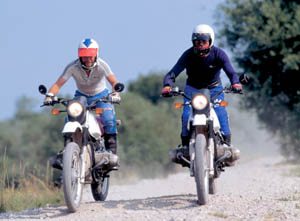
The decision in favor of the G/S was as bold as it was far-sighted. It had been made in 1978 during a period of decline in sales following almost a decade of growth. Across the Atlantic, endurance motorcycles – which were also popular among road bikers due to their easy handling – were riding on a wave of success.
Technically, BMW could easily match this. Back in the 1930s, the Munich brand had made a name for itself in sporting competitions aiming for best times on gravel and in mud. During the 1950s and ’60s, BMW riders raked in one title after another. The last three championship titles in cross-country sport had been taken by Herbert Schek on a modified BMW R 75/5 between 1970 and 1972.
 However, direct competition to the dominant single-cylinder motorcycles made by manufacturers in the Far East did not accord with BMW’s plans for the volume production market. A BMW had to be different: the characteristic attributes of comfort, long-distance viability and longevity were indispensable. And so the idea gradually gelled that off-road suitability should be combined with high performance and ride comfort on the road.
A careful study of the Enduro market corroborated this plan: only two percent of the kilometers covered were actually ridden across difficult terrain, while the remaining 98 percent was on roads, unsurfaced tracks or narrow paths. And so the idea of the large, comfortable endurance bike was born. It opened up a gap in the market which has remained almost inexhaustible to this day.
Such was the case from the very start. When the R 80G/S was unveiled before the public at the 1980 International Motorcycle Show, the BMW stand attracted huge crowds. The enthusiastic reception at the exhibition stand was reflected in orders for the coming motorcycle season: by the end of 1981, 6,631 motorcycles – more than twice the volume originally planned – had left the Berlin workshops, and one in five BMWs sold was a G/S. The touring Enduro thus played a significant role in pushing BMW’S sales figures steadily upwards once again.
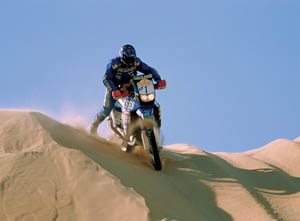
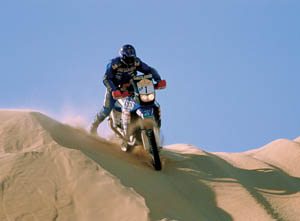
In parallel with that, BMW strengthened its involvement in cross-country sport. The stage for this was the world’s most challenging and high-publicity offroad event, the Paris-Dakar Rally. In 1981 Hubert Auriol was first to reach the destination on his G/S Dakar, and in 1983 he managed to repeat his overall win for BMW. 1984 and 1985 saw Belgian rider Gaston Rahier take the Dakar title before BMW withdrew its works team in 1986.
The successes of the G/S in the world’s toughest rally paved the way for the Boxer’s career as a dependable means of transport for globetrotters. The choice of appropriate accessories ranged from bigger fuel tanks made of every imaginable material, to luggage and navigation systems, all the way to special protective guards – a tradition upheld to this day.
1987 saw the BMW Enduro enter its second generation: R 80 GS and R 100 GS were the names given to the successor model, the oblique in the model designation having been deleted. Once again it was the frame that was the focus of further development. Thanks to a new rear wheel swing-arm by the name of Paralever, undesirable reactions particularly on off-road terrain were further reduced.
In 1993 the R 1100 GS caused a sensation at the Frankfurt Motor Show with its bold styling and imposing dimensions – compared with the R 100 GS the new bike was 65 mm taller. 80 bhp took the cross-country machine to a generous top speed of 200 km/h. Ensuring that such speeds could also be translated to the road with ease was the frame with its improved Paralever on the rear axle and the new Telelever front suspension. This was followed in autumn of 1999 by the R 1150 GS and in 2004 by the R 1200 GS.
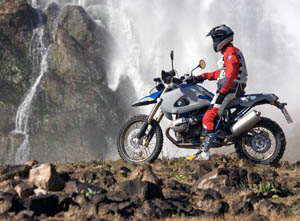
Today, a quarter of a century and some 220,000 units later, it is patently clear that BMW Motorrad created a class of its own with the GS. The recently launched BMW HP2 proves that the Munich manufacturers never fail to come up with appealing models that position the GS concept ahead of the competition: consistently designed with sportiness in mind, the HP2 weighs in at just 175 kg and comes with a 1.2-litre Boxer engine that is good for 105 bhp.
The frame is an all-new development with a telescopic fork at the front and a Paralever at the rear. All told, the HP2 is the most uncompromising production offroad Boxer of all time. And again it is the first model of a new motorcycle category
Note: For informational use only. All material and photographs are Copyright © webWorld International, LLC – 2000-2011. All rights reserved. See the webBikeWorld® Site Info page. NOTE: Product specifications, features and details may change or differ from our descriptions. Always check before purchasing. Read the Terms and Conditions!